
The standard advice is "just sign up for a track day." I've given that advice myself. For a lot of people it's the wrong first move.
Not because track days are bad. Because there are three different doors into this sport, they cost wildly different amounts, and they teach different things. Pick the wrong one first and you spend $800 learning something you could have learned for $50.
Here's the honest breakdown of all three.
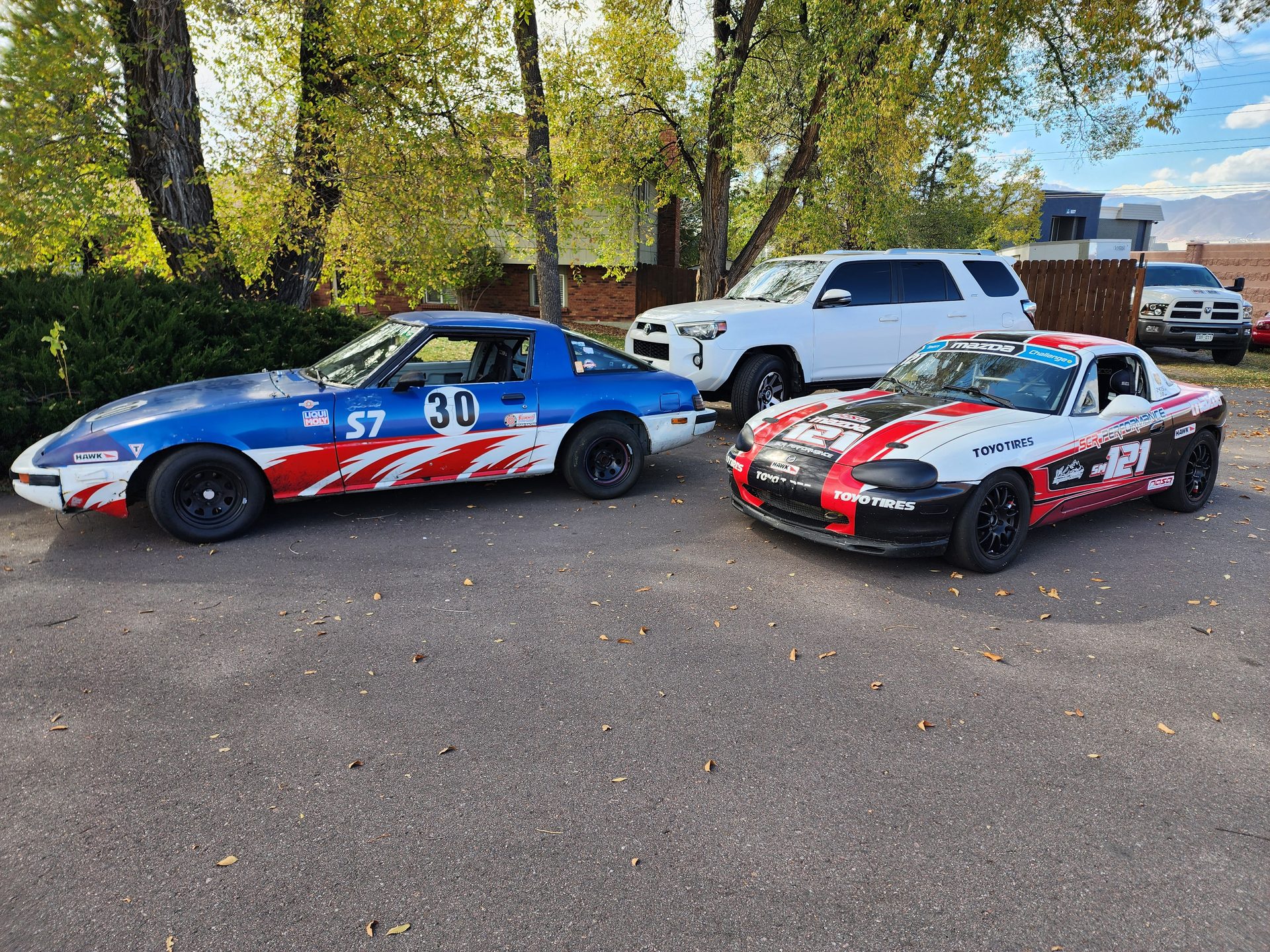 Everybody in this paddock started somewhere else. Almost nobody started here.
The 60-second version
| Autocross | HPDE / Track Day | Wheel-to-Wheel | |
|---|---|---|---|
| Where | Big parking lot, cone course | Real road course | Real road course |
| Speed | Usually under 60 mph | 100+ mph | 100+ mph |
| Seat time | 4-6 runs, ~1 minute each | 4-5 sessions, ~20-25 min each | Practice, qualifying, races |
| Entry cost | $25-$60 | $200-$500/day | ~$400-$500/weekend entry |
| Car needed | The one in your driveway | The one in your driveway | Caged, prepped race car |
| Gear needed | Helmet (often loaned) | Helmet, sometimes more | Full suit, HANS, cage |
| License | Driver's license | Driver's license | Competition license |
| Risk to your car | Very low | Real | Real, and you're racing |
Read that table again and notice the pattern. The cost of a mistake goes up by about a factor of ten at every step.
Autocross: the cheapest real seat time in motorsport
Autocross is a timed course made of traffic cones in a big paved lot. You run it alone, one car at a time, and your run lasts under a minute. Then you get out, go stand a corner and pick up cones for other people, and wait for your next run.
That sounds underwhelming. It isn't.
SCCA's own FAQ puts most regional entries at $25 to $45, and it's blunt about the car: "Run whatever you have. You can run anything from a Yugo to a Ferrari as long as it's in good shape mechanically and doesn't have a roll-over risk." A valid driver's license and a helmet is the requirement list. Most regions keep loaner helmets on hand, so your first event can genuinely cost less than a tank of gas and a set of brake pads.
Add a weekend SCCA membership (usually around $20-$25 if you're not a member yet) and you're on course.
What it actually teaches you: the limit. That's the whole point. At 45 mph you can push a car past grip, feel it let go, catch it, and do it again eight minutes later — with a cone as the only casualty. At High Plains Raceway you get one shot at that lesson per session, and the consequence of getting it wrong is a tire wall.
What it doesn't teach you: speed. Braking from 120. Managing tire temp over 20 minutes. Reading a corner you can't see the exit of. None of that exists in a parking lot.
The honest knock on autocross is the run-to-wait ratio. You'll spend six hours at an event for maybe four minutes of driving. If you want volume of seat time, this is not it. If you want cheap, repeatable reps at the limit, nothing beats it.
HPDE: where you learn what speed actually feels like
HPDE stands for High Performance Driver Education. It's your car, a real road course, an instructor in the right seat for your first few events, and no passing except in designated zones with a point-by.
This is where most enthusiasts start, and it's where the money starts to matter.
Registration runs $200 to $500 per day. As a real Colorado example, the PCA Rocky Mountain events at High Plains Raceway have been priced at $250 for a single day and $395 for both days. That's a fair price for a well-run event.
But registration isn't the cost. We broke the full math down in what a track day actually costs, and the short version is: budget roughly another $300 a day in tires, brakes, and fuel. Your street car is not designed to do 100 minutes of that. Something wears out, and it's usually the thing you didn't check.
What it actually teaches you: everything autocross can't. Sustained speed. Braking zones that matter. Line theory over a 2.5-mile lap instead of a 45-second cone maze. And the single most valuable thing on the list — an instructor who watches your hands and tells you exactly what you're doing wrong.
You'll start in the novice group with an instructor and work up as you demonstrate control and awareness. How the run groups work is worth understanding before you register, because that ladder is the actual product you're buying.
The catch: it's your street car out there. Track use voids most warranties, your street insurance almost certainly doesn't cover it, and a bad day can total a car you drove there in.
Wheel-to-wheel: racing for position
This is the one everybody actually means when they say they want to race. Grid, green flag, go take the position.
It's also the one with a gate in front of it. You need a competition license from NASA or SCCA, which means an HPDE ladder or a race school, a medical form, and paperwork. The paperwork itself is cheap — the full license path totals well under $300 in club fees. The seat time to earn it is the expensive part.
Then you need a car with a cage, a fire system, a full suit, and a HANS device. And entry fees at NASA Rocky Mountain weekends have run roughly $400 to $500 for a two-day.
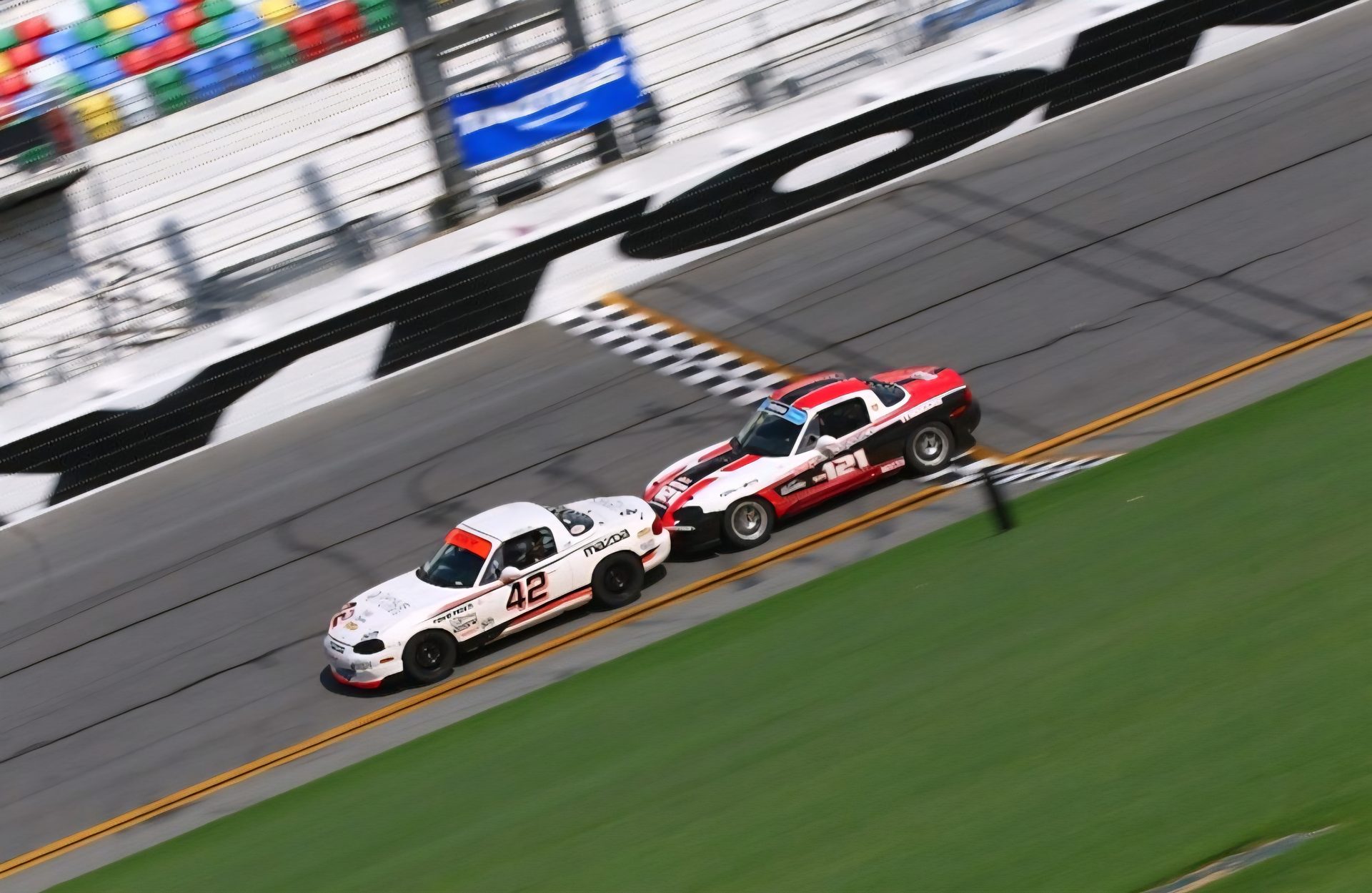 This is the part everyone pictures. It's also the third step, not the first.
Running your own Spec Miata competitively is realistically $2,000 to $3,500 a weekend all-in once you count fresh tires, entry, fuel, pads, and fluids — assuming you do your own wrenching and nothing breaks. Renting a fully prepped car with a crew is a different product at a different price. We rent ours by the full season (six events, paid in full before the season starts, no damage deposit), and pricing depends on the car and package.
I'm not putting that number there to scare you off. I'm putting it there because the gap between an HPDE day and a race weekend is the single most under-explained jump in this sport, and people deserve to see it before they fall in it. If you want the full comparison of what makes racing different from lapping, we wrote that one out too.
So which one first?
Here's my actual answer, and it isn't the one that sells anything.
Start with autocross. Do a full season of it if you can. Six events at $40-ish teaches you more about car control per dollar than anything else available to a human being with a driver's license. You will learn what oversteer feels like in your own car, in a place where the worst outcome is a cone and some laughter.
Then do HPDE. Show up already knowing what the limit feels like, and your instructor gets to spend the day teaching you lines and vision instead of teaching you not to panic. That's a genuinely better use of $250.
Then decide about racing. Not before. Most people find out at their third or fourth HPDE whether the itch is "I love driving fast" or "I need to beat that guy." Those are different diseases with different treatments and very different budgets.
The one exception: if you're 15 or 16 and already have years of karting behind you, the autocross step is largely redundant. You've already done the car-control education, just at 60 mph on a smaller vehicle. That's the whole premise behind Kart to Car — you're not a beginner, you just haven't driven a car yet.
The Colorado version of this answer
We're lucky here. All three doors are within a couple hours of the Front Range.
Autocross: Rocky Mountain Solo runs the Colorado and Continental Divide Region events, largely at Pikes Peak International Raceway in Fountain and the Colorado Air and Space Port in Watkins. Colorado entries have run above the national average recently, so pull up the specific event on MotorsportReg before you budget.
HPDE: High Plains Raceway in Byers and Pueblo Motorsports Park, run by NASA Rocky Mountain, PCA, and several other clubs through the season. If HPR is your target, our track guide walks it corner by corner.
Wheel-to-wheel: NASA Rocky Mountain is the deepest field in the region, and it's where we run. Six weekends split between HPR and Pueblo.
That's a complete ladder, in one state, without ever getting on a plane. Not every region can say that.
If you land at the top of that ladder and want to skip the trailer, the tow rig, and the garage — our full-season arrive-and-drive seats put you in a prepped Spec Miata with a crew and a coach, and you bring a helmet.
Do you believe?
Sources: SCCA Autocross FAQ, SCCA Autocross program page, Rocky Mountain Solo, PCA Rocky Mountain HPDE at High Plains Raceway on MotorsportReg, NASA Rocky Mountain event listings, and Grassroots Motorsports forum discussion on starting in autocross vs. HPDE. Entry fees verified against published 2026 listings as of August 2026 and vary by region and event — always check the specific listing. Race-weekend cost ranges come from our own operating numbers at NASA Rocky Mountain.