
Most people asking this question are picturing the wrong thing. They see a caged race car on Instagram and assume that's the price of admission to a track day. It isn't.
For a normal HPDE in a normal hardtop car, you don't need a roll cage. For wheel-to-wheel racing, you absolutely do, no exceptions. The confusing part is everything in between, and that's where convertibles and harnesses trip people up.
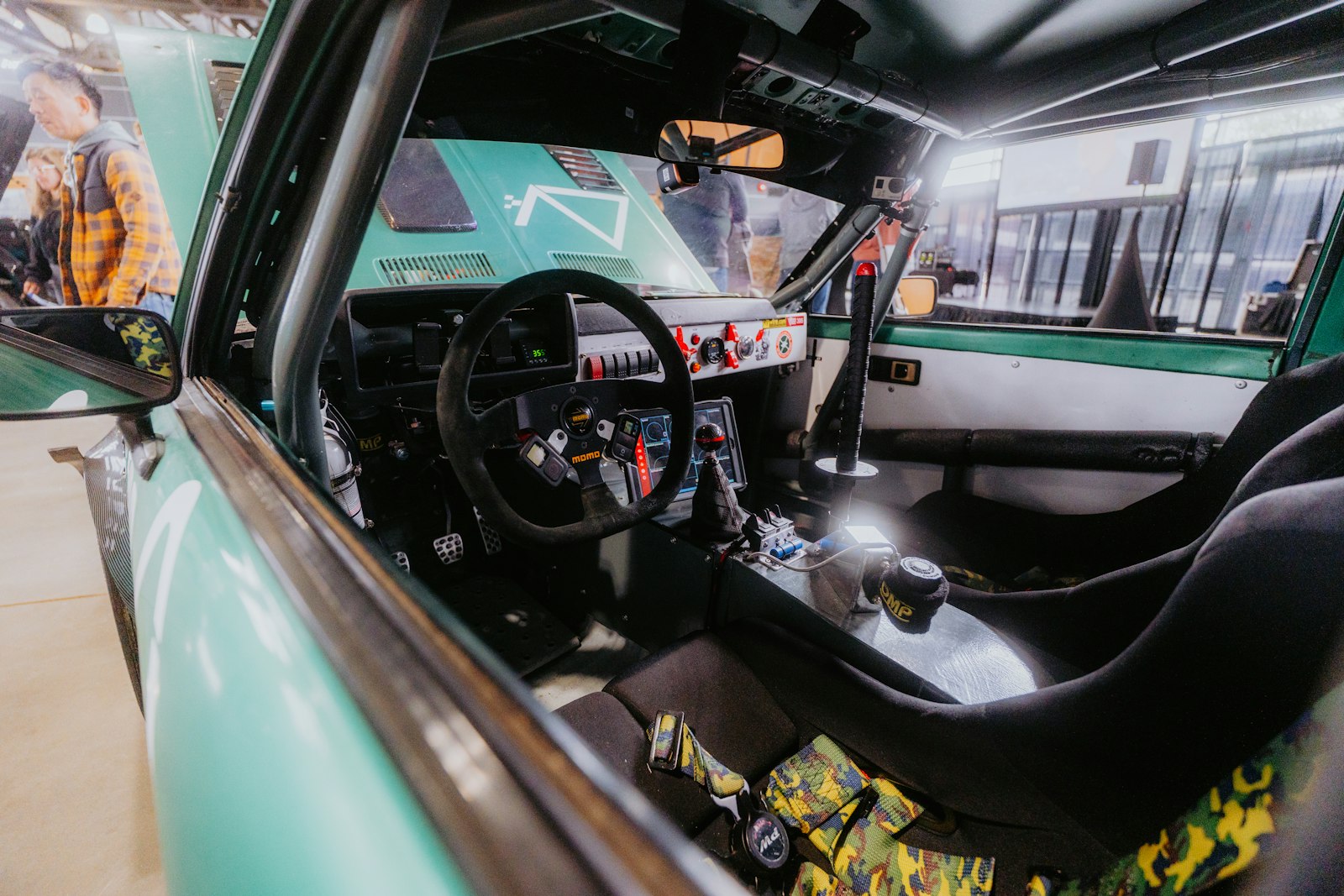 Photo by Luke Miller on Unsplash.
The short answer, in one table
| What you're doing | Rollover protection required? |
|---|---|
| HPDE / track day, hardtop car | No. Stock car, stock seat belts, helmet. |
| HPDE / track day, convertible | Usually yes — factory rollover protection or a compliant roll bar |
| Time trial, higher prep levels | Roll bar or full cage, depending on class and tires |
| Wheel-to-wheel club racing | Full cage. Always. Built to the rulebook. |
That's the whole answer. The rest of this post is the why, plus the parts that catch people.
What HPDE actually requires
A beginner track day is a lapping day, not a race. The safety bar reflects that. Bring a hardtop car in good mechanical shape, a helmet that meets the current Snell standard, and the seat belts the factory installed. That's the baseline at most NASA and SCCA beginner events.
Convertibles are the exception, and it's a big one in our world because a lot of first track cars are Miatas.
NASA's position is straightforward: convertibles need to meet the roll bar specs in the Club Codes and Regulations before they run HPDE. If your car came with factory rollover protection — the hoops behind an S2000's seats, a pop-up bar in a BMW — that generally satisfies tech. A soft-top with nothing behind your head generally does not.
SCCA's Track Night in America uses a model-year-and-engine test instead. Convertibles from 2006 and later with the original four- or six-cylinder engine can run without an added bar. Swap the engine, add forced induction, or bring something bigger than six cylinders, and you need documented factory rollover protection or an aftermarket bar.
Two details that catch people at tech:
- Helmet clearance. The top of the bar has to sit above the top of your helmet while you're seated normally. On open cars in the racing rules, that clearance is spelled out as at least two inches.
- Padding. Anything your helmet could hit needs padding. SCCA's rules call for non-resilient foam like Ethafoam or Ensolite, half an inch minimum on a roll bar.
And a bolt-on hardtop is not a roll bar. Some events treat a bolted hardtop as a hardtop car, many don't. Read the event supplemental rules before you tow, not in the tech line. Same goes for the rest of your prep — our first track day gear checklist covers what tech will actually look at.
The harness trap nobody warns you about
Here's the part that matters more than the rules.
A lot of new track drivers buy a five- or six-point harness before they buy anything else. It feels like the safety upgrade. In a car with no roll bar, it can be the opposite.
Factory three-point belts let your body move. That sounds bad until the roof comes down. A proper harness with a sub-belt holds you locked in place on purpose, so you can't slide out from under the lap belt. In a rollover with no bar above your head, you have nowhere to go and the roof is coming to you.
The harness isn't the safety device. The harness plus the cage plus the seat is the safety device. Buy the system, not the piece.
There's a second failure mode people miss. Harness shoulder belts mounted at the wrong angle — over a stock seat, anchored to the wrong point — can load your spine in a crash instead of protecting it. That's why racing rules pair harnesses with a proper seat and a harness bar, and why fixed-back seats, belts, and cages are always sold as one package by people who know what they're doing.
If you're running HPDE in a street car, the honest advice is to leave the factory belts alone until you're ready to do the whole system at once.
Wheel-to-wheel: the cage isn't optional
Cross the line from lapping to racing and the conversation ends. Every SCCA Club Racing and NASA competition car runs a full cage built to the rulebook, and tech will measure it.
A cage is not a roll bar with extra tubes. The rules define a structure: a main hoop behind you the full width of the cockpit, a front hoop or halo, side impact protection in the doors, and braces tying it together. The main hoop has to be one continuous piece of tubing with smooth mandrel bends, no crimping, no wall failure, and NASA's regulations cap it at four bends totaling 180 degrees.
Tube size is set by how much your car weighs. Under 3,000 pounds — which is every Spec Miata — NASA's CCR calls for 1.5-inch seamless tubing with a .120-inch wall, or 1.75-inch with a .095-inch wall. Cars from 3,001 to 4,000 pounds step up to 1.75 by .120.
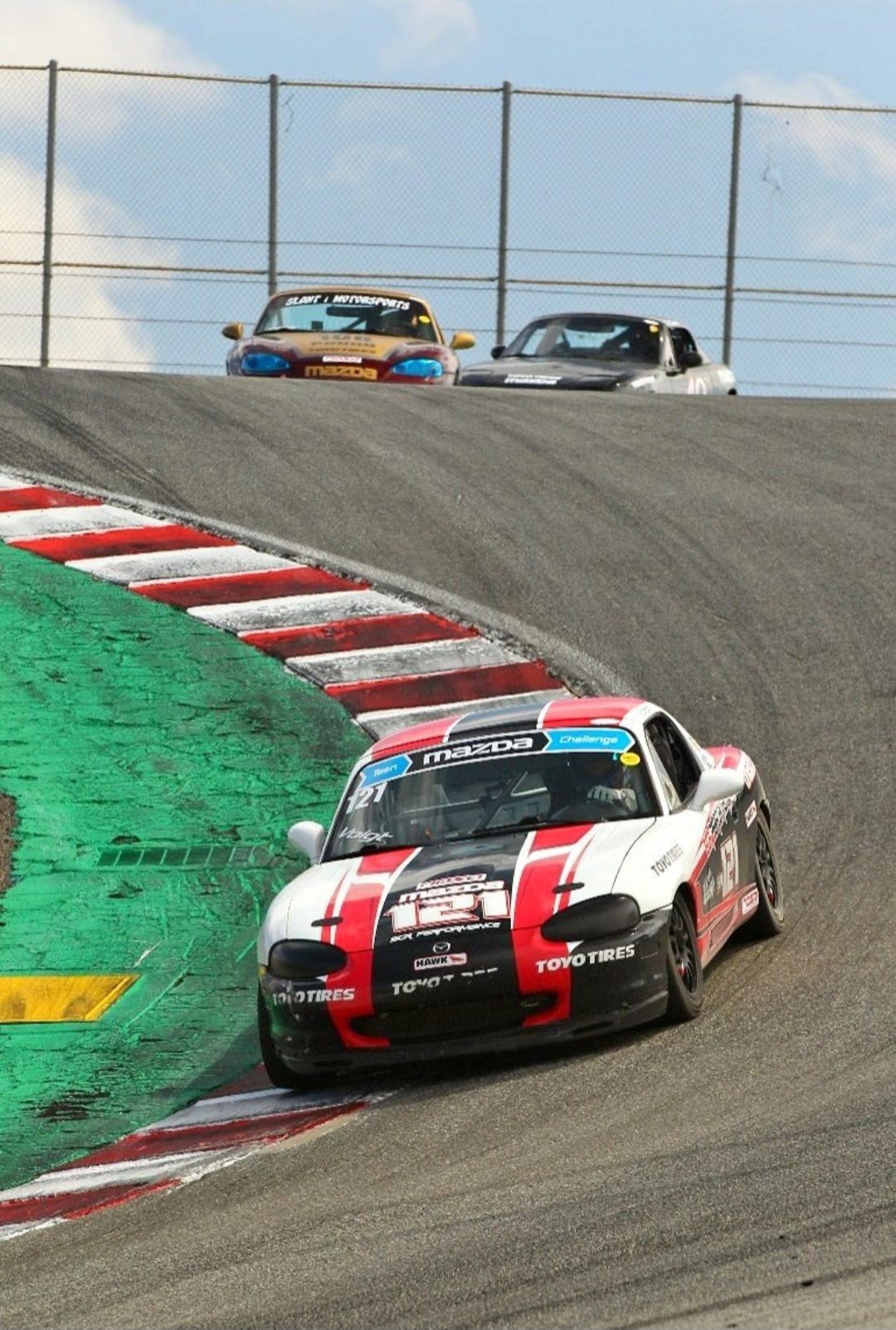 Every car we put a customer in carries a full cage, a fresh-dated seat, and current belts. That's the baseline, not the upgrade.
Our Spec Miatas are built to that standard because they have to be. It's also the reason a race car makes a lousy daily driver. Once the cage goes in, the interior is gone, the doors get bars across them, and getting in requires a plan.
What a cage actually costs
Cage pricing splits into two numbers: the tubing and the labor.
For a Miata, bare pre-bent tubing kits start under $700 — Advanced Autosports lists their Spec Miata standard DIY kit at $681. Complete weld-in kits from Miata cage specialists are commonly listed in the $1,300 to $1,500 range.
Labor is the bigger and blurrier number. Racers report shop quotes commonly landing somewhere around $2,000 to $3,000 for a proper weld-in install, and it swings hard by region and by how much prep the shell needs. Figure 16 to 20 hours of work if you're doing it yourself with real fabrication skill, and a couple of days in a shop if you're not.
So a caged car is roughly a $2,500 to $4,500 line item, installed, on top of everything else. That's before a seat, belts, a window net, and a fire system. It's one of the real reasons the jump from track days to racing costs what it does, and it's part of the math we break down in arrive and drive vs. owning a race car.
Where this leaves you
If you're doing your first few track days in a hardtop street car, stop shopping for tubing. Spend the money on seat time and coaching, which will make you faster and safer than any part you can bolt on. If your car is a convertible, check your organization's rules first — that's the one purchase you may genuinely need up front.
If you're eyeing wheel-to-wheel, the cage question becomes a car question. You're not buying a bar, you're building or buying a race car, and moving up the HPDE run group ladder first will tell you whether you actually want to.
That's the point where a lot of Colorado drivers we meet at High Plains Raceway and Pueblo hit the wall. They want to race, but they don't want to spend a winter learning to weld before they've ever gridded up. If that's you, our arrive-and-drive program puts you in a caged, tech-ready Spec Miata for the weekend, so you can find out what racing feels like before you commit to building one.
Do you believe?
Sources: SCCA Time Trials full safety rules, SCCA Track Night in America required safety equipment, NASA HPDE program, NASA Speed News roll cage build guidance, Advanced Autosports Spec Miata cage kits, and Grassroots Motorsports forum discussions on cage cost and harness safety. Rules and prices verified against current published sources as of August 2026. Install labor figures are racer-reported and vary widely by shop and region. Roll bar and cage rules differ by sanctioning body, region, and event — always confirm with your event's supplemental regulations before you tow.