
Most people compare arrive-and-drive to owning a race car and get the math wrong. They eyeball a per-weekend price, guess that owning must be cheaper, and stop there.
That's not the real comparison. The real question is what happens the other 51 weeks of the year, and how much cash you have to put down before you ever turn a lap.
Let me lay both paths out with honest numbers. No brochure spin. Just what it actually costs.
The Per-Weekend Number Doesn't Mean What You Think
Here's the part that surprises people.
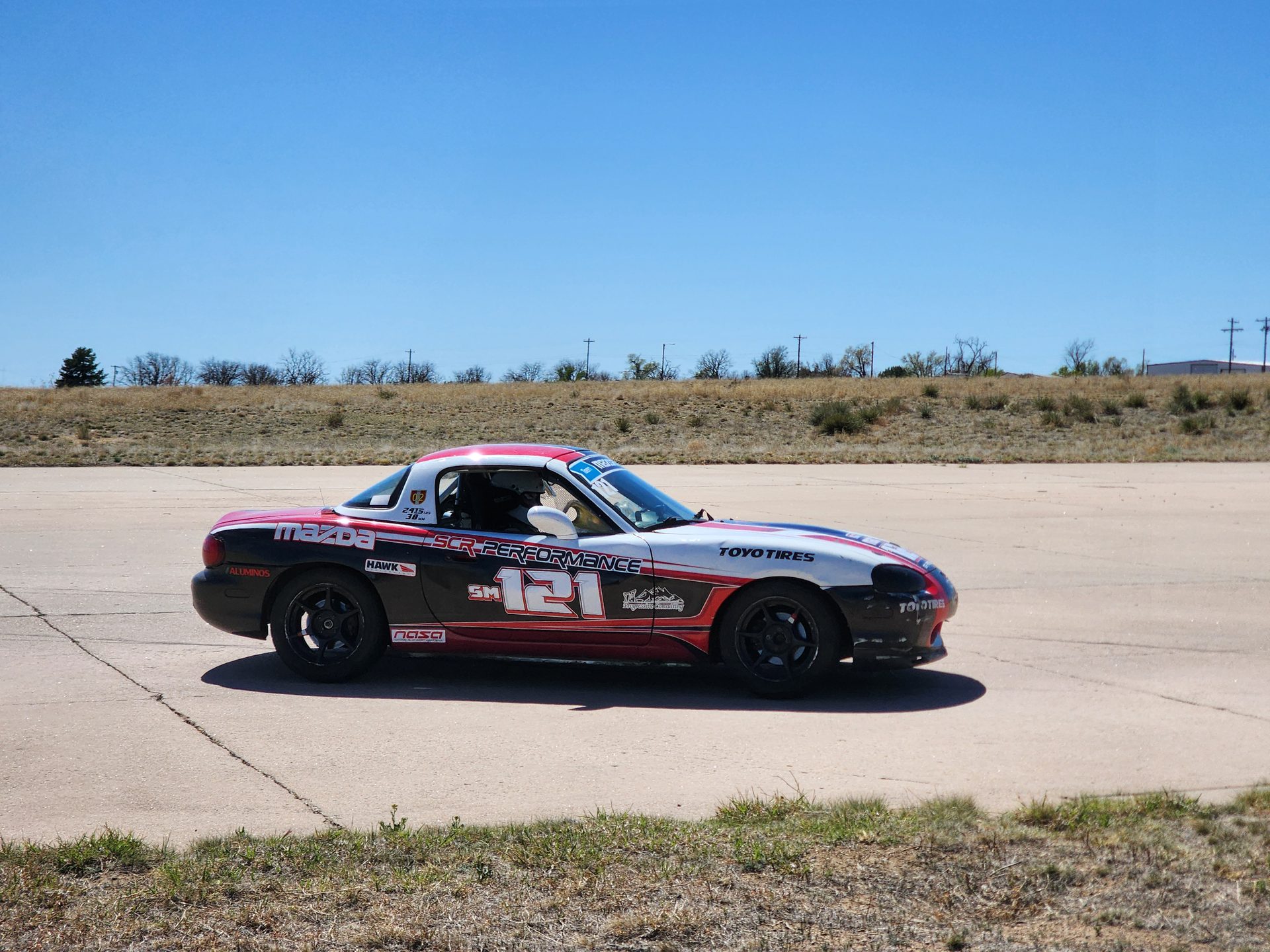
A race-weekend arrive-and-drive — a prepped car, a crew, coaching, tires, and fuel for an actual competition weekend — runs roughly $3,000 to $5,000. Advanced Autosports, one of the national leaders, lists about $3,150 for a two-day Spec Miata weekend all-in on the car side. Our own arrive-and-drive is $5,000 a weekend (our championship #121 car is $6,500), because the bundle runs deeper — coaching and data every session, hospitality, and the full paddock. Don't confuse any of that with a track-day lapping rental, which is a different, cheaper product (a non-competition day of laps, around $945 to $1,195 a day). That day-rate is not what a race weekend costs.
Owning your own car? People love to quote a rock-bottom number here, but a competitive Spec Miata weekend is a minimum of about $2,500 in consumables alone — roughly $1,200 for a fresh set of tires, ~$500 entry, plus fuel, brake pads, fluids, and the little stuff. Run it hard on fresh rubber and you're closer to $2,000 to $3,500 a weekend. You can get a weekend down to $1,000 to $1,500 — but only on old, heat-cycled tires, doing all your own work, not crashing, and towing with what you already own. That's the floor, not the typical number. One driver famously documented a whole cheap season around $6,600, but that assumed almost no tire replacement and free labor; front-runners who put on fresh tires every weekend spend $50,000-plus a season.
Per weekend, owning isn't the bargain the internet makes it sound like — and even at the floor, the real cost of ownership is everything that doesn't show up in that weekend number.
And here's the catch: that DIY consumable number assumes you already own the car. You don't yet. So before you've compared a single weekend, owning is already carrying a five-figure head start you have to pay off.
The Cost Nobody Warns You About: Buying In
Owning starts with a check you write before you ever race.
A ready-to-race used Spec Miata runs $10,000 to $35,000-plus for the car alone, depending on how many races it's won and how nice the build is. A fresh, front-running professional build climbs past that. Even a bare-bones parts-only build is around $15,000 — and that's before someone assembles it.
Then it doesn't stop at the car:
- A trailer — open or enclosed, used or new, budget several thousand at minimum
- A tow vehicle capable of pulling it
- Storage for a car you drive maybe six weekends a year
- Tools and spares — a corner balance setup, jack stands, spare parts, fluids
None of that turns a lap. It's the cost of being allowed to start.
Arrive-and-drive skips all of it. There's no down payment, no trailer, no tow rig, no storage bill, no garage full of parts depreciating in the corner. Your first weekend costs the same as your tenth.
The Hidden Ownership Costs That Add Up
Even after you've bought in, ownership keeps reaching into your pocket in ways renting never does.
Depreciation and damage. A race car is a depreciating asset that you're actively trying to bang against other cars. Budget an extra $2,000 to $5,000 for rookie incidents in your first year no matter which car you buy. When you own it, that repair is your bill. When you rent, damage terms are spelled out up front and you're not eating a full rebuild.
Maintenance labor. Those consumable numbers assume you do the work. If you don't own a torque wrench and a free Saturday, you're paying a shop — real money that quietly stacks on top of the running cost.
The time cost. Owning a race car is a second job. You prep it, load it, tow it, unload it, fix it, and store it. Some people love that part — the garage is half the hobby for them. Others just want to drive. Be honest about which one you are before you buy.
This is exactly why I got into arrive-and-drive in the first place. I broke a car during my own license process, rented one to finish the weekend, and realized the wrenching and towing were the real barrier — not the driving. That insight is the whole reason our arrive-and-drive program exists: full crew, coaching, tires, and fuel, so you show up and drive.
So Which One Is Actually Cheaper?
It depends entirely on how much you race.
If you're running two or three weekends a year, ownership almost never pencils out. You'd pay $15,000-plus to buy in, tow, and store a car so you can use it a handful of times. Renting wins easily.
If you're running eight-plus weekends a year for multiple seasons, and you can do your own work, ownership starts to make sense. You spread that upfront cost across a lot of track time, and you build a car that's yours.
Here's the honest breakpoint:
| Arrive & Drive | Owning | |
|---|---|---|
| Upfront cost | ~$0 | $10k–$35k+ car + trailer + tow |
| Per weekend | ~$3,150–$5,000 (car, crew, coaching, tires, fuel) | $2,500+ consumables (floor ~$1,000–$1,500 on old tires, DIY labor) |
| Best for | Few weekends, no garage, no time | Many weekends, DIY, long-term |
| Off-season cost | $0 | Storage, upkeep, depreciation |
| The hassle | None — they wrench | You wrench, tow, store, fix |
There's a middle path a lot of people miss: rent first, buy later. Do a season or two arrive-and-drive to find out if you actually love wheel-to-wheel racing before you drop $20,000 on a car. Plenty of drivers discover they love driving but hate owning. Better to learn that with a rental than a garage full of regret.
The Colorado Angle
If you're in Colorado and weighing this, the math shifts a little.
We race NASA Rocky Mountain at High Plains Raceway in Byers and Pueblo Motorsports Park. Both are a real drive from Denver or the Springs — which means if you own, you're towing a trailer over long highway stretches, sometimes over passes, every single event. That tow fuel and wear is a line item owners forget.
With arrive-and-drive, the car's already at the track. You drive yourself out in your daily, put on your suit, and go. For a lot of Front Range drivers, that alone tips the scale — especially in the first couple seasons when you're still deciding how deep you want to go.
The Real Answer
Owning a race car is cheaper per weekend only if you race a lot, wrench yourself, and keep it for years. For almost everyone starting out, arrive-and-drive is the smarter first move — no five-figure buy-in, no trailer, no storage, no wondering if you'll even like it.
Start by driving. Decide about owning later. That order saves people the most money and the most heartache.
If you want to try racing without buying a car, a trailer, and a second job, that's exactly what our arrive-and-drive program is built for — show up with a helmet, we handle the rest.
Sources: Advanced Autosports arrive-and-drive rates, spec-miata.com/costs, No Money Motorsports — season cost breakdown, SCDA Spec Miata rental cars (track-day rate), NASA Spec Miata. Numbers verified against current published rates as of July 2026. Any specific cost claims here are based on these sources plus my own racing experience.
Do you believe?