
The first time you register for a track day, you hit a menu that assumes you already know the answer. Novice, intermediate, advanced. HPDE1, 2, 3, 4. Which one are you?
If you've never turned a lap, the honest answer is easy: you're in the beginner group, every time. But it helps to understand the whole ladder before you show up. So here's what each run group actually means, what changes as you move up, and how you earn the next rung.
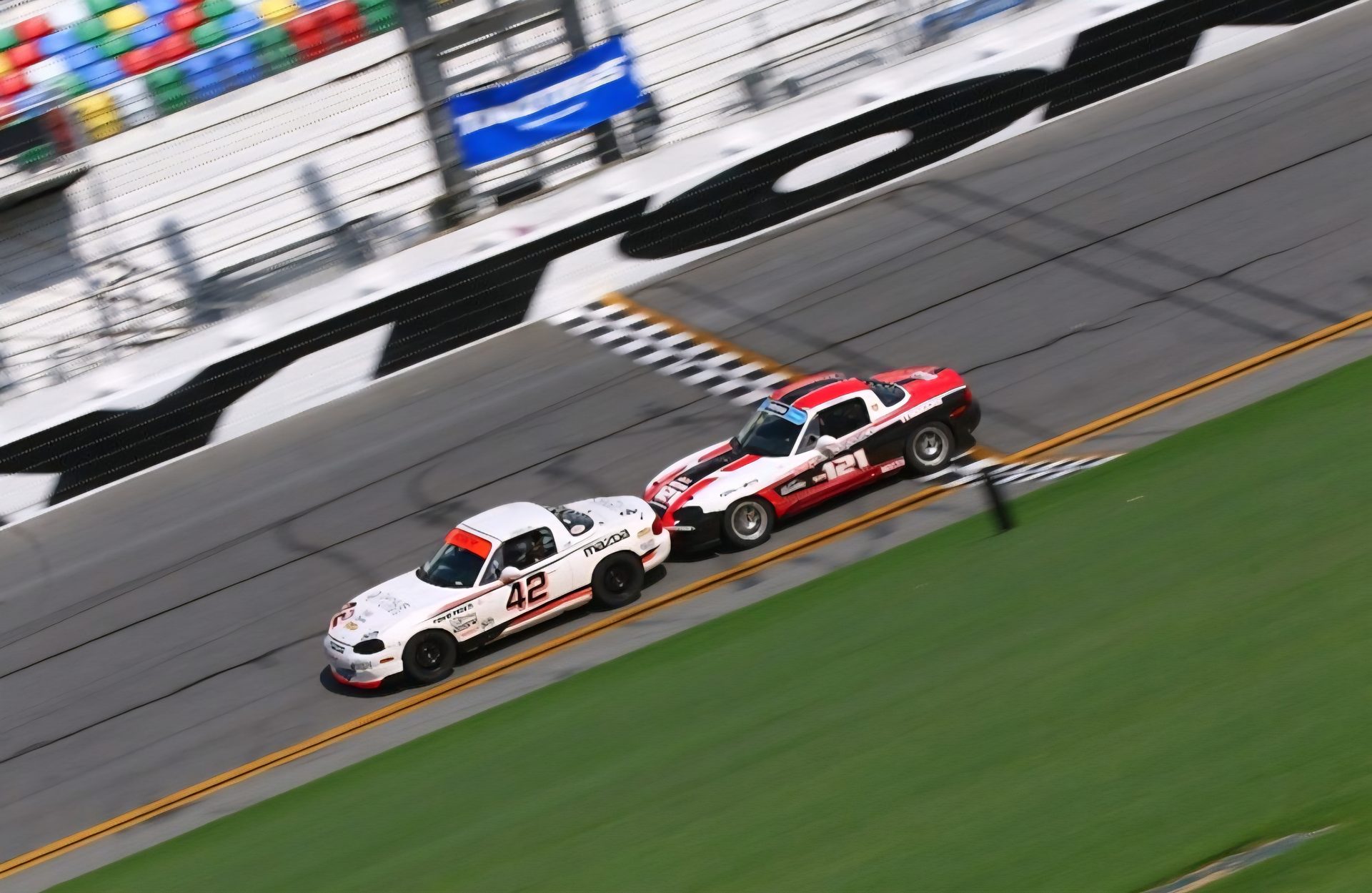 Our #121 Spec Miata sharing the track — run groups exist so cars at similar pace run together.
Why run groups exist at all
A track day mixes a rented Miata doing its first laps with a caged race car on slicks. Put those on track at the same time and someone gets hurt.
Run groups fix that. They sort drivers by experience and pace so the car behind you is roughly as fast, and as predictable, as you are. The faster and more open the group, the more you're trusted to handle traffic on your own.
Two sanctioning bodies run most of the beginner track days in the U.S., and they label things a little differently. NASA uses HPDE1 through HPDE4. SCCA's Track Night in America keeps it to three: Novice, Intermediate, Advanced. Same idea, different names. I'll walk the NASA ladder because it's the most common at wheel-to-wheel-adjacent events, then map SCCA onto it.
HPDE1: beginner, with an instructor in the seat
This is where everyone starts. Zero track days or close to it.
The defining feature of HPDE1 is that a certified instructor rides in your passenger seat, all day, every session. They talk you through the line, the braking points, and where to look. It feels like a lot at first. By the last session it feels like a cheat code.
Passing: very limited. Usually only on designated straights, only with a clear point-by from the car ahead, and often only under an instructor's direction. Nobody's racing. The goal is smooth and safe, not fast.
If you've never done this, read our full first-HPDE walkthrough before your first event. It covers tech inspection, the drivers' meeting, and the rhythm of the day.
HPDE2: novice solo
HPDE2 is the first group where you drive alone. You've done HPDE1, an instructor signed off on your car control and awareness, and now you're trusted on track without someone in the right seat.
You can still request an instructor if you want one for a session. Most people do, at least for a new track.
Passing: still conservative. Point-by required, usually restricted to designated straightaways. At smaller events, HPDE1 and HPDE2 sometimes share the track at the same time because the pace is similar.
Solo doesn't mean fast. HPDE2 is where you build the consistency that everything above it is built on.
HPDE3: intermediate
By HPDE3 you've run multiple track days across more than one track, and instructors have cleared you at each. You know how to read a corner you've never seen and not do anything dumb your first lap.
Passing: more open. On most NASA regions, HPDE3 allows passing anywhere on track with a point-by, done safely. That's a big jump in freedom and it comes with a big jump in responsibility for the mirror.
HPDE3 and HPDE4 often run together on track because their lap times and passing rules are close.
HPDE4: advanced
The top of the education ladder. Significant experience in open-passing situations, comfortable at speed, reads traffic instinctively.
Passing: essentially open, anywhere, as long as you use good judgment and proper etiquette. There's still a point-by culture, but the leash is off.
From here, drivers who want to race move on to Time Trial or start chasing a competition license. HPDE4 is the natural launch pad into wheel-to-wheel.
How the SCCA version maps
If you're running SCCA Track Night in America instead of NASA, the ladder is shorter but the logic is identical:
- Novice = HPDE1/HPDE2. New to the track, guidance and paced laps available, conservative passing. You can stay here as many nights as you need.
- Intermediate = HPDE3. You know the basics and you're focused on improving.
- Advanced = HPDE4. Higher pace, more open, for drivers who know their car and the track.
Each Track Night group gets three 20-minute sessions. Instructors and staff watch and recommend when you're ready to move up.
How you actually move up
This is the part people get wrong. Run groups are not a stopwatch. You don't graduate by hitting a lap time.
You move up when an instructor watches you and decides you're safe and smooth enough for the next level of traffic. On the NASA ladder, jumping from HPDE2 to HPDE3, and again to HPDE4, usually takes a written recommendation from at least one instructor plus a check ride, where an instructor or staff member rides along one more time to confirm it.
What they're grading:
- Consistency. Same line, same braking points, lap after lap. Predictable is safe.
- Awareness. You know what's around you before it's a problem. Good mirror discipline. Clean point-bys.
- Car control. You're smooth on inputs and you don't scare anyone, including yourself.
- Attitude. You listen, you fix what you're told, you don't chase heroics.
Chase lap times and spook your instructor, and you stay put. Drive clean and coachable, and the groups open up faster than you'd think. The move-up is a feature, not a waiting room.
Where this happens in Colorado
If you're local, most of this ladder plays out at High Plains Raceway near Byers and at Pueblo Motorsports Park. NASA Rocky Mountain runs HPDE weekends at both, and that's where a lot of Colorado drivers, including ours, cut their teeth before ever pinning a race number on the door.
The pattern I see over and over: a driver spends a season or two climbing the HPDE ladder, gets to HPDE3 or 4, and realizes they want to actually race. That transition, from lapping to wheel-to-wheel, is exactly the gap a coached, all-inclusive weekend is built to close.
If you're at that point and want to skip the "buy a car and figure it out alone" phase, our arrive-and-drive program puts you in a prepped, coached Spec Miata so the only thing you're learning is how to go faster, not how to rebuild a transmission at midnight.
Wherever you are on the ladder right now, the next group isn't earned with speed. It's earned by being the driver everyone else is glad to share a track with.
Do you believe?
Sources: NASA HPDE program, NASA NorCal HPDE run groups, NASA Arizona HPDE rules, and SCCA Track Night in America run-group info. Run-group definitions and passing rules verified against current published NASA and SCCA guidance as of August 2026. Specific rules vary by region and event — always read your event's supps and drivers' meeting.