
The scariest part of a first HPDE isn't the speed. It's not knowing what happens next.
You show up to a paddock full of people who clearly know the drill, and you have no idea where to park, who to talk to, or what you're supposed to do first. So let's fix that. Here's exactly how your first HPDE day unfolds, step by step, so you walk in knowing the plan instead of guessing at it.
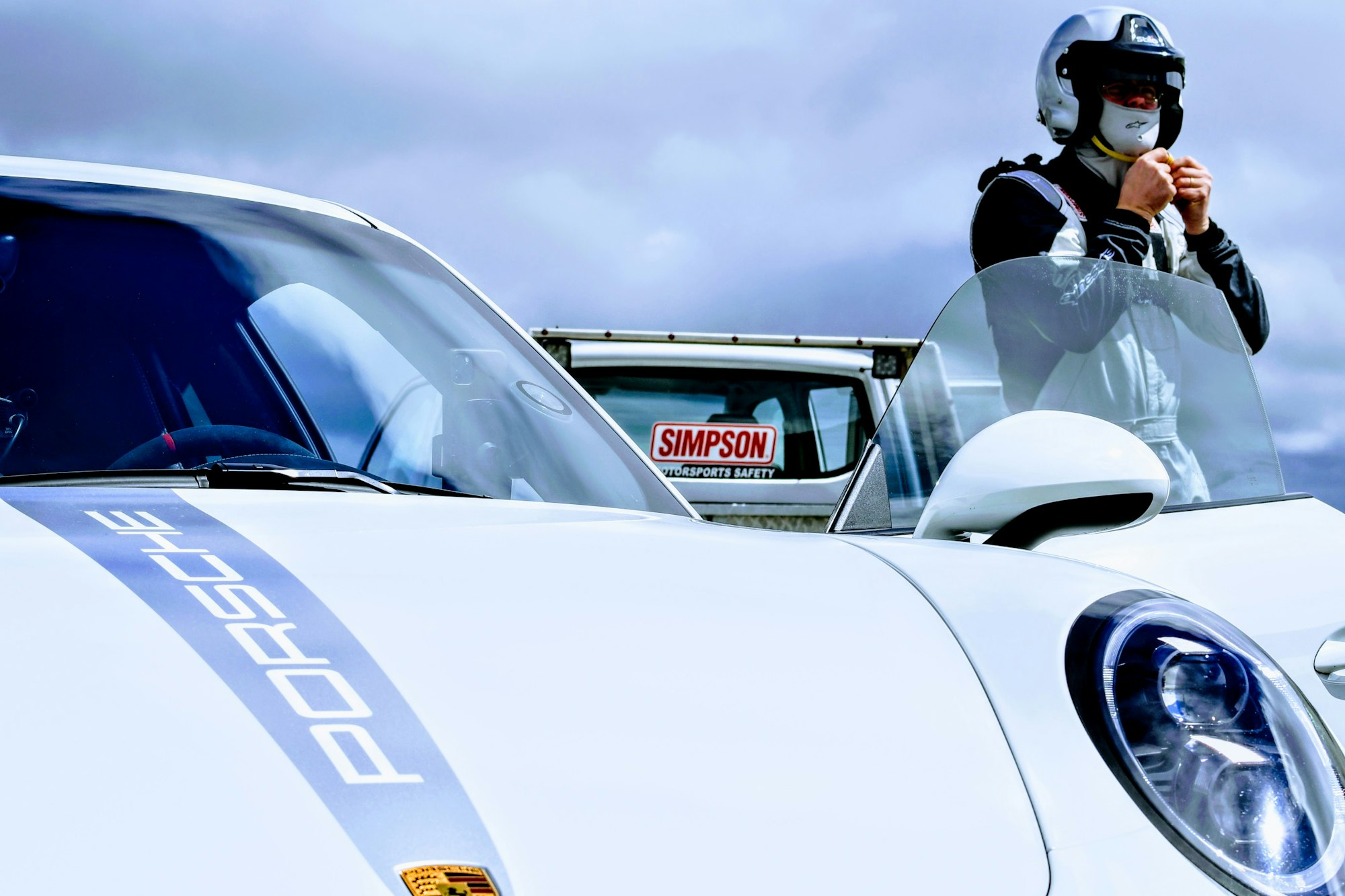 Photo by Carl Gelin on Unsplash.
First, what an HPDE actually is
HPDE stands for High Performance Driving Education. It's a track day built to teach you, not race you.
You bring your own street car. You get sorted into a run group with drivers at your level. And in the beginner group you get a certified instructor riding in the passenger seat, coaching you through every corner. Nobody keeps lap times. Nobody's racing you.
NASA and SCCA both run these nationwide. NASA sorts them into HPDE1 (novice) through HPDE4 (advanced). Your first event lands you in HPDE1. One thing to know up front: at NASA, if you're brand new, you'll need to run both days of your first weekend so an instructor can properly evaluate you.
Early morning: check-in and unloading
Plan to arrive early. Like, before-the-coffee's-cold early. Gates often open around 6:30 to 7:00 a.m., and a rushed morning is how you forget something that matters.
You'll find the registration table first. Check in, sign the waiver, and grab your wristband. They'll usually hand you a set of magnetic or stick-on numbers for your doors so corner workers can identify your car. Numbers need to be big, often at least 8 to 10 inches tall.
Then you find a spot in the paddock and unload. Pull everything out of the car that isn't bolted down. Floor mats, water bottles, the spare change in the cupholder, the jack rolling around your trunk. Anything loose becomes a projectile at speed, and tech will fail you for it.
Tech inspection: the safety gate
Before you turn a single lap, your car goes through tech.
An inspector checks the stuff that keeps you alive: brakes, tires, wheel bearings, fluid levels, no leaks, battery tied down, and your helmet meets the current Snell rating. They'll confirm the cabin is empty and your numbers are visible.
Pass, and they slap a sticker on your windshield that says which run group you're cleared for. If you prepped the car the week before, tech is a two-minute non-event. If you didn't, this is where your day can end before it starts. I wrote a full first-track-day prep and survival guide that covers exactly what to check so you clear tech without drama.
The mandatory drivers' meeting
Everybody stops for this one. No exceptions.
The event runs a general drivers' meeting, usually mid-morning, where they walk through the day's schedule, the flags, the passing rules, and the safety points that matter at that specific track. Show up. Sit near the front. Actually listen.
This is where you learn the flags cold: yellow means caution and no passing, black means come in and talk to us, the meatball flag means you have a mechanical problem, checkered means the session's over. Knowing these on sight is the difference between reacting in half a second and reacting too late.
The drivers' meeting is the most important 20 minutes of your day. It's also the one part everybody's tempted to skip. Don't.
After the general meeting, your run group usually breaks off for its own group meeting, and you meet your instructor.
The rhythm of the day: classroom, then track, repeat
Here's the part that surprises first-timers. An HPDE1 day isn't just driving. It's alternating classroom sessions and track sessions.
In the novice group, classroom time is mandatory. You'll sit down with your group and go over a concept, the racing line, braking zones, where to look, one skill at a time. Then you go put it into practice for a 20-minute session. Then back to the classroom to break down what happened and pick up the next thing.
A typical day gives you around four track sessions, each roughly 20 minutes, spread through the day with breaks between. Those breaks aren't downtime. That's when you talk to your instructor, ask questions, hydrate, and let your brain catch up. Track driving is more mentally exhausting than people expect.
Your first session: what it actually feels like
Your instructor climbs into your passenger seat. That alone calms most people down.
They'll talk you around the track, pointing to braking markers, showing you the line, telling you when to look up and where. In HPDE1 you drive at a pace you can handle, not a pace you think you should hit. Your first few laps should feel almost slow. That's correct.
Passing is the big rule change from sim racing. In the novice group you can only pass in designated zones, almost always the straights, and only after the driver ahead gives you a clear hand signal out the window. That's called a point-by. No point, no pass. Ever. It keeps a group of beginners from turning into a demolition derby.
Come in when you see the checkered, do a cool-down lap, and head back to the paddock buzzing. Then you do it again a few more times before the day's done.
How you move up
You don't stay in HPDE1 forever. As you show your instructor smooth, consistent, safe driving, they sign off on you moving toward HPDE2, where passing opens up a bit and instruction gets lighter.
Progression is on your skill, not a stopwatch. Drive clean, listen, and improve, and the run groups open up over a season. Chase lap times and scare your instructor, and you'll stay put. The move-up is a feature, not a wait.
Your only real goal for day one
Forget being fast. Your job on day one is to come home with the car in one piece, learn the rhythm, and have fun doing it. That's the whole win.
Here in Colorado, most of us cut our teeth at High Plains Raceway out in Byers, where NASA Rocky Mountain runs HPDE1 through HPDE3 across the season. It's a genuinely friendly place to have a first day, and the paddock's full of people happy to help a newcomer.
If your first HPDE lights the fire, and it usually does, the natural next question is how to get real seat time without owning a car, a trailer, and a garage full of spare tires. That's exactly what we built our arrive-and-drive program around here in Colorado. We bring the car prepped and ready, you bring a helmet, and we hand you the keys. No garage required. Just a helmet and the belief that this is actually possible for you.
Do you believe?
Sources: NASA HPDE program, NASA Speed News — Passing in HPDE 1 and 2, No Money Motorsports — A Day in the Life beginner HPDE guide, NASA Rocky Mountain. Run-group structure, passing rules, and tech-inspection details verified against currently published NASA rules as of July 2026. Every club runs its day a little differently, so let your event's own drivers' meeting be the final word over anything you read here.