
High Plains Raceway hides from you. You come over a crest at speed and the corner you were promised isn't where your eyes expected it. That's the thing first-timers never hear before they show up.
It's our home track. We run NASA weekends there, and I've watched a lot of good drivers spend a full day fighting the place before it finally clicks. Here's what I'd tell you the night before your first lap.
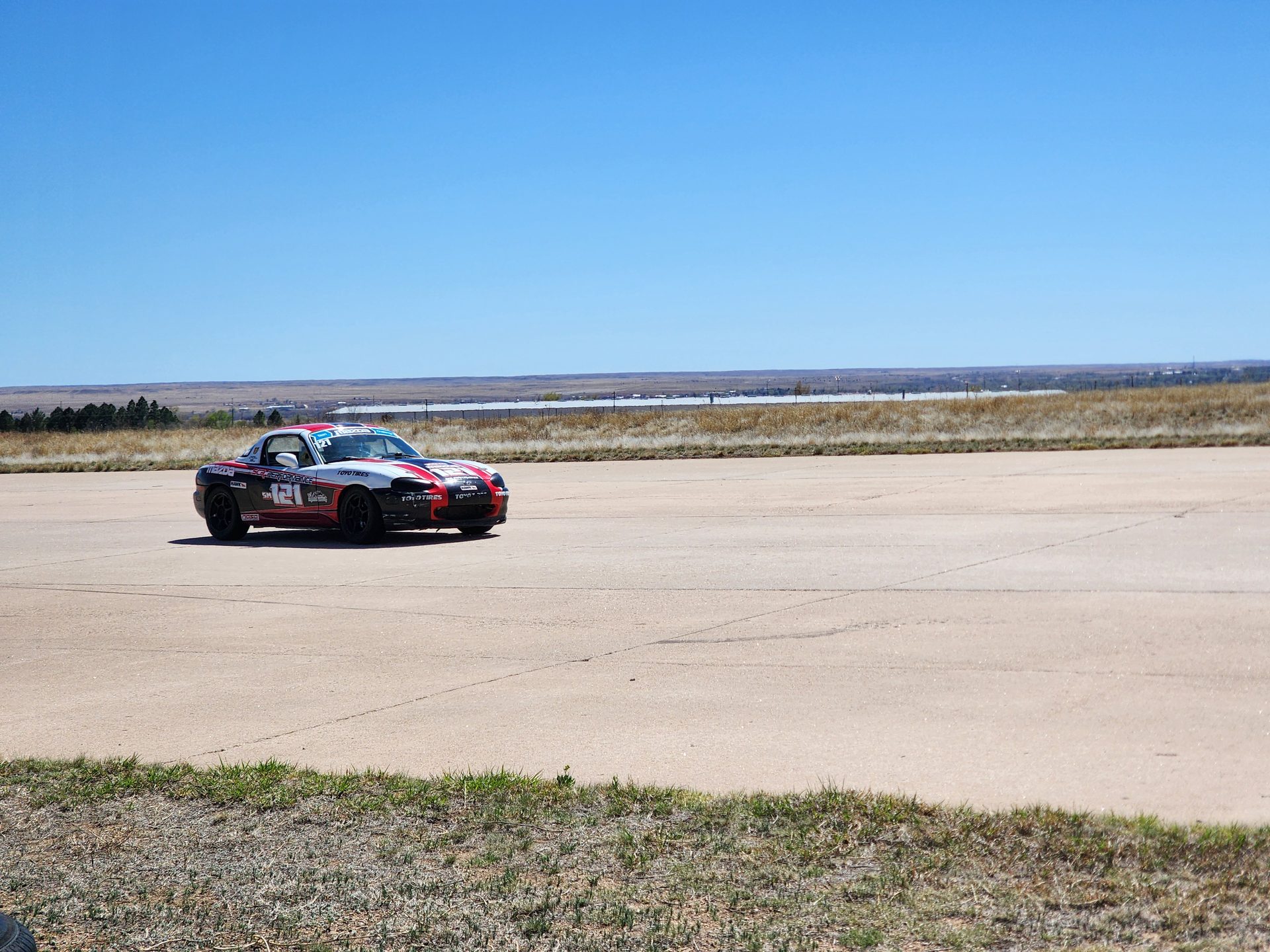 Our #121 Spec Miata. HPR is one of the two road courses we run every Colorado season.
What HPR actually is
High Plains Raceway sits out on the eastern plains at 93301 East US Highway 36 — mailing address Deer Trail, though everybody calls it Byers. You get there off I-70 exit 316, then about 18 miles north. Figure roughly an hour from Denver, longer from Colorado Springs.
The full course is 2.55 miles with 15 turns, run clockwise. There are three other configurations the track can run: a 2.00-mile west course, a 1.86-mile north course, and a 1.28-mile short course. Check your event registration, because which layout you're running changes your whole day.
The origin story matters here. When Second Creek Raceway near DIA was going away, Colorado's amateur racing clubs banded together as CAMA and built their own track. Around 1,000 private donors funded roughly $3.5 million, engineer and racer Bill Howard drew the layout, and the thing was paved in 2008 and opened in 2009.
That's why HPR feels like a club track instead of a corporate facility. Racers built it for racers. Nobody was optimizing for luxury suites.
The layout: elevation is the whole story
HPR is built on undulating prairie, and Howard used every foot of it. The published numbers tell you most of what you need to know:
- 300+ feet of cumulative elevation change per lap
- 10% steepest climb
- Longest straight: 2,838 feet (about half a mile)
- Tightest turn: 80-foot radius, 160 degrees of turn — and 1.5% off camber
- Highest point: 5,054 feet above sea level
Read that tightest-corner spec again. Eighty-foot radius, 160 degrees, and the pavement is falling away from you slightly the whole time. That's a corner that punishes anybody who carries in one extra mile per hour.
The elevation is what makes HPR hard to learn. Crests hide apexes. Downhill entries load the front and unload the rear right when you're asking the car to turn. Your eyes want to look at the pavement in front of the hood, and the pavement in front of the hood tells you nothing here.
At HPR, the corner you can't see yet is the one you're already driving.
The fix is boring and it works: look further ahead than feels natural, and let the reference points come to you. Brake a little earlier than you think on the downhill entries for your first few sessions. You can always brake later. You can't un-run-out-of-road.
Altitude and weather are part of the track
You're running at over 5,000 feet. A naturally aspirated engine loses roughly three percent of its power per 1,000 feet of altitude, so a stock car is down meaningfully compared to sea level. Everyone around you is down the same amount, so it doesn't change the racing much. It does change your expectations if you're comparing lap times to a video you watched from Florida.
Thinner air also means less cooling. Watch your temps, especially in July and August.
Then there's the plains weather. There is almost no shade at HPR, the wind can be genuinely strong, and afternoon thunderstorms build fast in the summer. A dry, hot, windy day dehydrates you quicker than you'd guess, and a dehydrated driver makes bad decisions in the last session — which is exactly when you're going fastest.
Pack more water than you think you need. Bring a pop-up canopy if you own one. Fuel up and grab food before you turn off the interstate, because the nearest towns are small.
What a day at HPR costs
The track runs its own Open Lapping days, and the published rates are refreshingly plain:
| Day type | Registered by deadline | After deadline |
|---|---|---|
| Summer Monday/Friday, full day | $219 | $239 |
| Summer Monday/Friday, half day | $159 | $179 |
| Summer Thursday and winter days | $159 | $179 |
There's also an Unlimited Season Pass at $1,500 for every 2026 open lapping day. If you're running more than about seven days a year, that math flips fast.
Open lapping isn't the same product as an HPDE. There's no instructor assigned to you and no formal curriculum — you sign up, you drive. Requirements are minimal: 18 or older, a helmet designed for car or motorcycle use that covers your ears and the back of your neck, at least factory three-point belts, and rollover protection behind the seat if you're in a convertible. If you've never been on track at HPR before, the drivers meeting is mandatory, and they'll turn you away if you're not there when your name is called.
If it's your very first time on a road course anywhere, I'd still start with a club HPDE instead — NASA, SCCA, PCA and the local clubs all run events at HPR, and having an instructor in the right seat is worth more than the extra session fee. Here's how HPDE run groups work and a broader look at getting started in road racing in Colorado if you're still mapping out the path.
Five things I'd tell you the night before
1. Know which configuration you're running. Showing up with the full-course line in your head and getting the west course is a wasted first session.
2. Walk it or at least study the map. HPR's blind crests are much less intimidating when you already know what's on the other side.
3. Start slow on purpose. The fastest guys at HPR are not the ones who went hardest in session one. They're the ones who built the lap in pieces.
4. Check tire pressures every session. Hot, dry, high-altitude days move pressures around more than you expect, and pressure is the cheapest lap time you'll ever find. Our track day gear checklist covers the gauge and the rest of the kit.
5. Respect the tow home. You'll be tired, dehydrated, and an hour from Denver on a two-lane road at dusk. Eat something before you drive.
Where HPR fits in a Colorado season
Between HPR and Pueblo Motorsports Park, Colorado racers have two very different road courses within a few hours of each other. Pueblo is flatter and more technical in a stop-and-go way. HPR is flowing, hilly, and asks more of your eyes.
NASA Rocky Mountain, SCCA, RMVR and the Porsche club all run events at HPR through the year. Our own 2026 season has us there multiple times, including the August round. If you want to understand the place before you ever pay an entry fee, go spectate a race weekend. Walk the paddock. Ask questions. Grassroots racers are the friendliest people in motorsport and almost nobody takes them up on it.
And if you'd rather learn HPR from behind the wheel of a car that's already sorted — with a crew, coaching, and data every session instead of a wrench and a guess — that's exactly what our arrive and drive program exists for.
Sources: High Plains Raceway — Track Info, High Plains Raceway — Open Lapping Days, RacingCircuits.info — High Plains Raceway, Lapmeta — High Plains Raceway Full. Track specifications and lapping day rates verified against the facility's published information as of August 2026. Everything else here comes from our own laps at the place.
Do you believe?