
Count the left turns at Pueblo Motorsports Park. On our own measured map of the 10-turn course, there are three. Turn 2, Turn 3, and the slow hairpin at Turn 7.
Everything else goes right. That one fact shapes the setup more than anything else about the place.
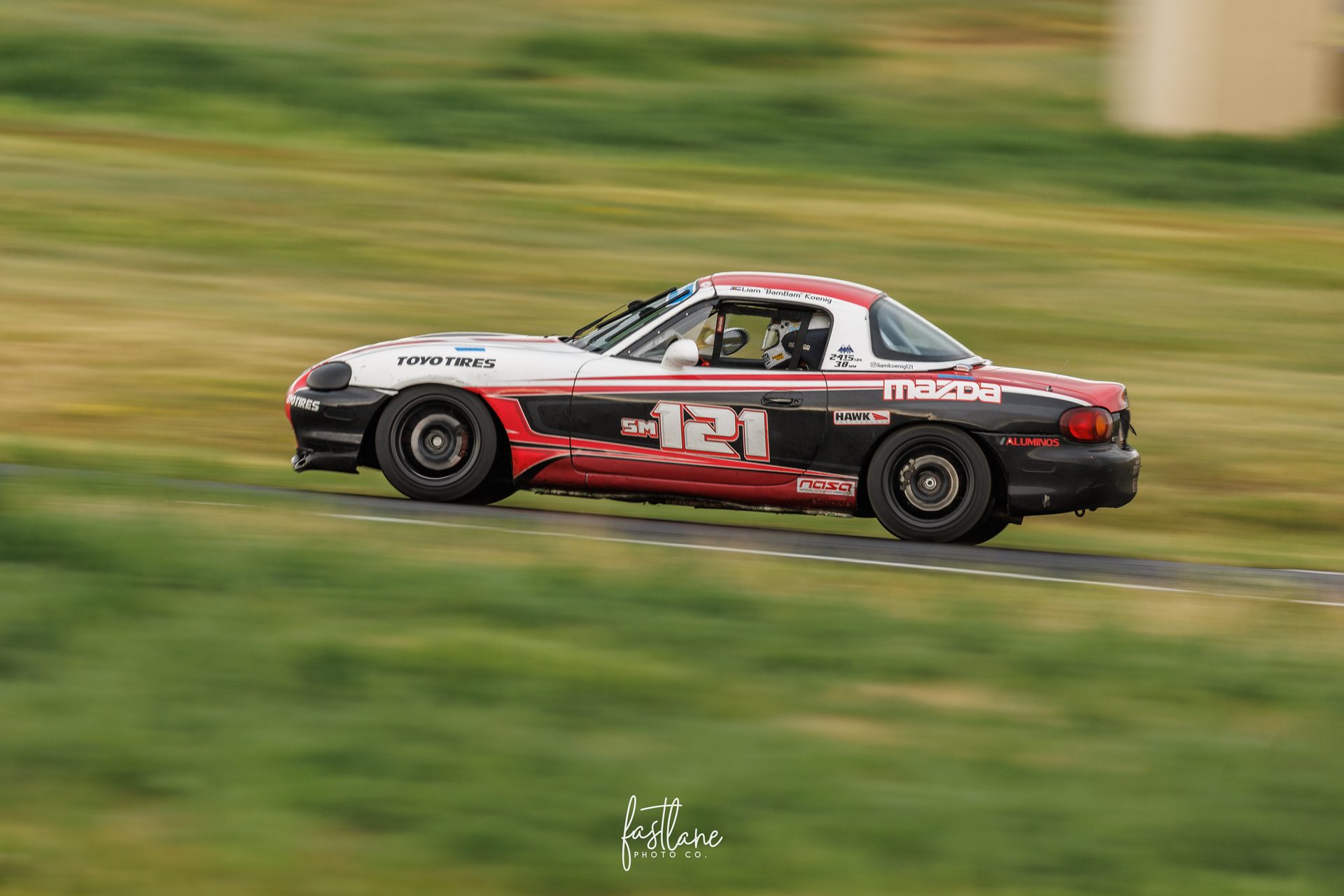 Our #121 at full speed during the August 2026 NASA weekend at High Plains Raceway. The same car heads to Pueblo for the NASA Rocky Mountain championship, November 6-8.
Is there a "Pueblo setup"?
Not a secret one. Spec Miata is a spec class. The springs are fixed, the dampers are spec, and the list of things you're allowed to adjust is short on purpose.
So we start where most of the paddock starts: Mazda Motorsports' published baseline. Camber, toe, caster, cross weight and hot pressures, set in Mazda's order of operations with the sway bars disconnected. We laid out that whole table in our post on Spec Miata setup for High Plains Raceway, so I won't repeat it here.
What changes from track to track is where you land inside those ranges. Mazda says so directly: "Camber and caster will be something you adjust a bit depending on the track characteristics."
Pueblo's characteristics are easy to name. It runs clockwise. It's mostly flat. And the track describes itself as "long high speed straights combined with fast sweeping corners" with "hard braking zones leading to sharp turns."
Each of those three things points at a different part of the car.
Why does a clockwise track change your camber?
In a right-hand corner, the car's weight shifts onto the left-side tires. They carry the load and do most of the work. Do that for seven of ten corners, every lap, and the left side of the car is working far harder than the right.
Mazda's baseline accounts for this. Their guidance: "On a clockwise track, the left side should be on the higher side of the camber range," with the right side lower in the range. A track with an even split of lefts and rights gets even camber on both sides.
Pueblo is not an even split. So the left side gets more negative camber, inside Mazda's published range, and the right side gets less.
At Pueblo, the left-side tires are the ones holding you on the road. Set the car up like you know that.
How do you know if you got it right? Tire temperatures. A tire that's working properly reads fairly even across the tread. A tire that's hot on the inside edge has too much camber for how hard it's being worked. Hot on the outside edge, not enough.
On a clockwise track, check the left side first. If you've never read a pyrometer, start with our guide to reading tire temps like a race engineer.
What do three lefts tell you about cross weight?
This is my favorite part of a mostly-right-hand track, because it gives you a built-in test.
Mazda's fine-tuning advice starts with left-right balance. Before you tell anybody "the car is loose," they say, "make sure it is happening when you turn in both directions, not just one."
At most tracks, that takes some sorting out. At Pueblo, you only have three left-handers to compare against. If the car is loose in the rights and perfectly happy through Turn 7, that's a strong hint. The problem might not be the whole car. It might be a balance problem that only shows up one direction.
Mazda's fix for that is a cross weight change, kept simple at the rear corners. In their words, "Raising the left rear of the car or dropping the right rear can correct an understeer in right-hand corners and/or an oversteer in left-hand corners." The opposite move fixes the opposite problem.
Their limits matter too. Move the spring perch a half turn to a full turn at a time. Don't go beyond two or three turns either way, or the sway bar starts binding. If that doesn't find it, the car goes back on the scales.
One more honest note. A car that suddenly handles differently left versus right can also be a bent part. Mazda says to re-check the alignment after a curb strike, an off, or anything that happened in transport. Rule that out before you start turning perches.
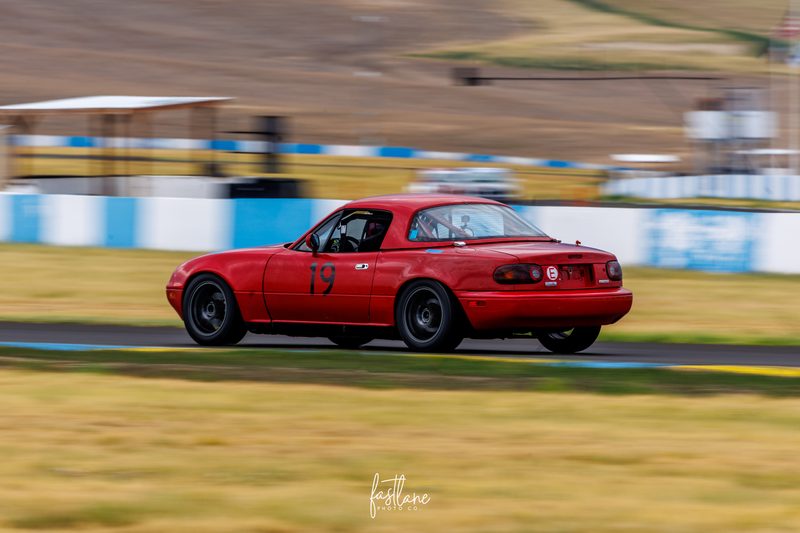 The #19 heading up the road after a corner at High Plains Raceway, August 2026. At Pueblo, the exit onto a long straight is where lap time is won or lost.
What does a long straight ask for?
Long straights reward two things: a good exit and a car that's stable at speed.
The exit part is mostly the driver. A corner that leads onto a long straight pays you all the way to the next braking zone. Blow the exit and you're slow for the whole straight. No setup change fixes that.
The stability part is where rear toe comes in. Mazda's baseline has rear toe at zero to 1/32" in. They're upfront that it's a preference. Some drivers run zero rear toe for straight-line speed. Some add a little toe-in for rear stability. A few run slight toe-out to help an understeering car.
There's no single right answer for Pueblo. There's the answer your driver trusts at the end of the straight with the brakes about to come on hard. Pick one, write it down, and don't change it mid-weekend unless the car tells you to.
What do the brakes need?
Pueblo is a braking track. Long straight, big stop, repeat. That's the part that catches people who show up with a car that felt fine at a twistier track.
Spec Miata doesn't give you much to tune here, so the work happens before you load the trailer.
- Fluid. The track's own rules page says it plainly: "We highly recommend a high-temperature brake fluid." Bleed the system before the weekend, not after the pedal goes long. Our racing brake fluid explainer covers why stock fluid boils.
- Pads. Check thickness before you leave home. A braking track eats pads faster than you're used to. Our post on brake pads for track days walks through compounds and temperature ranges. Run whatever your class rules allow.
- Cooling. The same rules page recommends running water with a coolant additive. Hot, thin air at Pueblo's elevation doesn't help cooling, and a car that's working its brakes hard every lap is working everything else hard too.
Does a November weekend change anything?
Yes. The championship weekend is November 6-8, and a fall morning in southern Colorado is cold.
Mazda's hot pressure target is generally 36-38 psi, and they tell you to check your tire maker's recommendations too. The hot number doesn't change in November. Your cold starting number does. On a cold morning, the gap between the trailer reading and the hot reading is bigger, and it keeps moving as the day warms up.
We broke down both halves of that already. Read cold tires vs. warm tires for the first lap of the day, and tire pressure creep for why your numbers climb from session to session.
The short version: don't expect your fastest lap in session one, and check pressures after every session.
When should you actually turn a wrench?
Early. Mazda's own read is that "you will make most of your changes when you first arrive at the track." That means the first practice sessions, not the session before qualifying.
And only one change at a time. Change three things and you learn nothing from a session you paid for.
Here's the rule I'd tape to the dash: don't test setup changes until the driver can lap the same way twice. If the lap times are scattered, the car isn't the problem yet. The driver is still learning the track. Our Pueblo Motorsports Park track guide is the place to start if that's you.
Then log it. Every change, which session, ambient and track temp, hot pressures, and one honest sentence from the driver. We built the free Race Day Ready Pack around exactly that. It has the checklists and setup sheets we use, so the good number from this weekend is still there next season.
Setup is the last few percent. Take a car set to the baseline, with the left side worked out. Put a driver in it who knows Pueblo's braking zones. That car beats a perfectly tuned one with a nervous driver every time.
If you're a young driver who wants to learn this stuff with a team instead of alone in a parking lot, that's what Kart to Car is for. Coaching, sim work, a real path into a race car. And if money is the wall, look at our scholarship. We want belief to be the only barrier.
Sources: Mazda Motorsports Engineering Tip #7: Spec Miata Baseline Setup, Mazda Motorsports Engineering Tip #8: Spec Miata Fine Tuning at the Track, Pueblo Motorsports Park: Road Course, Pueblo Motorsports Park: Rules, LapMeta: Pueblo Motorsports Park. Setup ranges and quotes are Mazda's published guidance, not our private sheet, verified October 2026. Turn count and direction come from LapMeta and our own measured track map. Always check against your current rulebook and your own corner scales.
Do you believe?