
You set your cold pressures at the trailer before the gate opens. Thirty psi, all four corners, written on your clipboard. Four sessions later, your gauge reads high before you've even left the pit lane — and you never touched a valve stem all day.
That's not a bad gauge. It's pressure creep, and almost nobody warns new drivers about it before their first full day on track.
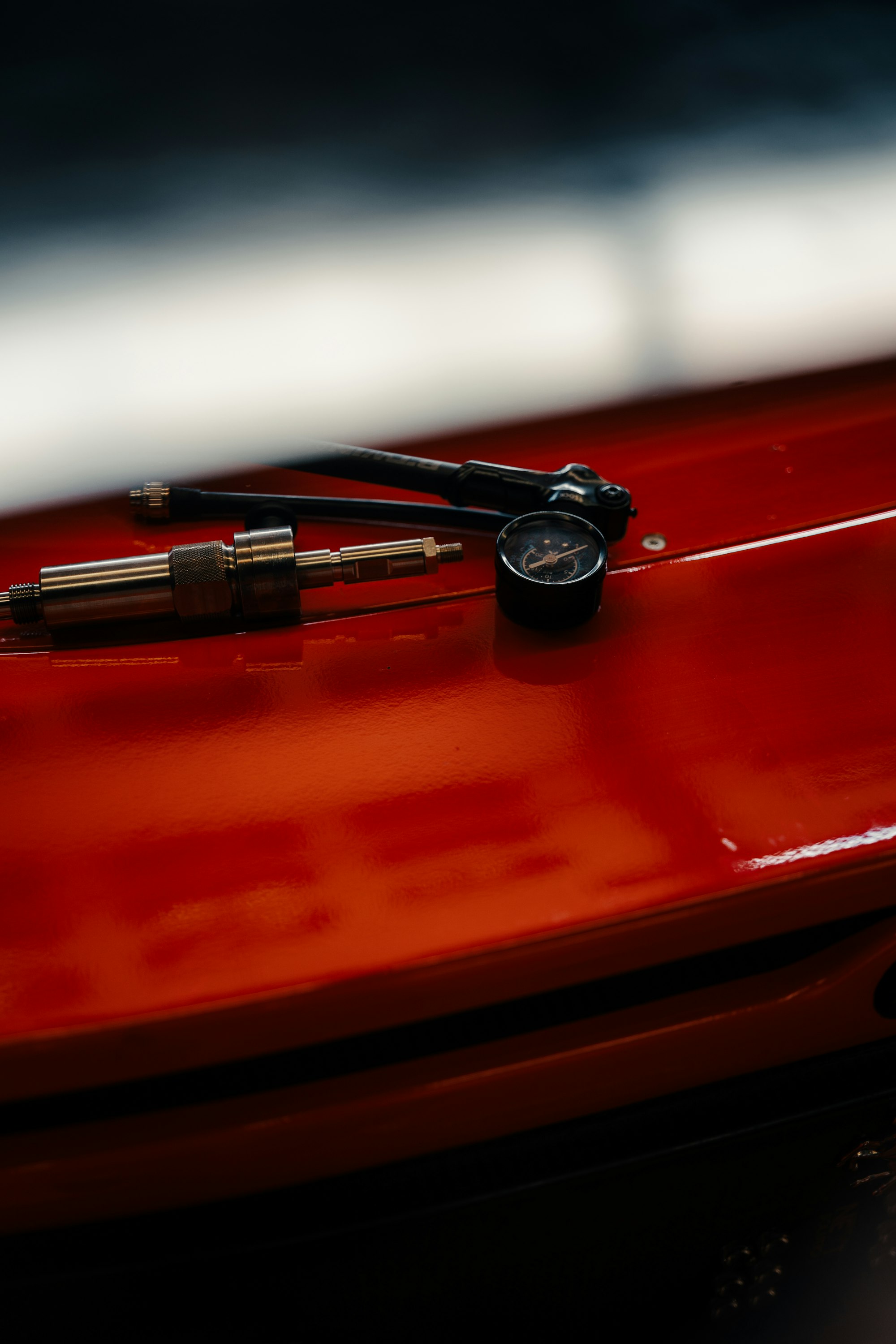 Photo by Thomas De Giorgio on Unsplash.
Why "Cold" Isn't Really Cold After Session One
Here's the part that trips people up. You run a session, come in, and your tires feel cool to the touch twenty minutes later. You assume they're back to cold. They aren't.
Tire pressure follows simple physics — hotter air takes up more room, so pressure climbs as the tire heats and drops as it cools. RPM Technik's track day guide lays out the rule behind it: "As temperature increases, the pressure of the air inside the tyre will increase" — that's Gay-Lussac's law, and it runs in both directions. The catch is that a tire's structure cools a lot slower than it feels. The rubber surface loses heat fast. The air and carcass underneath take much longer.
Most run groups give you somewhere between twenty minutes and ninety between sessions. That's rarely enough time for a tire to fully return to the temperature it started the day at. RPM Technik puts it plainly: pressures "do not return to morning baselines" — which is exactly why they recommend over-inflating a little before the drive home, since your track-day cold number ends up well below your street pressure by the end of the day.
So when you check pressure before session two and it reads a couple psi over your morning number, that's not a leak and it's not your gauge lying. It's a tire that was never actually cold to begin with.
The Session-by-Session Climb — and What It Looks Like
BRR Performance's track day management guide walks through two real examples that show how this stacks up over a full day. A first-time driver in a BMW E46 M3, aiming for a 35–36 psi hot target, starts session one at 32–33 psi cold. To hit that same hot number in session two, the guide says to "drop our tire pressures by about 1 psi before we go out" — then another psi before session three, another before session four. By session five, "we will not need to make any adjustments," because the car, the tires, and the track have all settled into a rhythm.
A more experienced driver in a Porsche Cayman S follows the same pattern faster: starting at 29 psi cold, dropping about 2 psi before session two, another 1.5 before session three, then just a half psi before session four. Different car, different pace, same direction — every session needs a little less starting pressure than the one before it, because the tire and the track both arrive warmer than they did last time out.
A logged example from an EK Civic owner on Trackdays.ie shows the same thing from a different angle. Morning guess: 28 psi cold, all four corners. After five or six quick laps, the left front read 38 psi and the right rear read 33 — up to 10 psi of climb in a single session. After a full lunch-break cooldown, true cold pressures across all four corners actually settled between 23 and 27 psi — every one of them below the morning's starting guess.
Here's the number that surprises people: BRR notes that by the end of a full day of progressive bleeding, "the effective cold pressures could now be in the 23–25psi range" — six to ten psi below where the morning started. That's not a mistake. That's the compounding effect of rising track temperature and a tire that never fully lets go of its heat between runs. If you don't bleed pressure down to match, the opposite happens — your hot pressures keep climbing past your target, session after session, because you're adding the same amount of air to a tire that's starting warmer every time.
 Photo by Mark Fletcher-Brown on Unsplash.
Two Heat Sources Stacking on Each Other
Creep isn't one effect. It's two, happening at the same time.
The first is the tire itself holding heat between sessions, which we just covered. The second is the track getting hotter as the day goes on — pavement that was 55 degrees at an 8 a.m. gate-open is routinely 90-plus by early afternoon. We wrote about that swing in our post on cold tires versus warm tires: High Plains Raceway and Pueblo Motorsports Park can both see 30-plus degree swings from gate-open to midday, especially in spring and fall.
Stack those two together and you get creep that compounds instead of just adding up. A tire that's already starting warmer, going onto a track that's already running hotter, gets to its hot number faster and higher than it did that morning. We dug into the track-temperature side of this in our post on why your second session is slower than your first — this is the same rising-temperature effect, just showing up as a pressure number instead of a lap time.
A Routine That Actually Keeps You on Target
You don't need to do math between every session. You need a habit.
- Set your true cold pressure at the trailer, before the gate opens, and write down the ambient temp next to it. This is the only reading all day that's genuinely cold.
- Check hot pressure the second you're back in the pit, not after you've unpacked or grabbed water. Heat bleeds off fast, so a reading taken five minutes late is already a little low.
- Expect to bleed a little before every session, not just the first time pressures run high. The BRR numbers above are a reasonable starting pattern — a psi or two less before session two, tapering down as the day goes on.
- Write every number down — cold before, hot after, time, ambient temp. One session tells you nothing. A full day of numbers tells you exactly how your car and your track behave together.
- Re-inflate before you drive home. Your track-day cold pressure will be well under your street pressure by the end of the day. Bring it back up to your door-jam spec before you're on the highway.
This is exactly the kind of thing we build into our free Race Day Ready Pack — a simple log sheet so you're writing down real numbers instead of trying to remember them between sessions four hours into a hot day.
The Honest Summary
Pressure creep isn't a problem with your car or your gauge. It's two predictable sources of heat — the tire and the track — both climbing through the day. Chase the number, not the feel, and it stops being a mystery.
If you'd rather have someone in the pit box managing pressures and logging the real numbers while you focus on driving, that's exactly what our full-season arrive-and-drive seats at High Plains Raceway and Pueblo are built for.
Do you believe?
Sources: RPM Technik — What Tyre Pressures Should My Porsche Have on Trackday?, BRR Performance — How to Manage Your Car During a Track Day, Trackdays.ie — Track Day Tyre Pressures and How to Set Them. Numbers and quotes verified against these published sources as of October 2026, cross-checked against our own tire-pressure logs from High Plains Raceway and Pueblo Motorsports Park.