
The gate opens at 8:10 a.m. It's 44 degrees at High Plains Raceway and the sun hasn't cleared the grandstand yet. You roll out, get to Turn 1 at maybe seventy percent, turn in the way you did all day yesterday, and the car just slides. No warning. No noise. Nothing.
That's not you getting worse overnight. That's cold rubber. And almost every driver learns it the hard way.
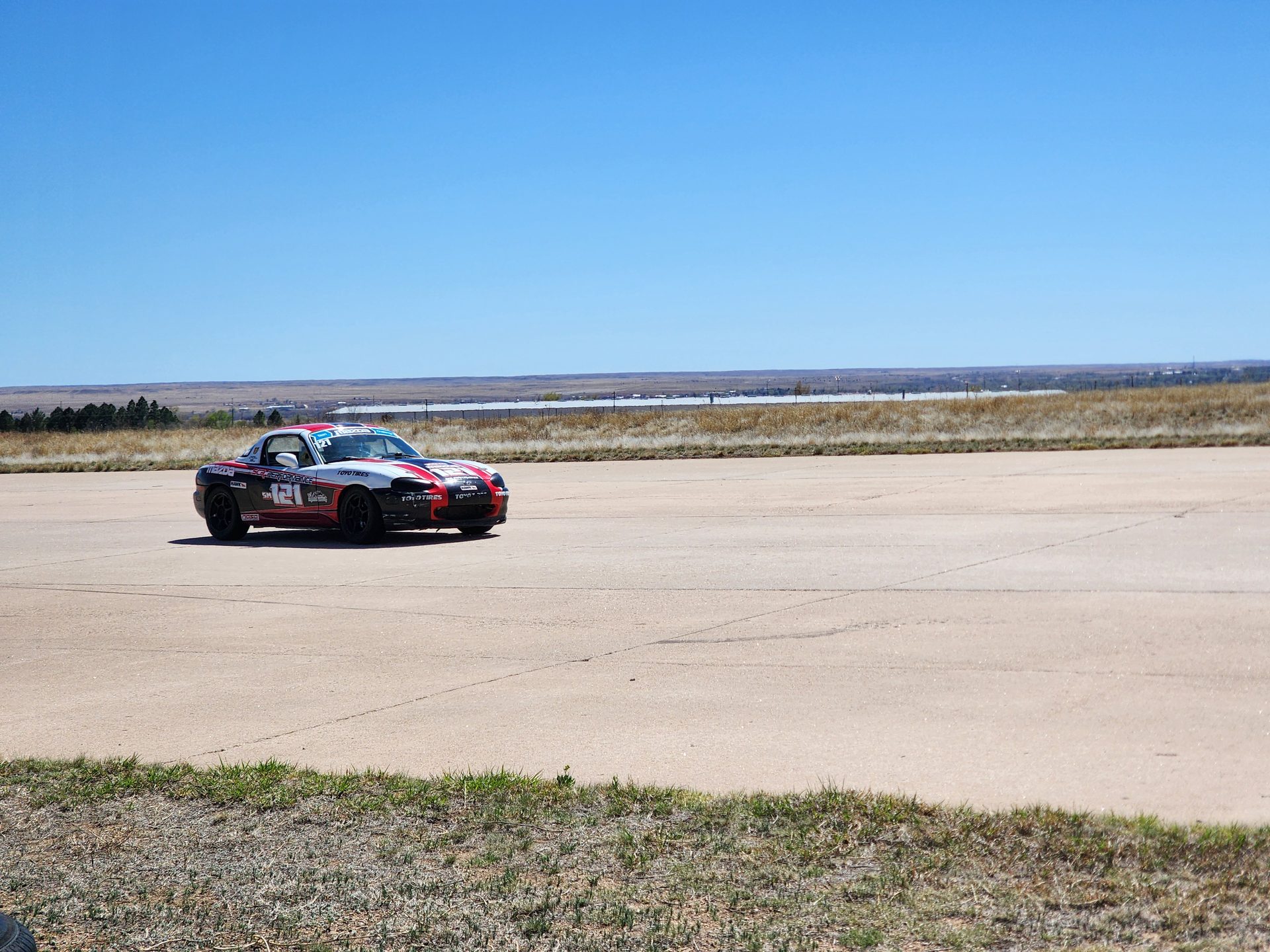 Our #121 Spec Miata. Even on a car this sorted, the first lap out of the paddock is a different car than the fifth.
A tire is a temperature-dependent part
Rubber isn't one thing. Its grip changes with heat, and the change is huge.
Below roughly 140°F, most performance rubber is stiff and low-grip. It doesn't deform into the pavement the way it needs to, so the contact patch never really works. Push a data-driven baseline and grip climbs steadily as the tire heats, peaks somewhere in the high-180s to mid-190s Fahrenheit, and then falls off again once you cook it past about 212°F.
Race compounds are pickier than street tires. Hoosier's own guidance for the R7 road-race tire is that optimum traction shows up when pit-lane readings land between 180 and 200°F. That's why an R-compound can feel greasier than your street tire on a cold out lap and then hook up like glue three laps later. It has a narrower, higher window, and you have to go get it.
A cold race tire is not a slow version of a warm one. It's a different tire with a different limit, and you don't know where that limit is.
That's the part beginners miss. You're not driving at 70 percent of your normal grip. You're driving at an unknown percentage of an unknown number.
Four other things on your car are cold too
The tires get all the blame. They're only part of it.
Your brakes. Race pad compounds are built for heat. Carbotech's XP8, a common club-racing pad, is rated from about 200°F up past 1,250°F. Hawk's track-day compounds work from around 100°F but hit their optimal bite well above that. On the first stop of the day, the pedal will feel long and the car won't slow the way you expect. That's normal, and it's a great way to lock a wheel or run deep if you're not expecting it.
Your fluids. Engine oil, gearbox oil, and diff oil are all thick when cold. Full throttle and full revs on a cold engine is how you shorten its life. Give it a couple of minutes.
The track surface. This one gets ignored. Cold pavement pulls heat out of the tire faster than it goes in. A 45-degree morning at Pueblo means the track is actively fighting your warm-up, and you may never get a street tire fully into its window in a 20-minute session.
You. Your eyes haven't calibrated to speed yet. Your hands aren't loose. Reaction times on the first lap of the day are genuinely worse than on lap ten, and that's true for pros too.
How long warming up actually takes
Rule of thumb from real practice: one to three hard laps to get tires into a usable window on a warm day. Longer when it's cold, longer on a short track, longer on a car that doesn't put much load into the tire.
For comparison, teams that use tire warmers run them for 90 minutes to two hours to do the same job in the pits. That should tell you how much energy has to go into a tire to heat it. You are not doing that in half a lap of gentle weaving.
You can also see the warm-up happening in your pressures. On a Spec Miata, a set will typically gain 6 to 9 psi from cold to hot over a session. If you check pressures after two laps and they've barely moved, the tire isn't working yet. We broke that math down in detail in our post on Spec Miata tire pressures if you want the numbers.
How to run an out lap that actually builds heat
Here's the trap, and it catches experienced people. Drivers know cold tires are dangerous, so they tiptoe. Tiptoeing puts no energy into the tire. Now they've spent two laps going slow, the tire is still cold, and they start pushing on lap three convinced it's ready.
Heat comes from work — from loading the tire — not from time on track.
The way to do it:
- Brake in a straight line, firmly, several times. Braking loads the tire heavily and safely because you're not asking it to turn at the same time. This is the fastest heat you can generate, and it warms the pads and rotors at the same time.
- Use throttle in a straight line. Accelerate, back off, accelerate again. Same idea — big load, no cornering.
- Build cornering speed gradually, corner by corner. Add ten percent per corner. Don't add it all in Turn 1 because Turn 1 is where you get punished.
- Skip the aggressive weaving. In traffic it's more of a hazard than a help, and it does far less for a car tire than most people believe. Motorcycles have a stronger case for it. You have brakes.
- Give yourself one clean corner as a test. Feel for when the front starts biting instead of pushing. That's the tire coming in, and you'll learn to recognize it.
If you're also learning the track that day, stack this with our walkthrough of the first ten laps at a new circuit — warm-up and track-learning happen in the same window, and they don't fight each other.
Colorado makes all of this harder
Our tracks sit high and dry, and the temperature swings are brutal.
High Plains Raceway sits out on the plains near Byers above 5,000 feet. Pueblo Motorsports Park is a little lower but still high desert. In spring and fall you can start a day near freezing and be in the 70s by the afternoon. That's not a small adjustment — that's a totally different tire behavior morning versus afternoon.
Three practical things that follow from that:
- Your morning session and your afternoon session need different cold pressures. Same target hot number, different starting point.
- Morning grip is genuinely lower even after warm-up, because the surface keeps stealing heat back.
- The fastest lap of the weekend is rarely in session one. Stop expecting it there. Use the morning to build, not to hero.
The late-season NASA Rocky Mountain rounds at Pueblo in October and November are the honest test of this. Gate time is cold. Everybody is on the same cold track. The drivers who do well are the ones who accept the first two laps as an investment instead of trying to force a lap time out of a tire that isn't ready.
The short version
Cold tires are slow because cold rubber doesn't deform into the pavement. They're also unpredictable, which is the actual danger. Your brakes, fluids, the track surface, and your own reflexes are all cold on that same lap.
Give it one to three laps of straight-line braking and throttle, add cornering load gradually, and let the car tell you when it's ready. You'll lose ten seconds on the out lap and get back far more than that over the session — plus the car stays on the track.
If you want to learn this with someone in your ear instead of learning it in a gravel trap, that's the whole point of our arrive-and-drive program — a sorted car, real coaching, and data every session so you actually know what the tire was doing when it let go.
Do you believe?
Sources: Hoosier A7/R7 Care and Safety Guidelines (RS Racing), What Should The Temperature Of Your Racing Car Tyres Be? — Your Data Driven, Hawk Brake Pad Compound Descriptions — Pegasus Auto Racing, Carbotech Compounds Technical Data, Track Day Tire Pressure Setup: Cold vs Hot PSI. Temperature ranges verified against current published manufacturer guidance as of August 2026. Windows vary by compound and car — always check your specific tire and pad data. Everything else here comes from running these tracks.