
There is no secret High Plains setup. I know that's not what anybody wants to hear.
Spec Miata is a spec class on purpose. The springs are fixed. The dampers are spec. What's left is a short list of adjustments, and at our home track, we change about three of them.
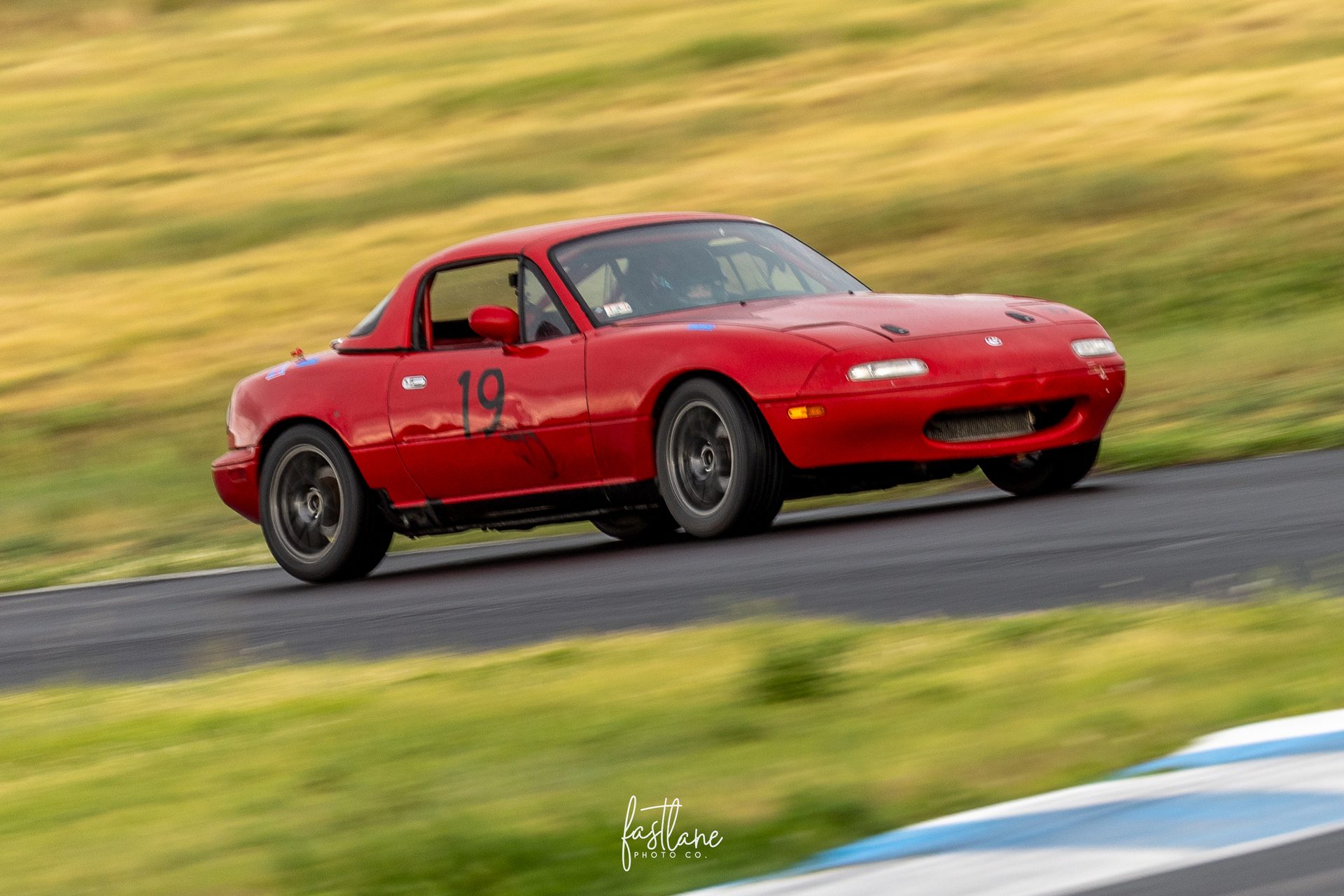 The #19 planted and pulling through the bend at High Plains Raceway during our NASA weekend, August 2026.
Start from Mazda's baseline, not a forum post
Mazda Motorsports publishes a Spec Miata baseline setup. It's free, it's from the people who run the class, and most of the paddock is running some version of it.
Here's what they publish:
| Setting | Published baseline |
|---|---|
| Front camber | -3.0 to -3.4 degrees |
| Rear camber | -2.5 to -2.8 degrees |
| Front toe | 1/32" out per side |
| Rear toe | 0 to 1/32" in |
| Caster | Max it out first |
| Cross weight | About 50.5% |
| Hot tire pressure | Generally 36-38 psi |
They also publish an order of operations, and the order matters more than people think. Ride height, then corner weight, then re-check ride height, then caster, then camber, then corner weight again, then toe. Sway bars disconnected the whole time, or you preload the bar and every number you just set is a lie.
Mazda's target is a half-degree of camber split between front and rear. That split, not the raw number, is what you're actually chasing.
Our #121 runs Penske shocks. Our second car runs Bilsteins. Both start from the same published numbers.
What High Plains actually asks the car for
HPR is 2.55 miles and 15 turns, with over 300 feet of cumulative elevation change per lap. The longest straight is 2,838 feet. The tightest corner is an 80-foot radius, 160 degrees of turn, and 1.5% off camber.
Read that last one again. The pavement falls away from you for the whole corner.
So the track asks for two things that fight each other. It wants a car that rotates in the slow, off-camber stuff. It also wants a car that stays planted through fast linked corners where a snap costs you a lot more than a tenth.
Every adjustment below is you trading one of those for the other. If you're not sure which one you have, start with what understeer and oversteer actually feel like before you touch a wrench.
At HPR, the fastest car is the one the driver trusts over a blind crest. That's a setup problem and a confidence problem at the same time.
Then there's the air. HPR's high point is 5,054 feet. A naturally aspirated engine gives up roughly 3% of its power per 1,000 feet of altitude, so everybody in the field is down. You can't tune that back. What it means practically is that momentum is worth more here than anywhere else you race, and a car that scrubs speed mid-corner never gets it back on the straight.
If you haven't run the place yet, read our High Plains Raceway track guide first. Setup won't save you from not knowing where the corner goes.
The three things we actually change
1. Tire pressure. Spring rates are fixed in Spec Miata, so Mazda's own advice is to use pressure as your spring-rate substitute. Less pressure behaves like a softer spring and more grip. More pressure stiffens it up. Move it half a pound to a pound at a time.
At altitude, on a hot dry day, pressures grow more than you expect between the paddock and lap four. We check every session, not every day. The full method is in our post on Spec Miata tire pressures.
2. The rear bar. Most Spec Miatas have a non-adjustable front bar and a three-hole adjustable rear. Loose mid-corner, move the end link toward the hole closest to the end of the bar. Tight, move it toward the hole furthest from the end. Change one side only and you get a half step, which is often exactly what you want.
3. Cross weight, by turns on the perch. Mazda's fine-tuning guidance is a half turn to a full turn at a time, with two to three turns as your ceiling before the sway bar starts binding. Loose on entry, drop the rear ride height a turn or two on both sides. Tight on entry, raise it.
That's the whole toolbox at a spec-class weekend. It's small on purpose.
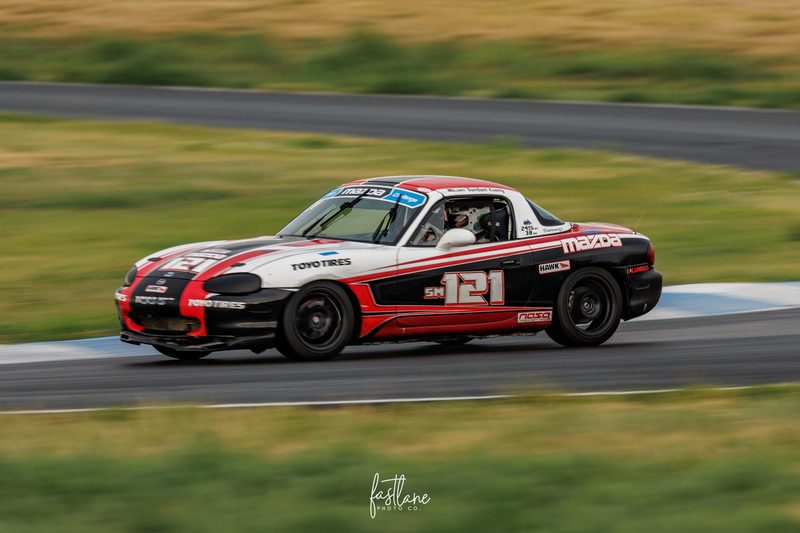 Corner exit at HPR, August 2026. Exit speed here pays you for the entire length of the front straight.
What we don't touch
We don't make two changes at once. Mazda says it plainly and they're right — change one thing, run a session, and you'll actually know what did it. Change three and you've learned nothing in an hour you paid for.
We don't chase a bad session. Traffic, a hot session in the middle of the day, a driver who got tight after a near-miss in turn 10 — none of those are setup problems, and turning wrenches to fix them makes the car worse for the next session when conditions come back.
And we don't touch anything in the last session before qualifying unless something is actually broken. A known car you've driven all weekend is worth more than a theoretically better one you've never felt.
Write it down or it didn't happen
The part nobody posts about is the log. Every change, the session it went on for, the ambient temp, the track temp, hot pressures off the car, and one honest sentence from the driver about what it did.
Do that for two weekends at the same track and you stop guessing. You start the third weekend at last year's good number instead of at the baseline.
We built a free Race Day Ready Pack around exactly this — the checklists and setup-tracking sheets we use so nothing gets remembered wrong on the tow home. Take it, print it, keep it in the trailer.
The honest truth about Spec Miata setup is that a properly baselined car in the hands of a driver who knows HPR will beat a beautifully tuned car driven by somebody still learning the crest into 13. Setup is the last five percent. Get the baseline right, log everything, and spend the rest of your money on seat time.
If you'd rather learn this track in a car that's already dialed, that's what our Driver Evaluation Day is for — $2,250 for a coached day in one of our cars with a written assessment at the end, and $1,000 of it credits toward a race weekend if you book within 30 days. We'll hand you the setup sheet too.
Sources: Mazda Motorsports Engineering Tip #7: Spec Miata Baseline Setup, Mazda Motorsports Engineering Tip #8: Spec Miata Fine Tuning at the Track, Mazda Motorsports Spec Miata Suspension Parts List, SCCA: Penske Racing Shocks Upgrade on Way to NASA and SCCA, High Plains Raceway. Baseline numbers are Mazda's published figures, not ours — always check them against your current rulebook and your own corner scales.
Do you believe?