
Everybody can recite the definitions. Understeer is when the front end lets go, oversteer is when the back end lets go, and there's a joke about which one you hit the wall with. Fine.
None of that helps you at 80 mph with your hands full. What helps is knowing what each one feels like in the two-tenths of a second before it becomes a problem.
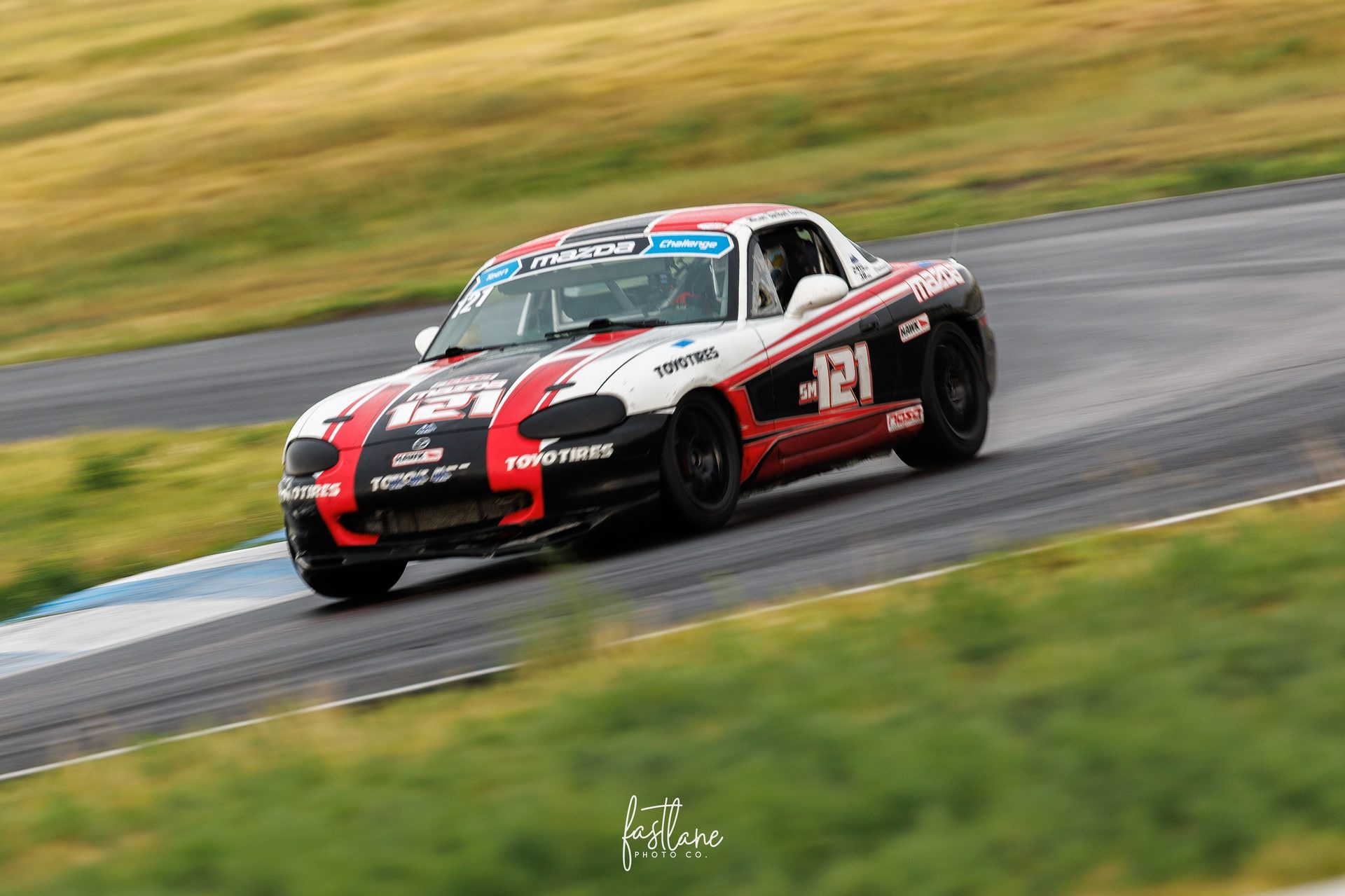 The #121 using every inch of the curbing at High Plains Raceway. Everything in this post is decided in about a second and a half of corner.
The Real Definition: Which End Ran Out First
Your car has four tires and each one has a finite amount of grip. Corner hard enough and one end runs out before the other. That's it. That's the whole concept.
If the front runs out first, the car doesn't turn as much as you asked. It pushes wide. That's understeer.
If the rear runs out first, the car turns more than you asked. The back end steps out. That's oversteer.
Understeer and oversteer aren't car problems or driver problems. They're a description of which end of the car ran out of grip first.
The reason this matters is that the fix for one makes the other worse. Adding steering to a car that's already understeering does nothing. Lifting off the throttle to slow down an oversteering car can spin it. You have to identify which one you've got before you react, and you have about half a second to do it.
So learn the feel, not the vocabulary.
What Understeer Actually Feels Like
Understeer is quiet. That's what makes it sneaky.
The clearest tell is the steering wheel itself. When the front tires are working, the wheel is loaded — there's weight and texture in your hands. When the fronts give up, that weight disappears. Driver61 describes it exactly that way: the wheel "feels less loaded."
Your hands go light. The nose keeps traveling toward the outside of the corner. You may hear the front tires scrub, a low howl rather than a squeal.
The instinct — every single time — is to add more steering. Don't. The front tires are already past their limit. More angle just makes them scrub harder and heats them up for nothing.
Understeer shows up in three places, and the cause is different in each:
- On entry. You came in too fast, or you're still heavy on the brakes as you turn the wheel. The fix is a smoother handoff from brake to steering — which is exactly what trail braking teaches you to control.
- In the middle. You're at the apex on neutral throttle and it still won't rotate. Usually too much entry speed, sometimes setup.
- On exit. The most common one. You got greedy with the throttle, the rear squats, weight leaves the front tires, and the car runs wide. Patience fixes it.
The universal correction is the same for all three: unwind a little steering and ease off whatever pedal you're on. Give the front tires back some grip, let the car take a set, then ask again. It feels like giving up. It's actually the fastest way out.
What Oversteer Actually Feels Like
Oversteer you feel in your hips, not your hands. You'll sense the car rotating through the seat before the view through the windshield catches up.
That's why a good seat and a tight belt matter more than people think. If you're sliding around in a worn-out stock seat, you lose the first and best warning you get.
There are a few flavors worth knowing:
Lift-off oversteer is the one that catches track-day drivers. You're mid-corner, you get nervous, you snap off the throttle. Lifting shifts weight forward, the rear tires unload, and the car suddenly steers more tightly into the turn. Driver61 calls it the most common incident type on track days, and that matches what I see.
Short, light cars feel it hardest. A Miata has a short wheelbase and not much mass, so the weight moves fast and the rotation arrives quickly. That's part of why Spec Miata teaches car control so well — the car tells you immediately, every time.
Power oversteer is rear-drive specific. Too much throttle, too early, before the car is pointed. The rear tires are being asked to turn and accelerate at once and they pick one.
Entry oversteer comes from too much brake carried too deep, or a steering input that was too fast. The rear gets light and the car rotates on its own schedule.
The hardest truth here: by the time you react, you're already behind. Experienced drivers don't catch slides — they feel them coming and adjust before there's anything to catch.
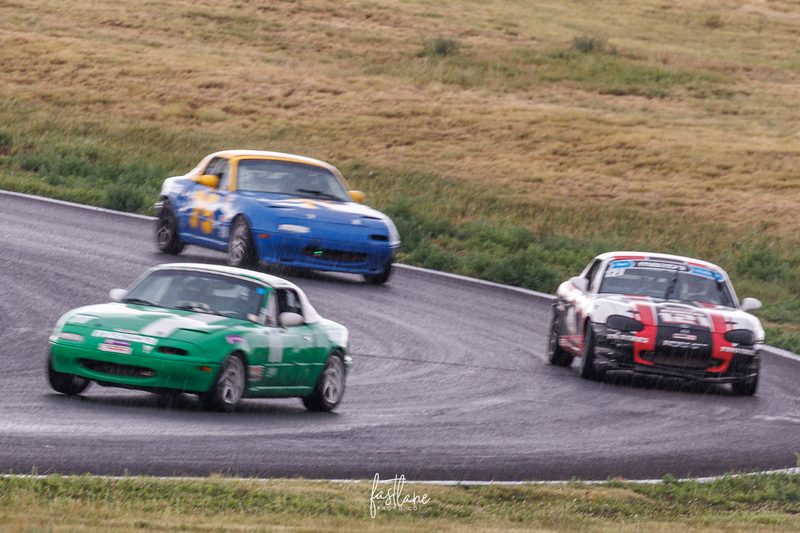 Rain at High Plains Raceway. Low grip doesn't change the physics — it just gives you less margin and more warning time.
How to Catch a Slide Without Making It Worse
If the rear does step out, the sequence is short and it has to be fast.
- Eyes first. Look where you want the car to go, not at the thing you're trying to miss. Drivingfast.net puts it well — focus on the direction you're hoping to go and the steering correction becomes almost automatic. Stare at the tire wall and you'll drive to it.
- Steer into the slide, quickly. Enough lock to point the front wheels where the car is actually heading. Half-measures let the rotation keep building.
- Unwind just as fast. This is the step everyone misses. As the rear comes back in line, get that correction off immediately, or the car snaps the other way. That second slide is usually worse than the first.
- Feet stay calm. For a lift-off slide, gently feed throttle back in to settle the rear. Keep lifting and you'll spin. For a power slide, ease off — don't stab.
Overcorrection is the single most common mistake. Too little lock and you spin. Too much and you spin the other direction, just later and with more drama.
Hand position is doing quiet work here too. At nine and three, you always know where straight-ahead is, because your hands tell you. Drivers who shuffle the wheel lose that reference right when they need it most.
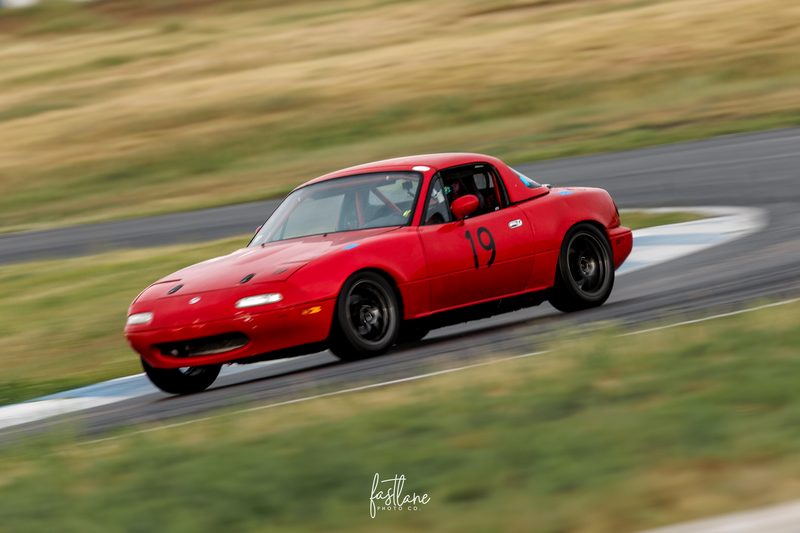 The #19 mid-corner at High Plains. A car this balanced is doing a little of both — and that's the target.
Your Car Understeers on Purpose
Here's something most drivers don't know. Almost every production car sold is built to understeer at the limit — deliberately.
It's a safety decision. Understeer is boring. You run wide, you lift, the car tucks back in. Oversteer is a spin, and a spin puts the car somewhere nobody planned. Manufacturers pick the boring one for you.
That bias isn't only safer. It's usually faster. A stable car lets you brake later and get to throttle sooner, while a loose car forces you to spend attention on keeping it pointed. One driver's side-by-side testing — run in a simulator with deliberately mismatched tires — put the understeering setup over a second a lap ahead of the oversteering one on the same car and track.
Worth reading the rest of that result honestly, though: the balanced setup beat both. Nobody's arguing for a car that pushes. The point is that if you have to be wrong in one direction, be wrong toward stable.
So when a fast driver tells you your car feels lazy, that's not an insult. It's the factory doing its job, and it's a fine place to learn from.
Where to Learn This for $60 Instead of $6,000
You cannot learn to catch a slide in a novice HPDE run group. There's traffic, there's a concrete wall somewhere, and passing rules mean you can't just explore. That's the wrong classroom.
The right one is a big empty piece of pavement.
Autocross is the cheapest car-control education on earth. Cones instead of walls, speeds low enough that mistakes are free, and enough runs to actually try things. Here in Colorado, Rocky Mountain Solo runs its events at the Colorado Air and Space Port in Watkins, and a 2026 entry is $60 — $55 if you're military. You'll feel understeer and oversteer in your own car, in a place where the worst outcome is a cone and some laughter. We break down how it stacks up against track days in our autocross vs. HPDE comparison.
If there's a teenager in the house, the Tire Rack Street Survival school is the best $175 in motorsports. It's built for drivers 15 to 21, they run it in their own car, and skid recovery is part of the curriculum. It's a street-safety school, not a racing school, and that's the point — those skills are the same skills.
A skid pad or car control clinic is the purest version if you can find one. A wet circle, an instructor in the right seat, and permission to go over the limit fifty times in an afternoon.
Wherever you do it, low grip is your friend while you're learning. A damp morning teaches you more than a hot dry afternoon, because everything happens slower and you get more warning. Same reason your first laps on cold tires feel so different from your fifth.
The Honest Summary
Understeer is the front end quitting, and it feels like the steering wheel going light. Oversteer is the rear end quitting, and you feel it in your hips first.
Both are just grip running out somewhere. The car isn't out to get you. It's telling you exactly what it needs, and the whole skill is learning to hear it early enough to do something small instead of something dramatic.
If you want to feel all of this in a car that's already sorted, with a coach in your ear and data to check your feel against, that's what our arrive-and-drive weekends at High Plains Raceway and Pueblo are for.
Do you believe?
Sources: Driver61 — Understeer, Driver61 — Oversteer, Drivingfast.net — Oversteer Explained, Wikipedia — Lift-off oversteer, Occam's Racer — Understeer Is Faster Than Oversteer, Rocky Mountain Solo, MotorsportReg — RMSolo Summer Series #1, Tire Rack Street Survival, SCCA — Street Survival. Entry fees verified against published 2026 registration pages as of September 2026. The lap-time comparison cited is one driver's simulator test, not instrumented real-world data — treat it as illustrative. Everything else is cross-checked against my own coaching and racing experience.