
Nothing about your next season gets decided in April.
It gets decided in the quiet months before it, when the trailer is shut and nobody is watching. Our 2026 season ends at Pueblo in November. The first green flag is at High Plains in April. That gap is either the most valuable stretch of your year or the part you waste.
Four jobs fill it. The car, the driver, the paperwork, and the money.
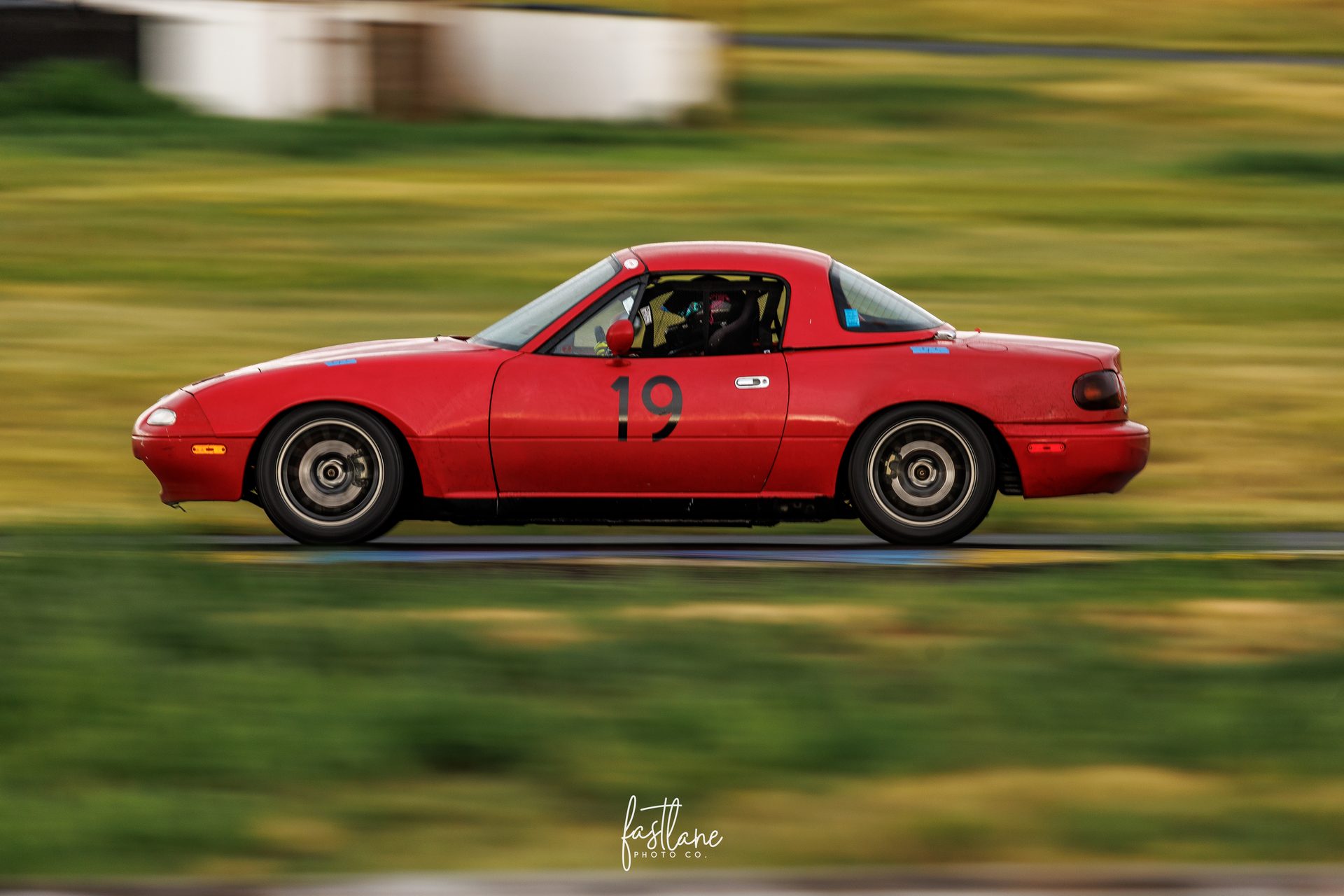 The #19 at High Plains during the August NASA weekend. Everything that made this lap possible happened months before it.
Job 1: The car comes apart, it doesn't just get parked
Putting a race car on jackstands is not maintenance. It's storage.
The off-season is when annual work gets done, because it's the only window long enough to do it. Look at how a real shop structures it. AccelRaceTek publishes its annual list for the Spec Racer Fords it runs, and it reads like this: shock check or rebuild, wheel bearing check or replace, half shaft check or repack, brake service, fluid lines checked, rod ends checked, a complete nut and bolt, frame crack check, and an alignment at the end.
The specific list changes with the car. The idea doesn't. Once a year, somebody looks at every fastener and every wear item on purpose, instead of at 7am on a Saturday.
A few things that get skipped every winter:
- Safety hardware. Belts and the fire bottle get inspected on the same schedule as the suspension. They have dates on them.
- Fuel, if you run anything exotic. Methanol and E85 should come out of the system at season's end to limit corrosion, with the filter cleaned or replaced and the lines inspected.
- The charging system. A voltmeter on the battery with the engine running tells you in thirty seconds whether you're about to lose a session in the spring.
- The logbook. Annual tech is the off-season's paperwork twin. If you're not sure what lives in that book or who writes in it, we covered that in what a race car logbook actually is.
Big-ticket work belongs here too. An engine refresh, a gearbox, a cage repair. Shop queues fill up in March when everyone panics at once, and the same job costs you a race weekend if you start it late. We broke the real numbers down in what a Spec Miata engine rebuild costs.
Job 2: The driver is the cheapest thing to improve
The car costs money to make faster. You don't.
Start with the season you just ran. Blayze's off-season guide puts it plainly — "review video footage and performance data from last season," and focus on concrete metrics like braking points and cornering speeds. Not vibes. Not the one lap you remember fondly. The laps you'd rather not watch.
Turn that into a written list of your two or three worst habits. If you've never done a structured version of this, use the same framework we use after every event in the post-race debrief that actually makes you faster.
Then attack the list in the sim. The useful approach is narrow: pick the tracks where you struggled and practice those specific sections over and over. That's deliberate practice, and it's the one thing sim time is genuinely great at. We sorted the gear that carries over in sim racing tools that translate to the real track.
Fitness is the third piece, and it's the one racers skip. Driver training guidance is consistent about where to spend the effort: core, neck and shoulders for load, plus cardio you can hold for the length of a race. You don't need a gym for it. Here's how to train like a racer at home.
Winter is the only time of year you can get better without getting a bill from a shop.
If you want an outside read on where you actually are, that's what our Driver Evaluation Day is for — a coached day in a prepped car with a written assessment at the end, $2,250, with $1,000 credited toward a package booked within 30 days. Book those dates in the winter, because spring fills first.
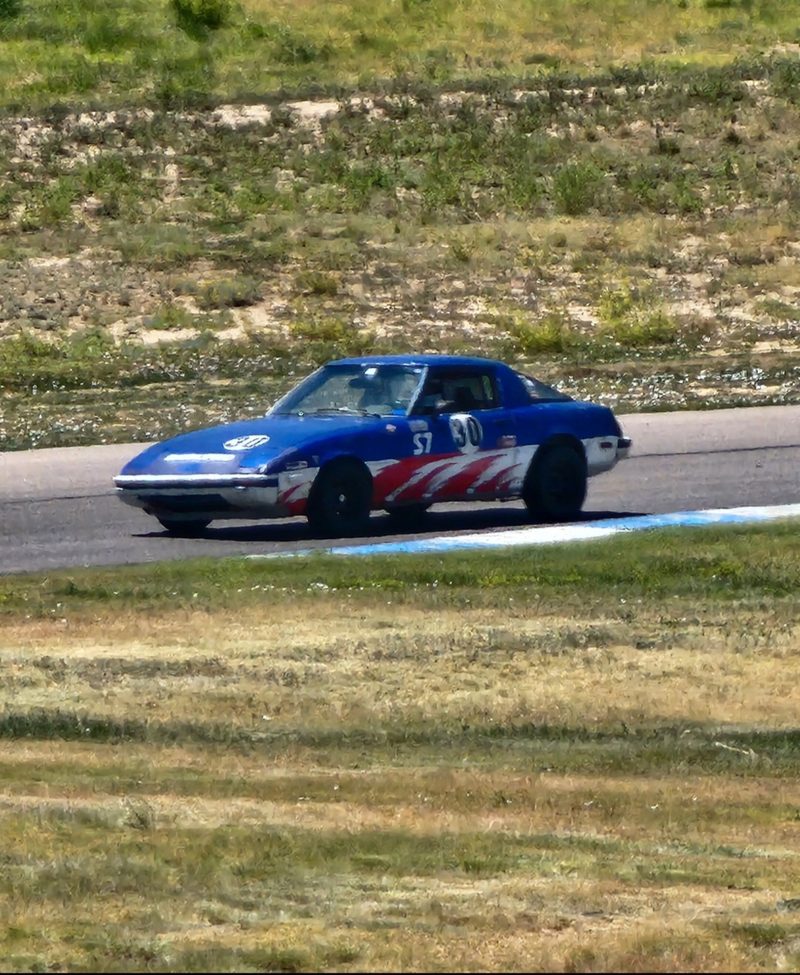 Our old Spec 7 RX-7. Cars and classes change. The off-season routine that keeps them on track doesn't.
Job 3: The paperwork quietly expires while you're not looking
This is the boring job that ends seasons before they start.
If you race with SCCA, know how the dates work. Your competition license expires on the same date as your membership anniversary, both have to be renewed, and renewing your membership does not renew your license. Those are two separate actions, and people find that out in April.
Medical paperwork runs on its own clock. SCCA's published requirements: adults complete a medical declaration each year, drivers 60 to 69 upload a physician-completed form every two years, drivers 70 and up do it annually, and minors need a physician-completed form every five years. NASA membership renews annually too — budget around $69 and confirm it at signup, since published figures vary.
Two more dates worth writing on a calendar:
- Your gear. Helmets, suits, belts and head-and-neck restraints all age out, and they don't all age out on the same schedule. Check them now, not in tech. Full breakdown: when racing gear expires.
- Your transponder subscription. An expired subscription doesn't score. You'll run the whole session and show up nowhere on the sheet. More on that in what a racing transponder is and why you need one.
Job 4: The money job nobody wants to start in November
Next season's budget is built now or it isn't built at all.
Start with honest numbers instead of hopeful ones. A NASA or SCCA weekend entry runs us around $500. A mounted race set of tires is about $1,200. A competitive DIY Spec Miata weekend lands around $2,000 to $3,500 all-in when you do your own wrenching, and more when you pay a shop. Multiply by the number of weekends you actually want to run, then look at the gap.
That gap is the sponsorship work, and winter is when it gets done — because company budgets for next year get set before their new year starts, not after. We wrote the full version of that in the sponsorship dead months and ranked the calendar in the best months to pitch racing sponsors.
If the part that stops you is not knowing what to say, start with our 25 free sponsorship email templates. They're free, and they exist because "I didn't know how to open the email" kills more deals than any pitch ever did.
The month-by-month version
| Month | The car | The driver | The admin |
|---|---|---|---|
| November | Strip, clean, write the damage and wear list | Watch the season's video, write down the three habits to fix | Renew memberships and license before the anniversary date |
| December | Annual maintenance — shocks, bearings, nut and bolt | Base fitness block, start neck and core work | Audit every date on your gear |
| January | Big-ticket work into the shop queue | Sim work on your two worst corners only | Medical paperwork submitted, transponder sub renewed |
| February | Reassembly, corner weights, alignment | Conditioning, add race-length cardio | Register for the first event as soon as it opens |
| March | Shakedown test, then fix what it finds | One real day of seat time | Sponsor deliverables agreed in writing |
Work it in that order and April is boring in the best way. The car is sorted, your neck survives the first double stint, and nobody is emailing a brand three weeks before the season asking for money.
None of this is glamorous. All of it is why some racers show up ready and some show up hoping.
If your winter job is the money — not one lucky sponsor, but a funded season — that's exactly what The Funded Season Kit is built for. Eleven modules, worksheets, and the two spreadsheets we use to track prospects and prove ROI, for $197.
Sources: SCCA Competition License application and downloads, SCCA "I Want to Road Race" medical requirements, AccelRaceTek annual maintenance checklist, Blayze off-season preparation guide, and the Circle Track Warehouse spring maintenance checklist. Membership, license and medical requirements verified against currently published pages as of September 2026, and they vary by sanctioning body and region — your club's current rulebook is the final word. Cost figures are LFR's own published pricing and our real operating numbers.
Do you believe?