
In a small field study of amateur kart drivers, average heart rate during races hit 168.8 beats per minute. Solo driving with nobody to race was 140.9. Resting was 75.
Three subjects, so hold it loosely. But nobody who has climbed out of a car after a hot race needs a study to believe it. You don't need a gym to train for that. You need to know what to train.
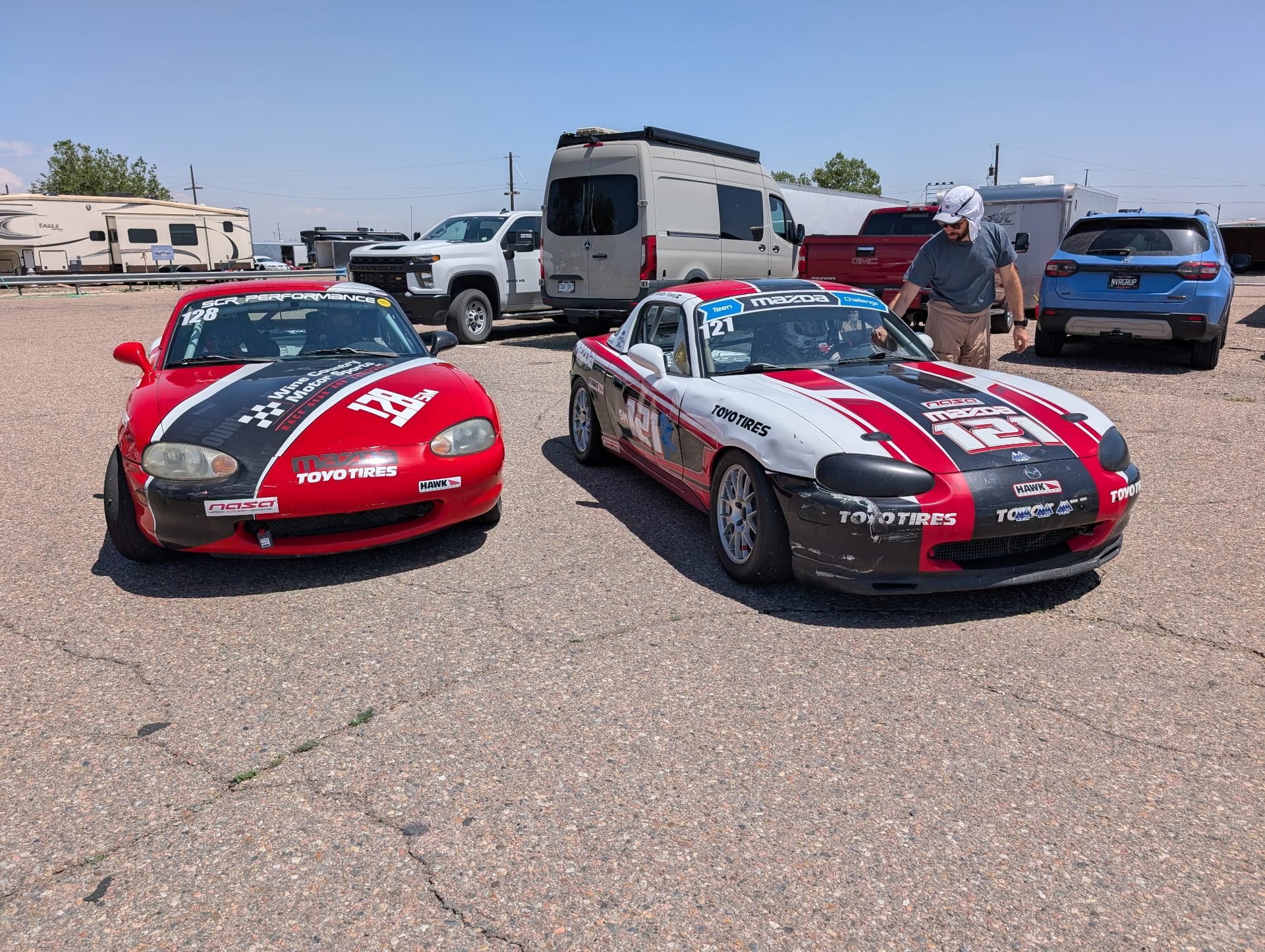
 Car #121 at work. Twenty-five minutes of this in August is a workout, whatever anyone tells you.
Real Racing Loads Your Body Way Harder Than a Sim
A 2025 study compared drivers in authentic racing against the same drivers in a simulator. Over the final 50 minutes, real racing averaged 159 beats per minute. The simulator averaged 112.
That's roughly 85 percent of max heart rate in the car versus about 60 percent on the rig.
Core temperature followed. Drivers hit 38.5 degrees Celsius in the real car and 37.4 in the sim. That's 101.3 Fahrenheit against 99.3. Same driver. Same track. Very different body.
The researchers pinned the gap on three things a simulator can't give you: g-loading through corners and braking, the stress of actual competition, and knowing the wall is real.
If you're coming from iRacing, that's the honest bridge nobody mentions. Your racecraft might transfer fine. Your body has never been asked to hold up under that. We wrote more about that gap in sim racing to real racing.
The Four Things Actually Worth Training
You can ignore most fitness advice aimed at racers. It's written for people driving cars with four times the downforce you have.
Here's what matters for a Spec Miata driver on a club weekend.
1. Your neck. F1 drivers train necks at least five days a week and can generate huge loads with those muscles alone. You aren't pulling their g-numbers. You are still holding a helmet and a head-and-neck restraint sideways for a 25-minute race, lap after lap. A weak neck shows up as sloppy hands in the last five laps.
2. Grip and forearms. Your forearms usually quit before your brain does. Fighting the wheel over curbs and through fast direction changes is endurance work for muscles most people never train.
3. Core and breathing. You brace against belts through every corner. If you can't breathe deeply while braced, your heart rate climbs and stays there. Planks, dead bugs, and bridges are boring, cheap, and work.
4. Aerobic base and heat tolerance. This is the biggest free win in racing. A better aerobic engine means a lower heart rate at the same workload, and heat hurts less when your fitness is higher.
Nobody loses a race weekend because their bench press was low. Plenty of drivers lose the last five laps because they cooked.
The Weekly Plan (Four Sessions, Zero Equipment)
This is what I'd hand a driver with no gym, no budget, and about three hours a week.
Session 1 — Neck and core (20 minutes). Neck isometrics first. Put your palm on your forehead and press, without letting your head move. Hold 20 to 30 seconds. Repeat on both sides and the back of your head. Three rounds of all four directions. No movement, no jerking, keep breathing.
Then plank for three sets of 45 seconds, dead bugs for three sets of eight per side, glute bridges for three sets of 12, and a side plank for 30 seconds each side.
Session 2 — Aerobic base (40 minutes). Easy running, riding, or hiking. Conversational pace. If you can't hold a sentence, slow down. The goal is time, not suffering.
Session 3 — Grip, forearms, and core (25 minutes). Dead hangs from anything solid, three sets to about 30 seconds. Farmer carries with two water jugs, three walks of 40 steps. Wrist curls holding a jug. Finish with the core block from session one.
Session 4 — Long and easy (50 to 60 minutes). Same as session two but longer, plus 10 minutes of hip and thoracic mobility. Race cars fold you into a shape your body wasn't designed for.
Add a resistance band later if you want. Anchor it to a door and use it for gentle neck work in the same four directions. That's the only purchase in this plan, and it costs less than one set of brake pads.
Two rules. Build slowly, because neck training is the fastest way to hurt yourself if you rush it. And if you're under 18, do this with a parent or coach watching the first few times.
I'm an engineer, not a doctor. If something hurts in a way that isn't muscle fatigue, stop and go ask a real one.
 The end of a long day at the track. Race weekends are 12-hour days, not 25-minute races.
Hydration Is the Cheapest Lap Time You'll Ever Buy
Sports science is consistent here. Once you're down around two percent of your body mass in fluid, reaction time, concentration, and decision-making start slipping. F1 teams report drivers losing up to four kilograms of water at the hottest races.
You're not in Singapore. You are in a steel box with a hot transmission tunnel, a fireproof suit, and no air conditioning. In August at High Plains, that's plenty.
One published randomized trial found that drinking cold water during simulated racing in the heat reduced both the rise in core temperature and how bad the drivers felt. Cold fluid, not room temperature. Small change, real effect.
What actually works on a race weekend:
- Start drinking two days out, not the morning of
- Add electrolytes, because plain water alone doesn't hold
- Keep drinks cold in the paddock and drink between every session
- Weigh yourself before and after a session once, just to see the number
- Get out of the suit and into shade the second you're done
We put the checklist version of this in the Race Day Ready Pack. It's free, it covers prep and packing and hydration together, and it exists because we kept watching fast drivers lose the last stint of a hot race to something completely preventable.
What You Can Skip
Max strength numbers. Nobody at tech inspection cares what you deadlift.
Marathon training. You need an aerobic base, not a race-day performance in a different sport.
Expensive neck machines. They're great. They are also not the difference between finishing strong and fading. Consistency is.
A perfect program. Four honest sessions a week beats a flawless plan you quit in nine days.
How to Know If It's Working
Look at your own lap times. Compare your best laps in the first five minutes of a session to your best laps in the last five. If the gap is shrinking week over week, you're getting fitter.
A cheap heart rate strap tells you more. Watch your average across a session across the season. Same track, same conditions, lower average heart rate means your engine improved.
And notice the small stuff. Do your hands still work at the end? Is your neck sore the next morning? Are you making dumb mistakes in the closing laps? That's fitness data, not a talent problem. It also makes your post-race debrief far more useful, because you stop blaming your driving for something your body did.
The Part You Can't Train at Home
All of this is free. Seat time isn't. That's the honest trade in grassroots racing, and it's why we built the rental side of LFR the way we did.
An LFR arrive-and-drive race weekend is $5,000 for a prepped car, crew, coaching, and data every session, with entry fees passed straight through at cost. You bring your gear, your fitness, and your belief. We handle everything else. If you're a young driver coming out of karts or sim, Kart to Car is the structured version, and fitness support is part of our season programs for exactly the reasons above.
Train the neck. Drink the water. Show up ready.
Do you believe?
Sources: Physiological responses of race car drivers in authentic and simulated motor-racing (2025), The effect of competition on heart rate during kart driving: a field study, Cold water ingestion ameliorates increase in core temperature and discomfort during simulated motor racing in a hot environment: a randomized trial, Formula 1 — How to train like an F1 driver, StrengthLog — Strength Training for Motorsports. Physiological figures are quoted directly from the published studies as of August 2026. The kart heart rate study used only three drivers, so treat it as directional. LFR pricing reflects our own published rates. Training guidance here is general, not medical advice.