
You finish your first session feeling fast. The results go up. Your number isn't on the sheet.
Nobody stole your lap times. Your transponder just didn't talk to the track. It's one of the most common first-weekend problems in club racing, and it's completely preventable once you understand what the little box actually does.
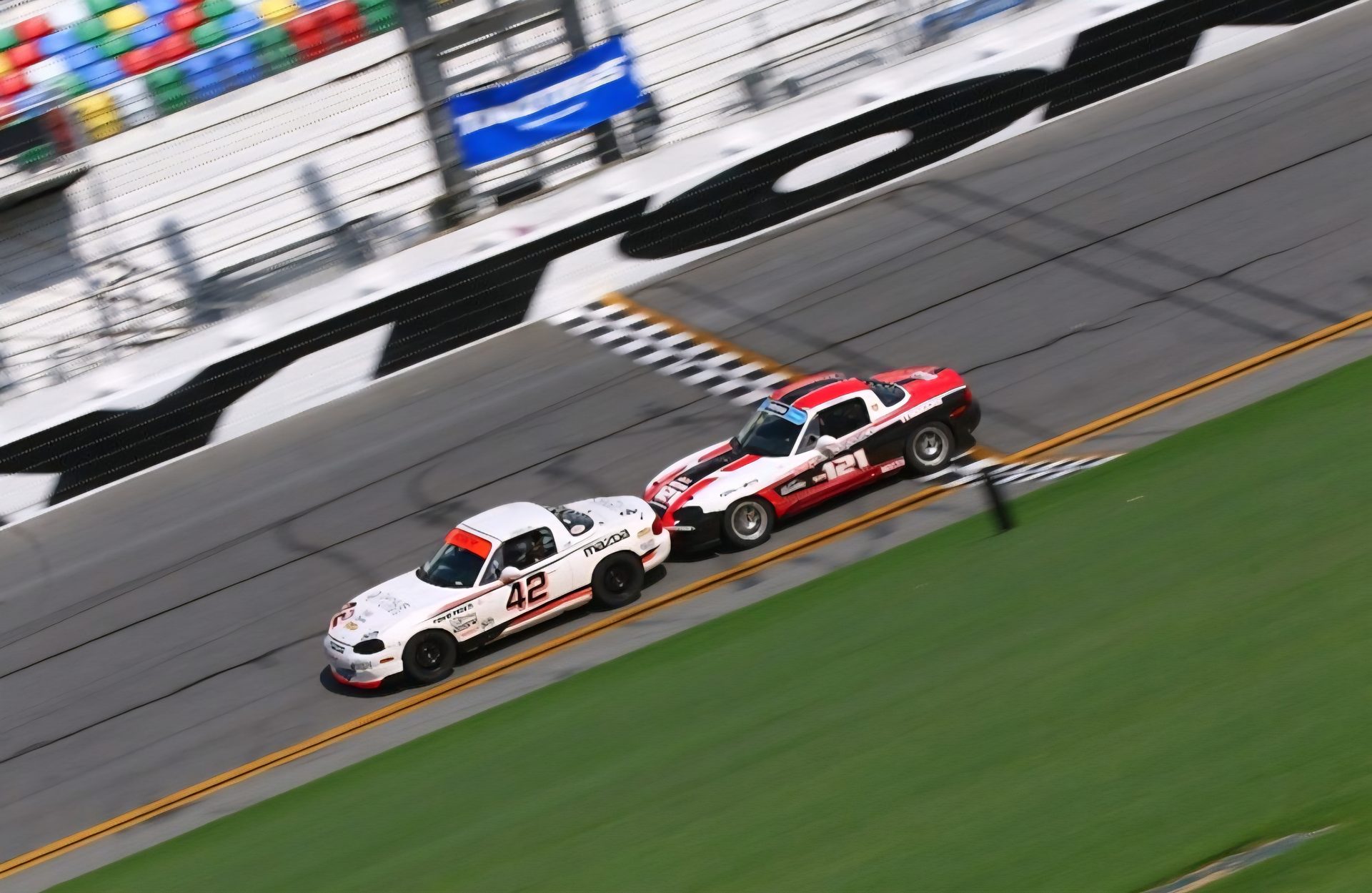 Two cars crossing the line together. The naked eye can't split that. The timing loop under the pavement can.
What a transponder actually is
It's a small battery-powered or hardwired box, usually mounted low on the front of the car, that broadcasts one thing: a unique ID number.
Buried in the track surface at start/finish — and at any intermediate split points — is a detection loop. When your car passes over it, the loop picks up your transponder's ID and hands it to a decoder in the timing tower. The software knows who you are and stamps the time.
That's the whole system. Your lap times don't come from a stopwatch, a corner worker, or the numbers on your doors. They come from that ID crossing a wire in the asphalt.
Nearly all of club racing in the US runs on MyLaps hardware, which most old-timers still call AMB. If you hear "AMB transponder," it's the same thing.
Why every club requires one
Because it's the only timing method they'll accept.
NASA's Club Codes and Regulations put it plainly in section 21.8: most NASA race classes use the AMB transponder system for timing and scoring. NASA's 2026 Time Trial rules go further and say that all competing vehicles must be equipped with a MyLaps transponder to obtain lap times, and that no other method of lap timing will be valid for competition.
SCCA club racing runs on the same hardware. Working transponder, on, for every session.
And the responsibility is yours, not theirs. CCR 21.8.1 spells it out: the driver is responsible for proper installation and maintenance of the transponder. If your car number doesn't show up in warm-up or practice results, you have to notify Timing and Scoring right away.
That rule has teeth. In NASA Time Trial, failing to flag an error before your next session can disqualify the lap times from both the previous and following sessions. Race stewards aren't going to reconstruct your weekend from memory.
Rent or buy? Run the three-weekend math
Most regions rent units at the track. NASA Rocky Mountain's published event pricing has listed transponder rental around $40 for a single day and $80 for a weekend. SCCA region supps commonly land in the same neighborhood, so check your event's supplemental regulations before you assume.
Buying is a different shape of cost. MyLaps sells the TR2 as hardware plus a subscription, and the subscription is not optional — it's what keeps the unit active.
| Option | Cost (Sept 2026, Pegasus pricing) | When it makes sense |
|---|---|---|
| Rent at the track | About $40/day, $80/weekend | One or two events a year, or a borrowed car |
| TR2 rechargeable, 1-year sub | $209.99 | Your first real season |
| TR2 rechargeable, 5-year sub | $511.00 | You're committed and want the cheapest per-year |
| TR2 direct power, 1-year sub | $279.99 | Dedicated race car with clean 12V wiring |
| TR2 direct power, 5-year sub | $565.00 | Same, long haul |
Three rented weekends cost about $240. A rechargeable TR2 with a year of subscription is about $210. The math flips almost immediately.
Two things to know before you order. Direct-power units wire into the car and can't be run as rechargeables — pick your lane. And when a subscription expires, the transponder stops scoring. It doesn't get slower or less accurate. It goes invisible.
For what it's worth, this is one of the line items people forget when they budget a season. It belongs on the same page as your race weekend entry fee, not as a surprise at registration.
Where to mount it (the part that costs people lap times)
MyLaps publishes the specs, and they're not suggestions.
- Maximum height is 60 cm — about 2 feet — above the track surface. Higher than that and detection gets unreliable.
- The most common car location is inside a front wheel arch, low and forward.
- Nothing metal or carbon fiber can sit between the transponder and the ground. The signal goes down. Block it and you disappear.
- Mount it as vertical as possible. Angled mounts read worse.
- Keep the position consistent across cars in the same class. A transponder mounted three feet farther back reads a slightly different lap.
Practical add-ons from our own cars: if it's hardwired, mount it where you can see the status LED without jacking the car up. If it's rechargeable, mount it where you can pull it in ten seconds to charge overnight. You will forget to charge it at some point. Make that a small problem instead of a big one.
The four ways transponders fail
Almost every "my times didn't show" story traces back to one of these.
- Dead battery. Rechargeables give you a warning LED, but only if you look. Charge it Thursday night, every time.
- Expired subscription. A unit that's flashing red rapidly isn't activated and won't score. Check your expiration date weeks before the event, not in the grid line.
- Wrong number on file. The transponder ID has to be tied to your car and your assigned number in the club's system. Borrowed a car? Swapped transponders? Tell Timing and Scoring before the session, not after.
- Bad mount. Zip-tied behind a steel subframe, or mounted too high, or flopping loose. Cheap bracket, big consequences.
Here in Colorado, none of this is exotic. High Plains Raceway and Pueblo Motorsports Park both run loop timing at start/finish, and the T&S crews at NASA Rocky Mountain events are genuinely helpful if you walk up and ask them to confirm your ID is registered before your first session. Do that. It takes two minutes and saves a day.
The short version
A transponder is the only thing that proves you were out there. Rent one for your first weekend, buy one by your third, mount it low and unobstructed, keep the subscription alive, and verify your number shows up in the first practice results.
If you'd rather skip the whole shopping list for your first time out, that's part of what our arrive-and-drive program covers — the car shows up with the transponder mounted, powered, and registered to your number, so you can spend the weekend learning the track instead of chasing a timing gremlin.
Sources: NASA Club Codes and Regulations, 2026 edition, sections 21.8 and 21.8.1, NASA 2026 Time Trial National Rules, MYLAPS X2 timing system, Pegasus Auto Racing MyLaps transponder pricing, PCA Club Racing transponder guide, SCCA Cars and Rules. Hardware prices verified against published listings as of September 2026 and will move — check current pricing before you buy. Rental fees vary by region and event; always read the supps.
Do you believe?