
The number on your door is the first decision about your race car that has nothing to do with going fast. Most drivers make it in about four minutes.
Then they live with it for years. Or they don't get to keep it at all, because nobody told them numbers get reserved on a calendar.
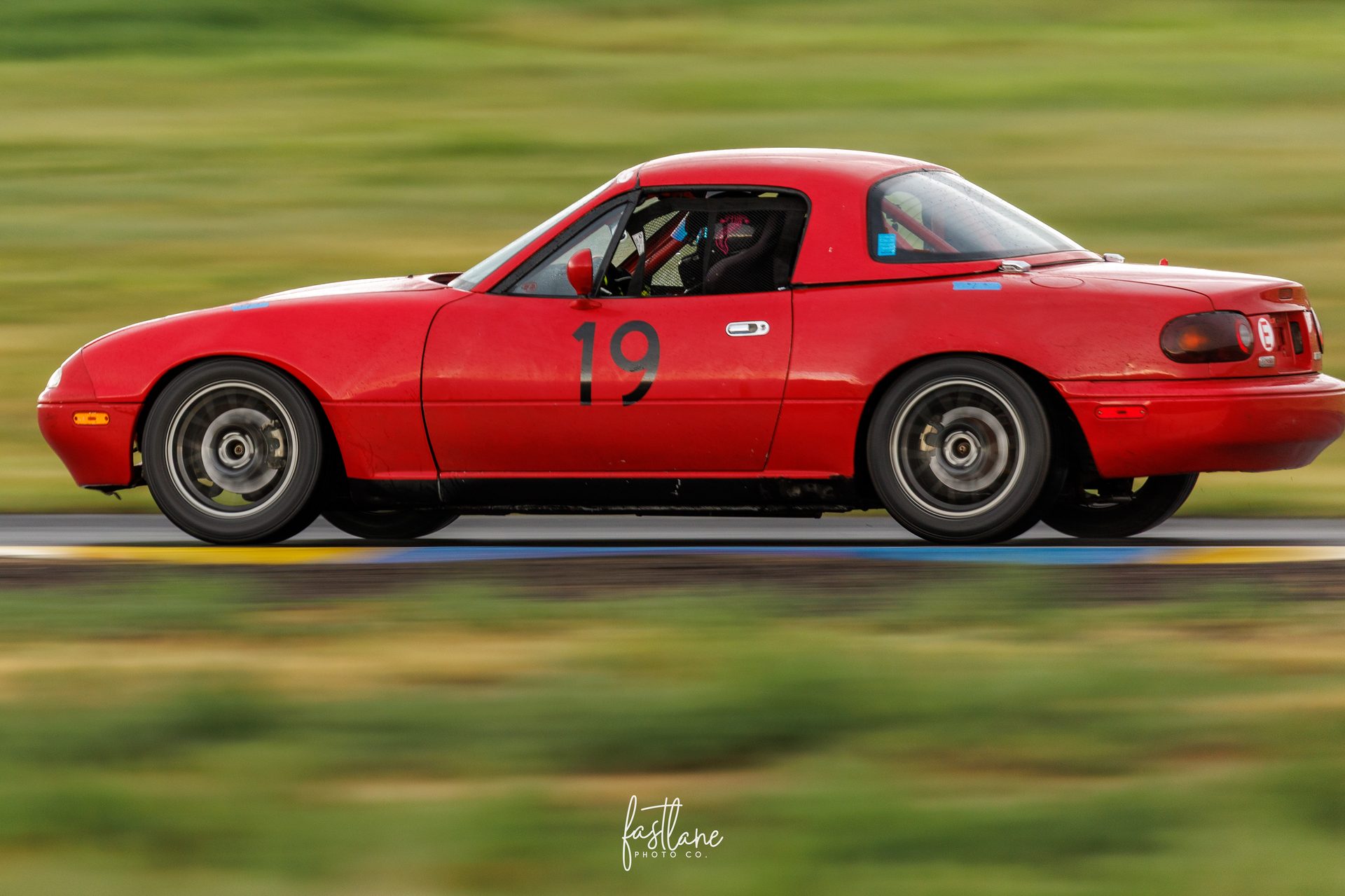 The #19 at High Plains Raceway. Two digits, high contrast, readable from a flag station at speed. That's the whole job.
Timing is by transponder. Everything else is by number.
Your lap times don't come off your doors. They come off a transponder. NASA's own number-reservation instructions have you confirm the transponder is attached to the right car in your profile before you even ask for a number.
Everything that isn't scoring runs on the number.
Corner workers report incidents by number. Race control writes penalties against a number. The black flag comes out with your number on a board beside it — we already walked through what to do in that exact moment. Grid lines you up by number. Tech finds your car by number. And the photographer who shot the best frame of your weekend files it under your number.
So the job isn't "pick something cool." The job is pick something a human can read at 100 mph, in the rain, from 200 feet away.
How numbers actually get handed out
You don't own a race number. You hold one — one season, one sanctioning body at a time.
NASA. Reserving is voluntary, and it's run region by region. NASA's Mid-Atlantic region publishes the process most clearly: update your online profile so the car and transponder are correct, then list your first three number choices, separated by commas, in the "Additional Info or Comments" box on the last page of registration. Drivers who held a reserved number before get first preference as long as they re-register by March 15. And the reservation only protects you at a given event if you pre-register by 6 p.m. the Monday of race week. Other regions run their own version of this. Check yours instead of assuming.
SCCA. Regional numbers are a division-level matter. National-level numbers are a paid product with published rules. Reserving a number for one U.S. Majors Tour conference costs $50. A second conference is another $50. All six conferences costs $150 — but that one has to be a three-digit number starting with 1, so 100 through 199. Single and double digits, 0 through 99, cover one or two conferences. The solitary numeral "1" belongs to the current National Champion in each class, and nobody else.
Two more SCCA details that bite people. Reservations have to be in at least 14 days before event registration. And when two drivers want the same number at a dual-conference event, it goes to whoever registered for the event first.
The pattern is identical everywhere: early and organized beats clever.
If you haven't gotten your competition license yet, that comes first anyway — here's how the NASA and SCCA license paths work.
Bring three choices, not one
Registration forms ask for three because you are going to need three.
- Look at last season's entry lists first. Results and entry lists are public. Two minutes there tells you whether your number is already spoken for in your class and your region.
- Three digits are easier to get. Single and double digits go fast, and they tend to go to drivers who have been there a while. A three-digit number you actually keep beats a two-digit number you fight for every March.
- Try to hold the same number in both clubs. If your car is legal in NASA and SCCA — Spec Miata is — the same digits in both places is worth more than a number you like better in one of them.
- Read it upside down and half-covered. 6 and 9 are the classic problem. So is any number that reads as something else when a corner worker only sees part of the door through traffic.
- Skip the meaning test if it costs you availability. A birthday is a nice story. Being findable for five straight seasons is a better one.
The rules decide how it looks
This is where people waste money. They order a beautiful set of decals, and then a tech inspector points at them on Saturday morning.
SCCA tightened this up recently. As of the August 2026 General Competition Rules, section 9.3.29 sets a minimum number height of 8 inches with a minimum 1.5-inch stroke width, on a single-color contrasting background. Every number on the car has to be the same color and the same style. Metallic and reflective materials are prohibited — for the numbers and for the background. Class identification is smaller, with its own published minimum of 4 inches and a half-inch stroke.
Recent revisions also added clear area around the front and side numbers. That space has to stay free of other graphics.
Read 9.3.29 yourself before you buy anything. Don't trust a forum post from 2019, and don't trust me either — pull the current rulebook. That clear-area rule in particular decides where sponsor decals can and can't live on your doors.
NASA publishes its requirements in the Club Codes and Regulations, plus whatever your region adds in its supplement. Same advice applies.
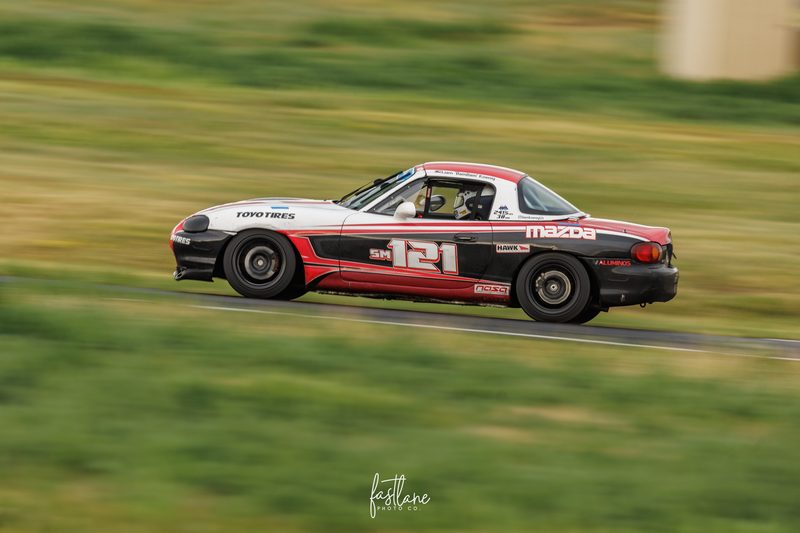 Number, background, class letters, sponsor decals. Lay the whole door out as one design before you order a single piece of vinyl.
Two practical notes. Use vinyl, not paint, for your first season — numbers change and cars get sold. And design the entire door as one layout before you order anything.
Your number outlives the car
Cars get sold. Classes change. Somebody steps up a level. The number can follow all of it.
We run 121 and 19. Those digits show up on the cars, in results, in the recaps we send out, and in every photo that goes to a sponsor. That consistency costs nothing and compounds every season.
So use it on purpose. Put the number in your social handles if it's available. Put it on your helmet — which is the other piece of branding that travels with you between cars. Put it on your driver profile and in your email signature.
When a brand Googles you two years from now, one number that pulls up one driver is worth more than a logo you paid somebody to design.
Before you order decals
Run this list:
- Pull the current number rules for your sanctioning body and your region.
- Pick three numbers and check them against last season's entry lists.
- Reserve on the calendar — March 15 for NASA regions that offer it, 14 days out for SCCA Majors.
- Measure the door before you size anything, so 8 inches tall actually fits with its background.
- Lay out number, background, class letters, and sponsor space as one design.
- Order a spare set of digits. They peel.
If you want the rest of the pre-weekend list — what goes in the trailer, what to check the night before, what to write down after each session — that's what the free Race Day Ready Pack covers. Numbers are one line on a much longer sheet.
The space around those numbers is the space you eventually sell. Once your layout is set, the real question is what a company will pay to put a logo there, and how you ask without sounding like you're begging. That's The First Sponsor System — $67, the whole process from building a local target list to sending the pitch.
Sources: SCCA Central Division — GCR Car Number Updates (GCR 9.3.29, effective August 1, 2026), SCCA — Reserve Your Majors and Super Tour Car Number, SCCA Cars and Rules / current GCR, NASA Mid-Atlantic Region — Car Numbers, and the NASA Club Codes and Regulations. Verified against currently published rules as of September 2026. Number reservation procedures are set regionally and change year to year — your region's registration page is the final word.
Do you believe?