
Nobody in the paddock remembers where you finished two events ago. They remember your helmet.
It's the one piece of you that doesn't change when the car changes. Most racers treat it as a safety purchase and stop thinking about it. It's that. It's also the only logo you actually own.
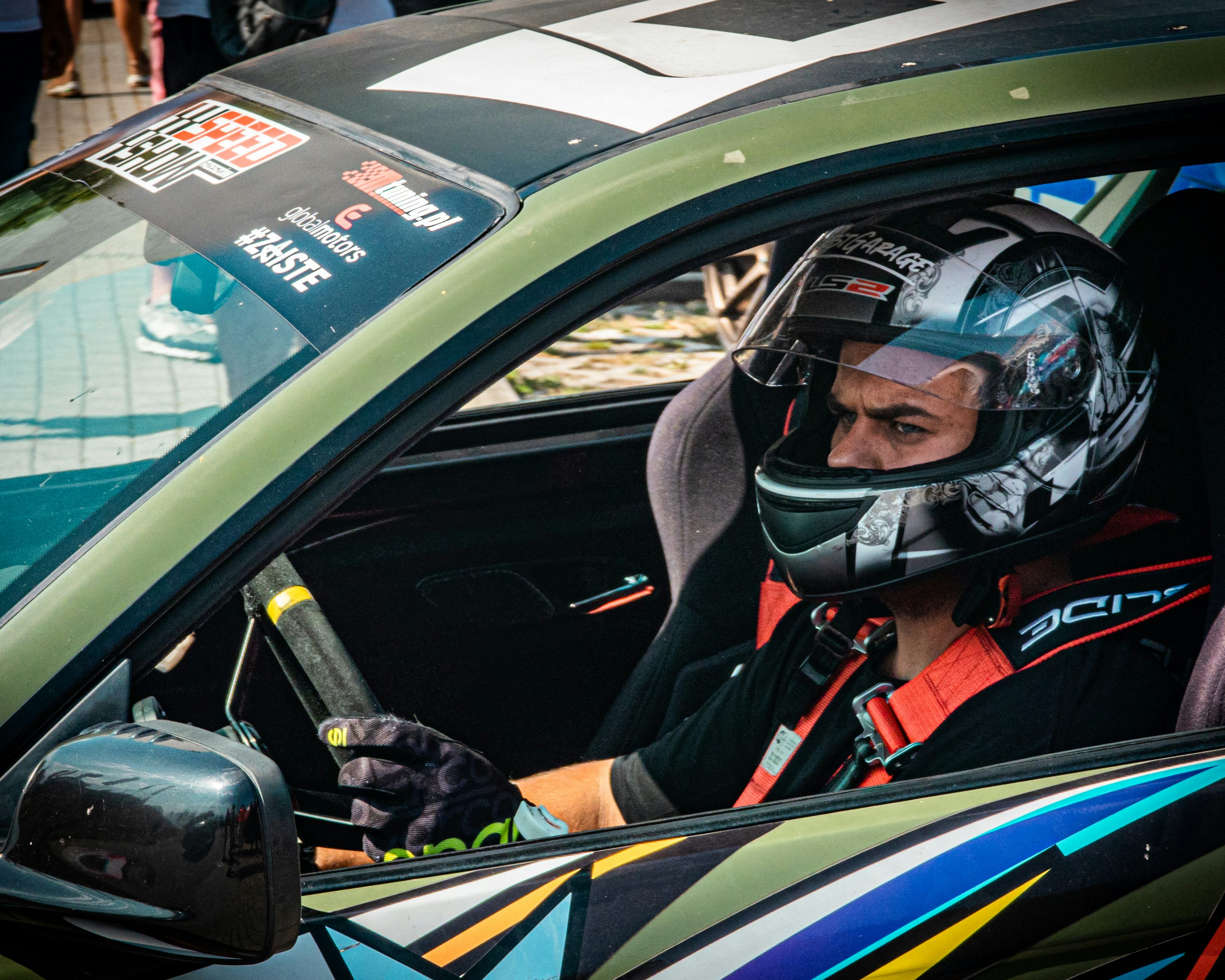 Photo by Scroll_ua on Unsplash.
It's the only equipment that's actually yours
Think about what changes over a racing career.
Your car number changes when you switch series. Your livery changes when a sponsor comes or goes. Your team changes. If you rent a seat, the car isn't even yours for the weekend.
The helmet stays.
That's true for every driver who runs with us. Our arrive-and-drive customers show up with their own safety gear and drive our car. The car has our purple on it. The helmet on the driver's head is the only thing in that photo that belongs to them.
Same story on the Kart to Car path. A kid moves from a kart to a Spec Miata and almost everything about their program resets. The helmet carries over. It's the visual thread that ties year one to year five.
The sticker on the back says more than you think
Flip your helmet over. There's a Snell sticker inside or on the back, and it has a year on it.
That year matters. Here's what's actually true right now:
- You need an SA rating, not an M rating. SA is the auto-racing standard — it's fire-tested and built for a roll-cage environment. An M-rated motorcycle helmet is a different tool.
- Most sanctioning bodies honor a Snell rating for about ten years. SA2015 aged out at the end of 2025. SA2020 is generally good through the end of 2030.
- NASA is tightening it up. Beginning January 1, 2027, NASA competition helmets must carry Snell SA2020 or newer, or an FIA 8859-2015 / 8860-2018 certification or newer.
- Snell itself recommends replacing a helmet after about five years of normal use — not because the rating dies, but because the foam liner and pads break down from being pulled on and off.
The tech inspector reads that sticker. So does the coach standing next to you, and the guy in the next paddock spot deciding whether you look like someone who knows what they're doing.
An SA-rated helmet runs roughly $320 on the entry end to $1,000 and up for the light carbon stuff — those are real listed prices from OG Racing, who supplies our safety gear. It's not a small purchase. Buy the cert year that gives you the most seasons.
If you want the rest of your weekend gear organized the same way, the free Race Day Ready Pack has the pre-race checklist we actually run — helmet cert year is a line item on it, right next to fluids and tire pressures.
Design it like a logo, not a paint job
Here's where most racers get it backwards. They design a helmet that looks great sitting on a table under garage lights.
Design for the two places people will actually see it: through a fence at 100 mph, and in a 600-pixel photo on a phone.
That means:
Two colors and one strong shape. Not seven colors and a mural. Complexity disappears at speed.
High contrast against your car, not matching it. You want to be findable in a pack shot. If your helmet blends into your roof, you vanish in every photo anyone takes of you.
The same design for years. Recognition compounds. Changing your helmet every season resets the counter to zero. Look at the drivers whose helmets you can picture right now — they've run the same idea for a decade.
If someone who's raced against you can't sketch your helmet from memory, it isn't a brand yet. It's just paint.
Careful — paint and stickers can void the certification
This part is not optional reading.
The Snell Foundation is direct about it: never repaint a helmet with paints the manufacturer hasn't authorized, and installing aftermarket accessories can invalidate the certification entirely. Certification applies to the helmet in its as-manufactured condition.
So if you're getting a helmet painted or wrapped, use a shop that does racing helmets specifically and uses manufacturer-approved materials. Don't drill it. Don't epoxy a camera mount to the shell. Don't let a buddy hit it with rattle-can primer.
And check the cert year before you spend money on artwork. Paying $400 to paint a helmet that ages out in eighteen months is a lesson you only need once.
The helmet is sponsor real estate — small, but the best you own
A sponsor decal on your quarter panel shows up when someone photographs your car. A sponsor mark on your helmet shows up in the grid walk, the pre-race shot, the podium photo, the in-car GoPro frame, and every headshot you'll ever use.
It's the one surface that's in the picture even when the car isn't.
That's worth naming when you build a package. Don't throw helmet space in as a freebie at the bottom of a proposal — put it in the deck with the rest of your assets and explain where it appears. If you're building that deck now, our post on the three numbers sponsors want before your lap times covers what to put around it.
One honest limit: if you race under a series with helmet-marking restrictions, check the rulebook before you promise anything. Selling space you can't legally deliver is a fast way to lose a partner.
Your helmet is the cheapest branding asset in motorsports and the one most racers never think about. Buy the right cert year, design something readable, keep it for a decade, and put it on the asset list.
If you want the full system for turning that identity into funded seat time — positioning, brand kit, driver resume, sponsor tracker, and the whole sponsorship method in one place — that's The Get-Funded System, $67.
Sources: Snell Memorial Foundation FAQ, OG Racing — Understanding Snell Helmet Ratings, NASA Speed News — What's New in NASA for 2026, Competition Motorsport — The New Snell SA2025 Certification. Certification dates and price ranges verified against published rates as of August 2026. Always confirm against the current rulebook for the series you're running — regional rules can be stricter than national ones.
Do you believe?