
A Spec Miata makes somewhere around 130 horsepower and weighs about as much as a loaded golf cart with a roll cage. People hear that and assume it's a starter car you graduate out of.
It isn't. It's a filter.
The class strips out almost everything a driver can hide behind. What's left is the part of racing that actually transfers to every other car you'll ever sit in.
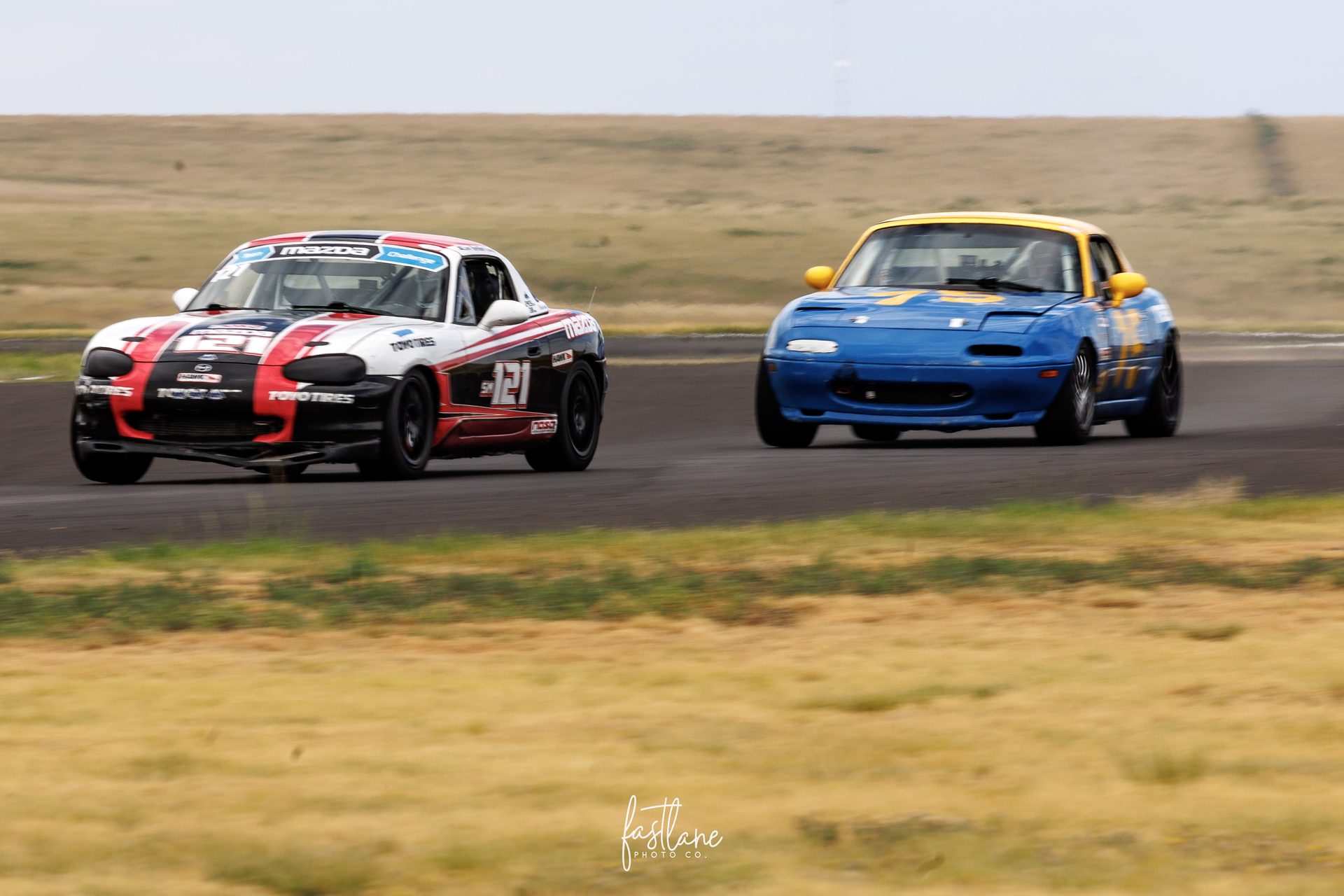 #121 out front of a rival Miata at High Plains Raceway. This is what most of a Spec Miata race looks like — someone in your mirrors, all weekend.
1. You can't buy a mistake back
This is the big one.
Spec Miata cars run between roughly 2,275 and 2,450 pounds depending on engine and year, and published builder dyno numbers for a fresh legal motor land around 127 to 128 horsepower. That ratio changes how a mistake feels.
Blow an apex in a powerful car and you stand on the throttle. The engine erases most of it before the next braking zone. Blow an apex in a Miata and you carry that error the entire length of the straight. Then you carry it into the next corner because you're now off your line and out of the draft.
So you stop chasing the last five feet of braking and start chasing minimum corner speed. You learn to release the brake instead of dropping it. You learn that smooth isn't a personality trait, it's a lap time.
That habit shows up again in every car you drive later. Drivers who learn it in a fast car usually don't learn it at all.
2. Racecraft, because nobody drives away
Mazda calls Spec Miata the most popular road racing class in the world, and puts it plainly on their grassroots page: between SCCA and NASA, there is not a more raced car.
That popularity is the second lesson. Big grids mean traffic in every single session.
And because the cars are near-identical, you cannot escape. There's no straight where you pull three car lengths and disappear. You will spend an entire race within a second of somebody, which means you're forced to learn things a lonely race never teaches:
- How to use a draft, and how to time the pull so you arrive at the braking zone with the pass already half done
- How to defend without blocking — one move, taken early, held
- How to be predictable, because unpredictable drivers get hit and hit drivers get parked
- How to lose a position on purpose to set up a better one two laps later
Most classes give you this eventually. Spec Miata gives it to you on lap two of your first race, whether or not you're ready.
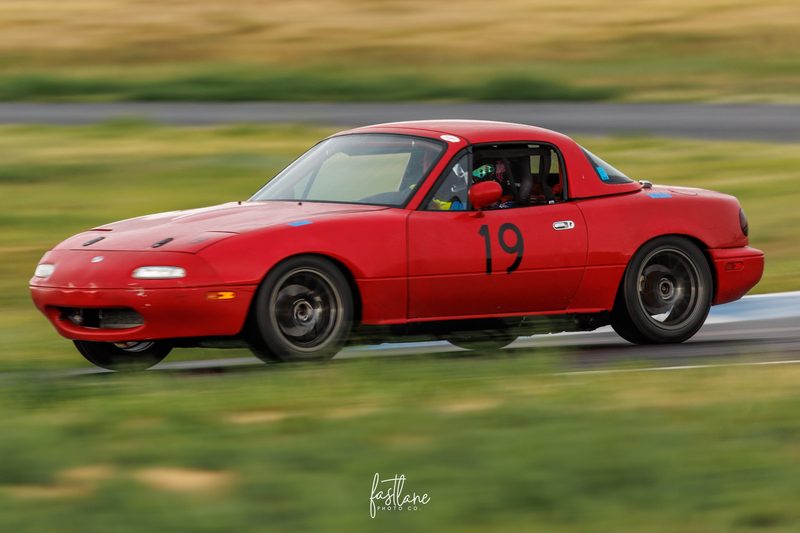 Momentum is the whole game. The #19 carrying every bit of it through High Plains Raceway.
3. The car stops being an excuse
Spec Miata rules are deliberately tight. Fixed 15x7 wheels, a spec tire, spec shocks and springs, and a very short list of legal modifications. The class exists to keep the cars close, and it works.
That means the gap between you and the guy who beat you by four tenths is not the car. It's you.
The first time you see your data next to a faster driver's, in the same model car, on the same tire, on the same day, is uncomfortable. It's also the most valuable thirty minutes in grassroots racing. There is nothing to blame and nowhere to look but the trace.
That's the honest reason we run Spec Miata as the backbone of Kart to Car instead of something faster. A young driver learns more from a clean, boring, identical car than from a fast one that flatters them.
4. You learn to feel the car, not the aero
There's no downforce here. Grip comes from tires and mechanical setup, which means the feedback loop is short and honest.
Change tire pressure by a couple of psi and you feel it in the first corner. Get the temps wrong and the car tells you in the middle of a stint, not on a spreadsheet afterward. We've written up what we actually run for pressures and how to read tire temps — both of those skills exist because the Miata is transparent enough to teach them.
Drivers who come up this way arrive in bigger cars already able to say "loose on entry, tight from mid-corner out, and it got worse after lap four." Engineers love that driver. Engineers cannot do much with "the car feels weird."
What Spec Miata doesn't teach you
Being honest matters more than selling the class, so here's the other side.
Spec Miata will not teach you high-speed aero balance, because there isn't any. It won't teach you a sequential or paddle gearbox. It won't teach you a 160-mph braking zone, or pit stops, or managing a tire over a two-hour stint.
Those are real gaps. If your goal is single-seaters specifically, we broke down that fork in Spec Miata vs. Formula 4. And the wider ladder, with the actual published scholarship numbers, is in our karting to pro racing guide.
But every one of those gaps is a skill you can add later, on top of a foundation. Momentum and racecraft are not. Those get built early or they get built badly.
Why the ladder keeps starting here
Mazda's own driver development path runs straight through this class. Teen Mazda Challenge, for drivers roughly 13 to 20, feeds into the Idemitsu Mazda MX-5 Cup, and Mazda points to drivers like Elliott Skeer and Nathanial "Sparky" Sparks as having come up that road.
That path exists for a reason. Not because the Miata is fast, but because a driver who's fast in one has nothing left to hide behind.
If you want to find out where you actually stand, the honest answer is racing a real Spec Miata with data every session. Our arrive-and-drive seats go by the full season (six NASA Rocky Mountain events, paid in full before the season starts, no damage deposit), and pricing depends on the car and package, so it starts with a call. No guessing, and no car to buy first.
Sources: Mazda Motorsports — Spec Miata, Mazda Motorsports — Grassroots Club Racing, Spec Miata class specifications, NASA Road Racing. Weight, wheel and tire specifications and the class modification philosophy verified against published class references as of September 2026; the 127-128 horsepower figure is a published builder dyno number for a fresh legal engine, not a class maximum. Everything else here is what we've learned running these cars ourselves.
Do you believe?