
Almost every sponsorship pitch I read opens the same way. Class, championship position, best finish, fastest lap. The racer leads with the thing they're proudest of and assumes the brand cares about it as much as they do.
They don't. Not first, anyway. A marketing manager reading your email is going to look for three completely different numbers before they get anywhere near your lap times.
Here they are, in the order they matter.
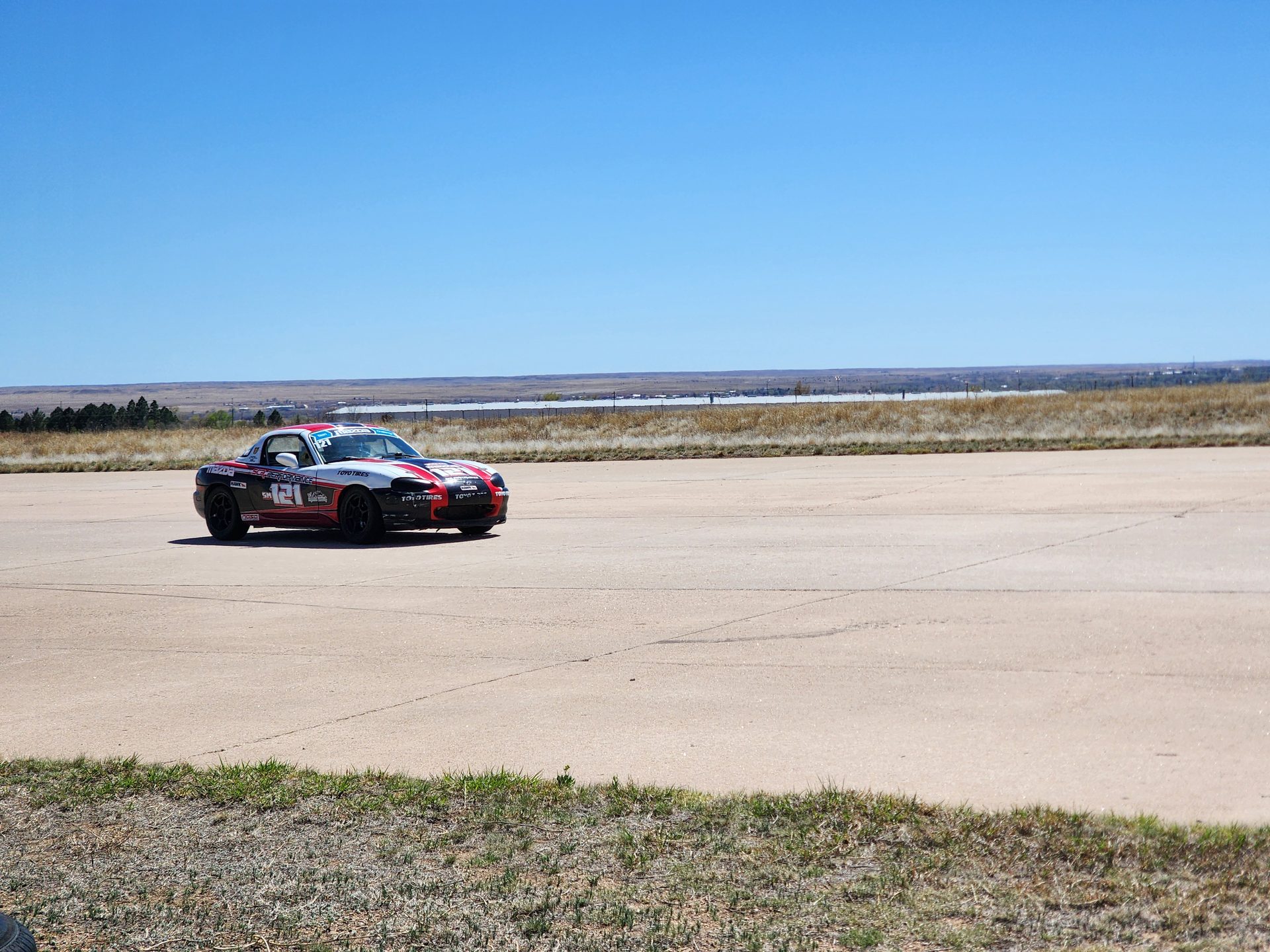 Our #121 Spec Miata. The car is what you're selling. The numbers are what makes it buyable.
Why the order is backwards from what you'd guess
The person reading your pitch has a job, and their job is not motorsport. Their job is to spend a marketing budget and then explain to someone above them why that was a good idea.
That second part is harder than it sounds. RTR Sports, a motorsport sponsorship agency, points to 2024 Forrester research finding 76% of brands struggle to justify sponsorship ROI. Three out of four. So when your email lands, the reader isn't asking "is this racer fast?" They're asking "can I defend this in a meeting?"
Every number below is a number that helps them defend it.
Number 1: Who your audience actually is
Not how many. Who.
RTR's own decision framework for brands puts audience overlap at the top of the list — before objectives, before activation, before anything. The first real question is whether the sponsor's target customer and the racing audience are the same people. Their framework cites NASCAR's roughly 75 million US fans and the fact that 71% of them actively choose sponsors' products. That number is the whole argument for motorsport as a category.
It's written for brands weighing a $500,000 rights fee. The questions are identical at $500.
So give them the answer before they ask. For our platform, that's around 24,000 Instagram followers, concentrated in Colorado and the Rocky Mountain region, skewed toward car-obsessed men roughly 18 to 40, plus the parents of teenage drivers. That's specific enough for a local tire shop or a hydration brand to picture their customer in it.
"I have 24,000 followers" is a stat. "24,000 people who buy performance parts and live within two hours of your store" is an argument.
Number 2: Your engagement rate
Follower count is the number racers brag about. Engagement rate is the number that tells a brand whether the followers are real.
Published 2026 benchmarks land in a consistent place. Accounts under 10,000 followers average around 7%, with micro accounts in the 10,000 to 50,000 range near 3.5%, while big macro accounts fall to under 1%. Generally, above 1% is fine and above 3% is excellent.
Read that again, because it's the best news in this whole post. Small accounts win this metric. A 4,000-follower racer with a 6% engagement rate is a better buy than a 200,000-follower account at 0.5%, and any competent marketer knows it.
The formula is simple. Add your likes, comments, saves and shares on a post, divide by your follower count, multiply by 100. Do it across your last ten posts and average it.
If that average is good, lead with it. If it's ugly, don't include it — go fix it first, then include it. The audience-value calculator and sponsor tracker inside The Get-Funded System do this math for you and keep the result somewhere you can grab it mid-pitch, which is the point.
Number 3: The number they'll be graded on
This is the one nobody sends, and it's the one that closes deals.
Sponsorship buying has moved hard toward measurable outcomes. One 2026 industry review describes sponsors now expecting hard metrics — qualified leads, pipeline, and revenue influenced — with attribution reporting, not vague exposure. RTR's framework says the same thing from the brand side: a sponsor should walk in with three specific, measurable KPIs they can hit inside twelve months.
Most racers hand a brand zero.
So hand them one. Pick a single trackable outcome you will actually deliver:
- A discount code with their name on it, and the redemptions reported back
- A tracked link in your bio and every recap post, with monthly click numbers
- Two in-store or at-track activation events with a headcount
- A named number of content assets they can reuse on their own channels
You do not need to promise revenue. You need to promise something countable, then count it. That's the difference between "we'll give you exposure" and "you'll get a report."
A brand doesn't buy a logo spot. They buy a number they can put in a slide.
That's also why the deal isn't over when the check clears. The activation menu and the reporting templates in the $67 Get-Funded System exist because delivering proof is what gets you renewed at a higher number next season — and renewal is where grassroots sponsorship money actually lives.
So where do lap times fit?
Fourth. Genuinely fourth, and still important.
Results are your credibility layer. They prove you're a real competitor running a real program, not someone with a Miata and a dream. They matter enormously to endemic sponsors — tires, oil, parts — because on-track performance is the product demonstration.
But results are the reason a brand trusts you to deliver. They are not the reason a brand pays. Plenty of mid-pack racers hold partnerships that faster drivers in the same paddock never landed, because they showed up with audience data and a deliverable instead of a trophy photo. I made that whole case in why you don't need to be fast to get sponsored.
Put your results in the pitch. Just stop putting them in paragraph one.
Build the three numbers this week
Give yourself one hour. Open your Instagram insights and write down your follower count, your top three geographic markets, and your age and gender split. That's Number 1.
Average the engagement on your last ten posts. That's Number 2.
Then decide the one countable thing you'll deliver and how you'll report it. That's Number 3.
If you want the pricing math that turns those three numbers into an actual dollar ask, we ran ours out loud in what a race team's sponsorship is actually worth.
And if you'd rather not build the spreadsheets, the media kit, and the activation menu from scratch, that's the whole reason The Get-Funded System exists — the complete method, the calculators, the tracker, the live media kit, and 16 sellable deliverables, for $67. It's the cheapest thing in racing that has a chance of paying for your season.
Not ready to spend anything? Start with our 25 free sponsorship email templates and put your three numbers into one of them tonight.
Your lap times get you respect in the paddock. These three numbers get you funded.
Do you believe?
Sources: RTR Sports — Is Motorsport Sponsorship Right for Your Brand? The 2026 Decision Framework, AttendZen — Sponsorship in 2026: From Brand Visibility to Data-Driven Partnerships, Nowadays — Engagement Rate Benchmarks 2026 by Follower Tier, Virallized — Good Instagram Engagement Rate 2026. Benchmarks verified against published 2026 figures as of August 2026. The Forrester and NASCAR figures are as cited by RTR Sports. LFR's audience numbers are our own real platform data, and I'd never quote a number I couldn't defend.