
Most sim racers own the wrong tools for the goal they actually have.
They chase a stiffer wheelbase and a fourth monitor. Meanwhile the tool that would make them faster on a real track sits unused in a folder. If your dream is a real race car and not just a higher iRating, some of your rig matters a lot and some of it matters almost none.
Here's the honest breakdown of what carries over.
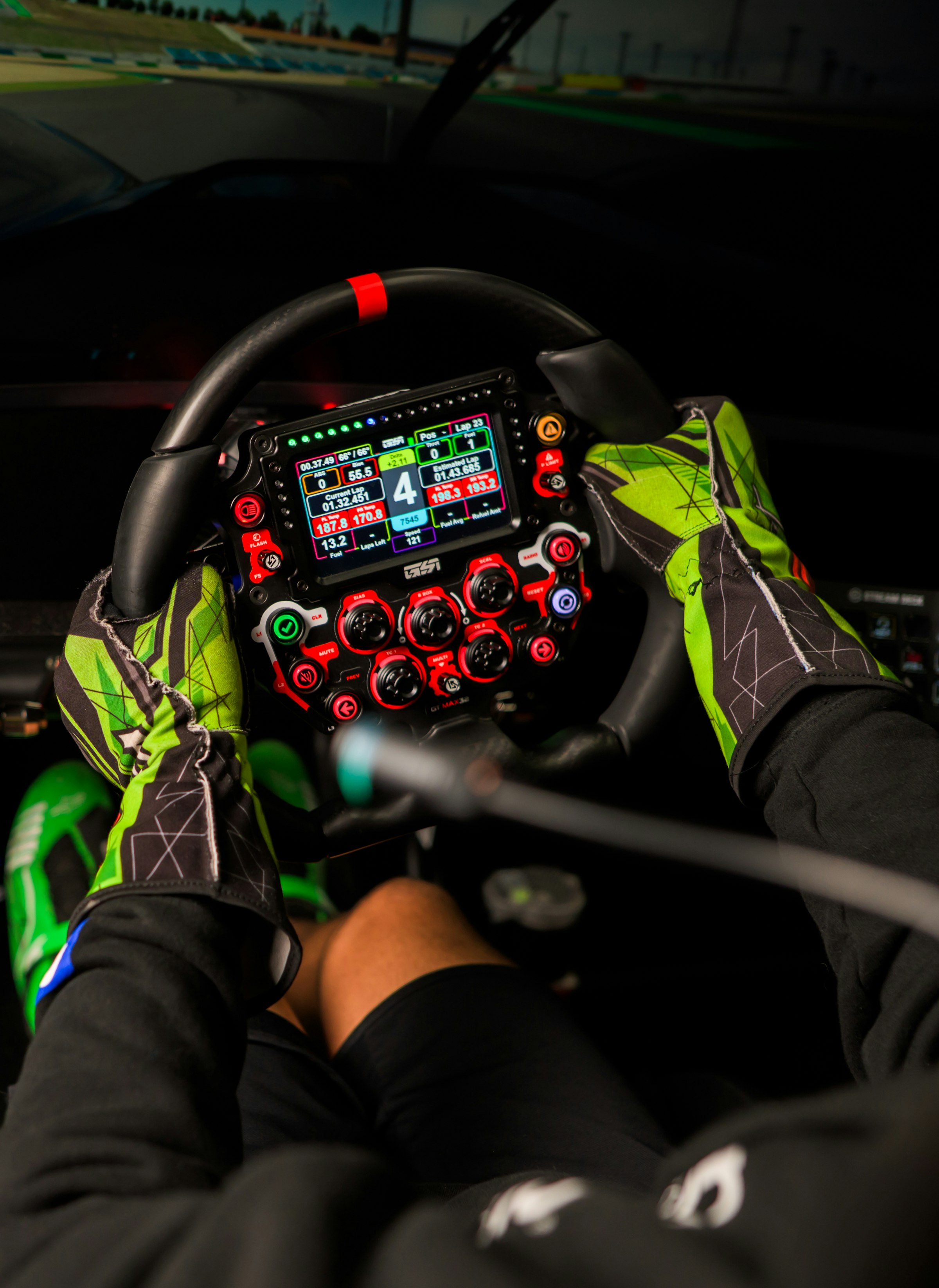 Photo by Pro Motion Media on Unsplash.
1. Telemetry Software (The One That Matters Most)
If you only take one thing from this post, take this. The single most transferable tool in sim racing is telemetry analysis.
Here's why. The software that real race engineers stare at all weekend is MoTeC i2. It reads brake traces, throttle traces, steering angle, speed, and where you're losing time turn by turn. And both iRacing and Assetto Corsa Competizione export straight into MoTeC i2 for free.
That means the exact workflow a pro uses to debrief a real session is the one you can run tonight from your desk.
You learn to read a brake trace and spot where you're braking too early. You see a throttle trace and catch yourself feeding it in too slow on exit. Those are the same numbers, in the same layout, that we look at on a Spec Miata weekend. The tool doesn't know it's a game.
Cosworth even built a Pi Toolbox integration for iRacing so sim data sits next to data from real Cosworth-equipped cars. The industry is treating sim telemetry as real training. You should too.
2. Pedals With Load-Cell Braking
Your brake pedal is the most important input you have in a real car. It's also the one cheap sim setups get most wrong.
A basic potentiometer pedal measures how far you push. A real brake responds to how hard you push — that's pressure, not travel. A load-cell brake pedal measures force, and that's what teaches your leg the thing that actually transfers: threshold and trail braking by feel, not by watching a bar on screen.
Your right leg learns braking as a pressure, not a position. That habit is worth more than any monitor.
If you're going to spend money to get better for real racing, spend it here before you spend it on the wheel. A good load-cell pedal set is the upgrade I'd make first.
3. A Wheel — But Not the One You Think
Everyone obsesses over the wheelbase. A direct-drive wheel feels incredible, and force feedback does teach you something real: it helps your hands sense the front tires loading up and starting to slide.
That part transfers. Reading understeer through your palms is a genuine skill.
But here's the catch nobody tells sim racers. In a real car, most of what you feel comes through the seat and your body, not the wheel. Your hips feel the rear step out a beat before your hands do. So a $1,500 wheelbase past a certain point is diminishing returns for real-world prep.
Get a decent force-feedback wheel. Don't mortgage your season for the top-tier one. The money is better spent on a real test day.
4. VR or a Triple-Screen Setup (For Track Learning)
This one is real, and it's underrated. Learning a track in a sim actually works.
Not from a map — from driving it. When you run 200 laps of High Plains Raceway in a sim, you build reference points. Braking markers. Where the track goes off-camber. Where you can carry more speed than your gut wants to.
VR or a triple-screen widens your field of view so those reference points sit where they'll actually be in the car. A single flat monitor squishes your peripheral vision and makes corner entry harder to judge.
We tell every driver in our Kart to Car program to sim the track before a weekend. It's the cheapest coaching you'll ever get. You show up already knowing the shape of the place, so your first session is spent building speed instead of getting lost.
5. A Simple Practice Log (The Free Tool Everyone Skips)
You don't need to buy this one. You need to actually do it.
The fastest sim racers who make the jump to real cars treat practice like training, not entertainment. They set one goal per session. They log what they worked on. They review the telemetry after, not during.
Here's a workflow that carries straight over to a real weekend:
- Pick one corner or one skill per session
- Run it, then pull the telemetry and compare to a faster reference lap
- Write down the one thing you'll change next time
- Repeat
That's a debrief. It's the same loop we run at the track, just without the cost of tires and fuel. If you build the habit now, you'll walk into your first real weekend already knowing how to learn from data instead of vibes.
What Doesn't Translate (Save Your Money)
Some gear is fun and adds almost nothing to real-world skill:
- A fourth monitor. Cool. Doesn't make you faster in a car.
- Fancy button boxes. A Spec Miata doesn't have 30 switches.
- A motion rig. It moves the whole cockpit, but it can't reproduce sustained cornering G-load on your neck. Only a real car does that.
- The top-tier everything. Past mid-range, you're buying feel, not skill transfer.
None of these are bad. They're just not where your money goes if the goal is a real race car and not a nicer sim experience.
The Tool the Sim Can't Give You
Here's the honest ceiling. Every tool above builds the mental and technical side. What the sim can never hand you is the physical side — heat, fatigue, fear, and the seat-of-the-pants grip cues that only show up when the car can actually hurt you.
That's not a knock on sim racing. It's the reason the transition still needs a real seat at the end of it.
We wrote a full breakdown of what transfers and what humbles you if you want the complete bridge. Read it before you spend a dollar. The gap is real, but it's smaller for someone who trained with the right tools than for someone who never touched a sim.
Ready to Take Your Sim Skills to a Real Car?
You've done the hard part. You've got the lines, the reference points, and the discipline. The only thing left is the seat.
If money is the wall between you and your first real lap, that's exactly what we built the LeadFoot Racing scholarship to knock down. We want belief to be the barrier — not budget. Get on the waitlist and let's get you off the screen and onto the track.
Do you believe?
Sources: iRacing + Cosworth Pi Toolbox announcement, Coach Dave Academy — Using MoTeC data in iRacing, SimCraft — How realistic is sim racing vs real racing, Fanatec — How game telemetry improves your sim racing skills. Tool details verified against current published info as of July 2026. Any specific claims here are backed by these sources plus my own coaching experience with sim racers making the jump to real cars.