
It's Sunday night. The car is back on the trailer, and you finally open your banking app. The number staring back is a lot bigger than the one you had in your head on Friday.
That gap isn't bad luck. It's a budget that only counted the stuff you remembered. Here's a six-step way to build a race weekend budget that matches reality.
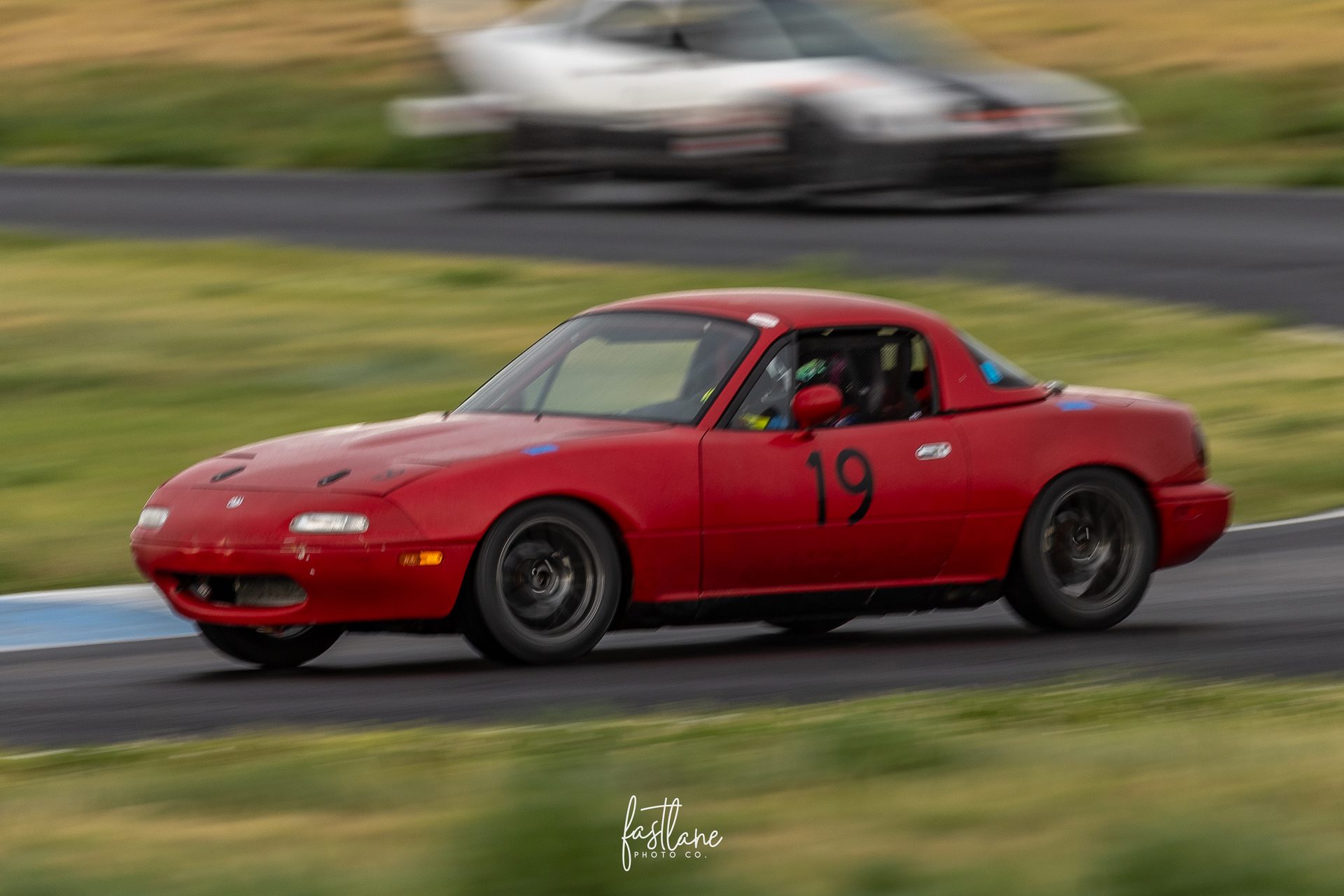 The #19 at High Plains Raceway. Every lap on that track has a line item behind it.
Step 1: Sort Every Cost Into Four Buckets
Most racers budget a weekend as one big guess. Don't. Split it into four buckets, because each one behaves differently.
- Fixed costs. Entry fee, transponder, your share of membership and license. You can know these to the dollar.
- Wear costs. Tires, race fuel, brake pads, fluids. You use them up a little every session.
- Travel costs. Tow mileage, lodging, meals. These depend on the track, not the car.
- The "what if" line. Damage, a broken part, a session you have to re-buy.
Once you see those four buckets side by side, the surprises stop hiding. Most blown budgets come from bucket two or bucket four, and almost never from bucket one.
Step 2: Price the Fixed Costs First
Start with the numbers you can actually look up. They anchor everything else.
Entry is the big one. NASA Rocky Mountain's published schedule has listed a race weekend at $399 early, $449 late, and $499 at the track. Treat that as a floor, since fees move year to year. We budget about $500 a weekend and are happy when it comes in under.
Notice the spread, though. Registering early instead of at the gate saves about $100. That's free money for anyone who plans ahead.
Next is timing. Renting a transponder runs about $80 a weekend at NASA Rocky Mountain. Buying a rechargeable MyLaps TR2 with a year of subscription runs about $210. If you're racing three or more weekends a year, buying wins.
Last, take your annual membership and license fees and divide them by the weekends you plan to run. If you race six times, each weekend carries one-sixth of that bill. It's small, but it's real.
Step 3: Turn Parts Into Per-Weekend Wear
This is where most budgets fall apart. People budget the parts they buy that weekend. They forget the parts they're slowly wearing out.
The fix is one simple formula: what it costs, divided by how many weekends it lasts.
Tires are the biggest example. A mounted race set runs about $1,200. If you put fresh tires on every competitive weekend, that's $1,200 a weekend. If a set honestly lasts you two weekends, it's $600. Either way, it goes on the sheet. I break down how long a set really lasts in what Spec Miata tires cost per race weekend.
Do the same math for brake pads, fluids, and anything else with a life span. The engine and transmission count too. A rebuild might be seasons away, but it's coming. A small slice belongs on every weekend.
For a reality check, one documented lean NASA Spec Miata season spent $930 on race fuel across six weekends. That's roughly $155 a weekend for an experienced driver doing his own work.
Here's our honest ground truth. A competitive Spec Miata weekend on fresh tires is $2,500 or more in consumables alone, before travel or damage. The rock-bottom floor is closer to $1,000 to $1,500. That only works on old tires, with no crashes, doing every wrench turn yourself. Plan for the real number, not the floor.
 Check the bumper. Contact happens in Spec Miata, and your budget should already know that.
Step 4: Price the Drive Like an Accountant
Gas money is not the cost of getting to the track. Your truck wears out while it tows, too.
The honest shortcut is the IRS standard mileage rate. It bundles fuel, maintenance, and depreciation into one number. For 2026, it's 72.5 cents a mile through June and 76 cents from July on.
From Colorado Springs, that works out to roughly:
| Track | Round trip | Cost at the IRS rate |
|---|---|---|
| High Plains Raceway | ~234 miles | ~$169–$178 |
| Pueblo Motorsports Park | ~90 miles | ~$65–$68 |
Meals need simple math, not a guess. Say $15 to $25 a meal, three meals a day, two people, three days. That's $270 to $450. Pack a cooler and you'll come in under it.
Lodging depends on you. A hotel and a tent in the paddock are very different numbers. I compare them in camping at the track vs. a hotel. The full breakdown of the drive itself lives in the hidden cost of race weekend travel.
Step 5: Give the "What If" Line a Real Number
Here's the line almost nobody writes down. It's also the one that ends seasons.
The driver behind that lean season said it plainly: crashes and mechanical failures are the real budget killers. He sets money aside for spares and buys used parts when they're cheap.
I won't hand you a magic percentage. Nobody has published one worth trusting. Instead, size the line to the most likely expensive thing that could happen to your car. That might be a fender and a radiator. It might be a set of tires you flat-spot on Saturday morning. Our breakdown of Spec Miata crash damage costs is a good place to find that number.
Then make one rule. If the "what if" money gets used, refill it before you enter the next race. That single habit keeps one bad weekend from becoming a lost season.
Step 6: Track Actual vs. Budget After Every Weekend
A budget you never check is just a wish. Give your spreadsheet two columns per line: budgeted and actual.
Fill in the actual column Sunday night or Monday morning, while the receipts are still in your truck. After two or three weekends, patterns jump out. Maybe your tires last longer than you planned. Maybe meals always run hot. Adjust the next weekend's budget to match what really happened.
This is also where your sponsor pitch gets sharper. A sponsor can't say yes to "help me go racing." They can say yes to "cover my $500 entry at Pueblo." Line items make that ask easy, which is why I wrote about asking a sponsor to buy one specific thing.
Got a gap you can't close alone? That's the exact problem The First Sponsor System was built to solve. It's the $97 set of working documents we use to fund our own Spec Miatas. It includes a sponsor tracker spreadsheet and a prospect list of companies that actually back grassroots racers.
The Short Version
Price the fixed stuff first. Turn every part into per-weekend wear. Cost the drive with the IRS rate, not the pump. Give "what if" its own real number. Then check actuals every single weekend.
Do that, and Sunday night stops being a surprise.
Ready to turn that budget into a funded season instead of a personal bill? The Funded Season Kit walks you through building a full sponsorship program, step by step. It's $197 once, with a sponsor tracker and ROI calculator built in.
Do you believe?
Sources: No Money Motorsports — How Much Does a Season of Racing Spec Miata Cost?, IRS — Standard Mileage Rates, NASA Rocky Mountain, Pegasus Auto Racing (MyLaps TR2 transponder listings). Entry, transponder, and mileage figures verified as of October 2026 and will drift — check the current event listing before you budget off ours. Tire and consumables figures come from our own published cost numbers and racing experience.