
Four new Spec Miata tires at retail is $924. That's before mounting, before tax, before you turn a single lap.
Tires are the biggest recurring line item in this class. Not the engine. Not entries. Tires. And most people budget them wrong, because the sticker price on a set is not the number that decides what you spend.
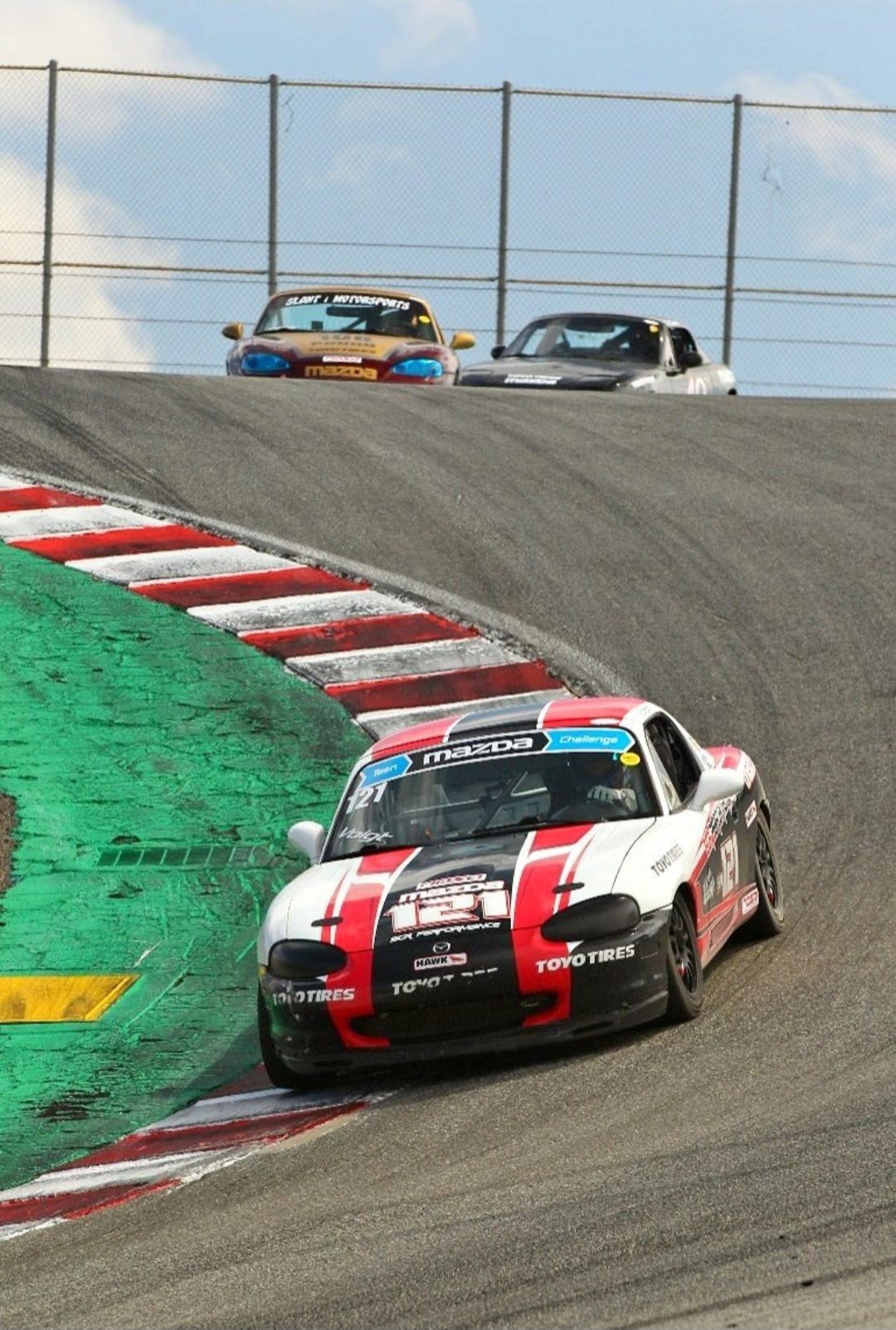 Car #121. Everything that matters in that photo is happening in four contact patches the size of your hand.
What a Set Costs in 2026
Spec Miata is a spec-tire class. You don't get to shop compounds. You buy the tire your sanctioning body says you buy.
| Where you race | Dry tire | Size | Published retail, each | Set of four |
|---|---|---|---|---|
| NASA (2026–2028) | Hoosier RCES | P205/50ZR15 | $231 | $924 |
| SCCA | Hoosier SM7.5 | 205/50R15 | $237 (Frisby Performance Tire) | $948 |
Wet tires are separate. NASA runs the Hoosier SMW for wet-weather competition, and most club racers own one wet set that lasts years because it only comes out a few times.
Retail isn't out-the-door. Add mounting, balancing, shipping, and tax. We budget roughly $1,200 per mounted race set internally, which is about $275 over the tire retail. That gap is the part people forget when they build their first season budget.
Tires are roughly half of what a competitive Spec Miata weekend costs in consumables.
Our own floor for a competitive weekend is about $2,500 in consumables — a set of tires, an entry around $500, fuel, brake pads, fluids, and the small stuff. A realistic DIY weekend lands somewhere between $2,000 and $3,500 if you do your own wrenching. Tires are the single fattest slice of that.
The Number That Actually Sets Your Cost
Your tire cost per weekend isn't the price of a set. It's the price of a set divided by how many weekends you run it.
That's the whole equation, and it's why two drivers in identical cars can be $700 apart on the same Saturday.
Here's what that division looks like. This is arithmetic built from published tire pricing, not a survey of drivers — I'm not going to invent data I don't have.
| How you run | What you buy | Weekends per set | Tire cost per weekend |
|---|---|---|---|
| Front-running, fresh rubber often | New set nearly every event | 1–2 | roughly $600–$1,200 |
| Competitive club racer | One new race set + one used practice set | 3–4 | roughly $300–$450 |
| Budget racer on used tires | Scrubs only, bought used | 3+ | roughly $150 or less |
None of those rows is "wrong." They're three different sports played in the same class.
The thing to understand about tire life here is that "worn out" almost never means bald. A Spec Miata tire gets retired because it stopped being fast, not because it ran out of rubber. On the Toyo Proxes RR that NASA ran through 2025, one long-running Spec Miata blog put it plainly: the tire feels best for about the first six heat cycles, is still quite good through the first dozen, and stays plenty drivable past twenty.
That's a huge window. Where you decide to get off that tire is a budget decision disguised as a performance decision.
The Scrub Tire Economy
The cheapest tire strategy in this class isn't a strategy at all. It's a second set.
Used Spec Miata tires are a real market. At the time of writing, one used-race-tire seller lists 205/50/15 Hoosier SM7.5s at three-quarter tread for $100 each — $400 a set. The No Money Motorsports write-up on running a season cheap describes getting scrubs either free or for $100 to $200 a set when they're lightly used.
So the two-set system works like this:
- Scrubs for practice, test days, and Friday sessions. Nobody hands out trophies on Friday.
- Your good set comes out for qualifying and the race. That's where lap time is worth money.
- When the good set falls off, it becomes next season's practice set. It doesn't go in the dumpster.
Do that and a $924 purchase covers two or three times the track time it would have if you burned it in practice sessions.
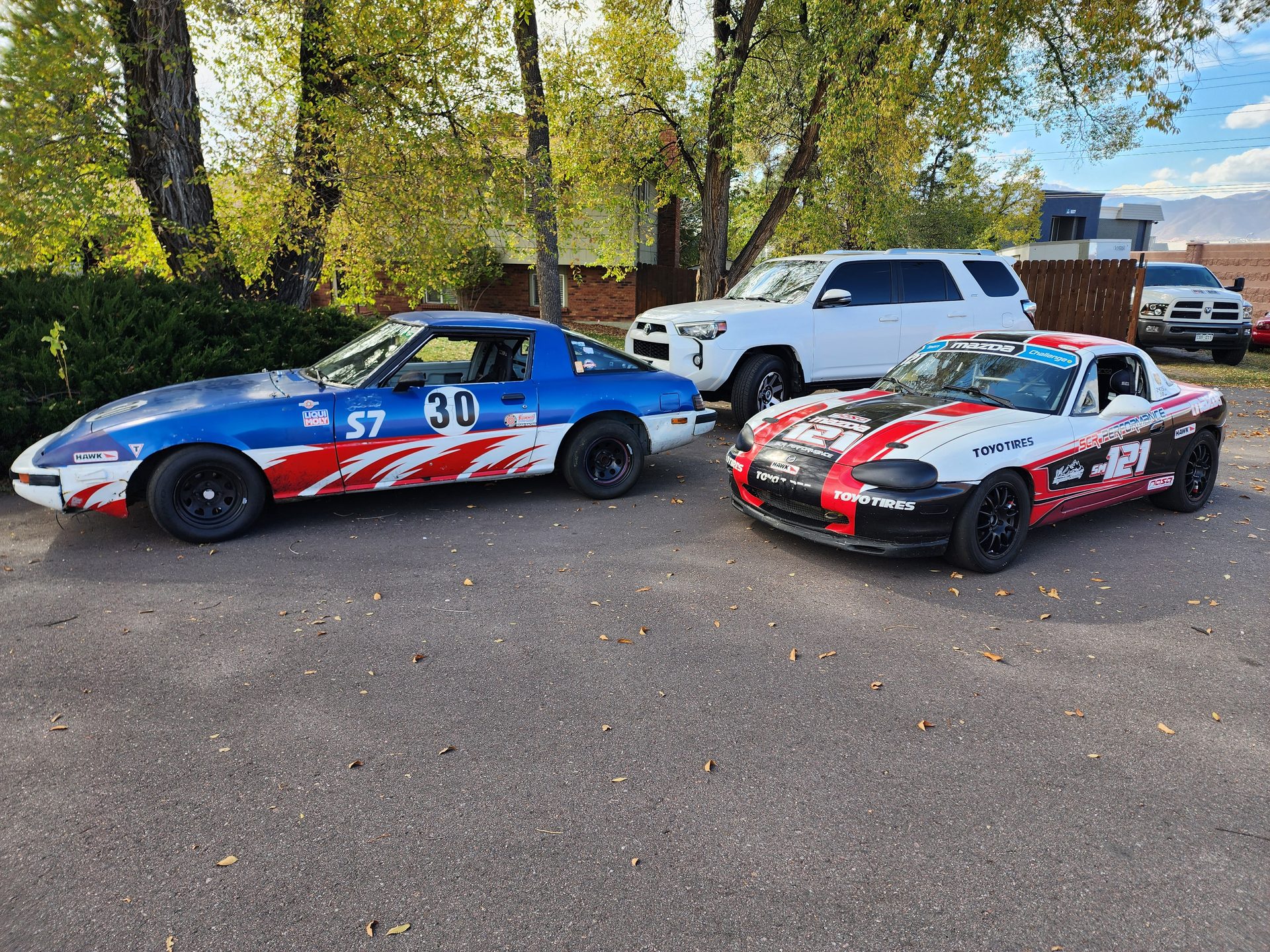 Paddock day. Every one of these cars has a tire budget, and no two of them are the same number.
What Changed for 2026 (NASA Drivers, Read This)
NASA Spec Miata moved to the Hoosier RCES starting in 2026, and it's locked in as the spec tire through 2028. That replaced the Toyo Proxes RR the class had been on.
On the sticker, this is close to a wash. The Toyo Proxes RR in 205/50R15 carried an advised price around $227. The RCES is $231. Four dollars a tire.
The budget impact isn't the price. It's the behavior.
RCES stands for Road Course Endurance Spec, and Hoosier built it around durability and a consistent performance curve across multiple heat cycles. That's the good news for your wallet. The catch reported by drivers who ran the transition is that it's less forgiving than the Toyo once you get it hot — overheat it and performance falls off until the tire fully cools back down.
Translated into money: sloppy tire management costs more on this tire than it used to. If you're driving a car that's pushing, sliding, and cooking the fronts every session, you're not just slow. You're buying tires faster than the guy who's smooth.
That makes two things worth more than they used to be. One is getting your Spec Miata tire pressures right instead of guessing at them. The other is actually reading your tire temps after a session instead of walking past the car. Both are free. Both directly extend the number of weekends a set gives you.
One housekeeping note: transition allowances for leftover tires were handled at the region level. Check with your region before you assume an old set is legal for a given event.
The Money That Comes Back
Contingency is the part of the tire budget nobody explains to new racers, and it's real money.
Hoosier's spec-tire program awards Victory Vouchers in scaled dollar amounts to first- through fifth-place finishers, and also to 10th through 14th when a race has ten or more starters. To be eligible you have to register for the program at the start of the season and run four Hoosier decals on the car. NASA lets you claim right on their website.
Mazda's contingency program runs alongside it. Mazda's published 2026 program spans everything from $100 for a fifth-place autocross finish up to a $250,000 championship prize depending on the series. Pull the current PDF and read the line for your exact class and sanctioning body — the requirements are specific and the decals matter.
The No Money Motorsports season write-up is the honest illustration of what this can do. That author started one season on a set fully earned through the previous year's contingency, then earned a second free set. His summary was blunt: on a budget, "you gotta win to win."
That's the fair caveat. Contingency is a discount for people who are already finishing well. It is not a plan for your first season. Budget your tires like you'll pay full price, and treat vouchers as a bonus when they show up.
Three Ways to Cut Tire Cost Without Getting Slower
1. Stop practicing on stickers. This is the single largest lever and it costs you nothing. Every heat cycle you put into a new set during an open practice session is a heat cycle you don't have on Sunday.
2. Fix the driving that eats fronts. Understeer is expensive. If you're washing out the front tires every session, no tire brand is going to save that budget. That's a line-and-braking problem, and it's why cold-tire discipline on an out lap matters more than people think — I broke that down in cold tires vs. warm tires.
3. Get the service side sponsored. Mounting, balancing, and disposal are boring, recurring, and completely sponsorable. Les Schwab handles that for us, and at our tire volume that partnership saves real money every season. It is not a glamorous deal. It's just a local business trading a service for visibility with a race team in their own town.
That third one is the most repeatable, and it's the one most racers never try. If you want the actual script for walking into a shop like that, the free Local-Business Workbook is the process we use — how to build the list, who to ask for, and what to say when they ask what's in it for them.
Here's the honest bottom line. If you own the car, tires are a permanent, non-negotiable, several-thousand-dollar-a-year subscription, and the only real variables are how many heat cycles you're willing to run and how disciplined your driving is.
If that math doesn't work for you yet, LFR rents arrive-and-drive seats by the full season — car, crew, coaching and data every session, fuel, and hospitality, for six events, paid in full before the season starts, with no damage deposit. Tires are part of the season package, extra sets are an add-on, and pricing depends on the car and package. You still pay for rubber. What you stop paying for is storage, mounting logistics, the spare-set gamble, and the trailer to haul it all.
Get the tire number right and the rest of the season budget stops surprising you. Get it wrong and it eats everything else.
Do you believe?
Sources: NASA Speed News — NASA Selects Hoosier RCES as New Spec Tire for Spec Miata, Phil's Tire Service — Hoosier RCES, Frisby Performance Tire — P205/50ZR15 Hoosier SM7.5, UsedRacingTires — 205/50/15 Hoosier SM7.5, No Money Motorsports — How much does a season of racing Spec Miata cost?, NASA — Hoosier Racing Spec Tire Contingency Program, Mazda Motorsports — 2026 Contingency Awards Program, NASA 2026 Spec Miata Rules. Tire pricing verified against published retail listings as of September 2026 and changes without notice. The per-weekend figures in the table are arithmetic from those published prices, not survey data. Always confirm the current spec tire and any transition allowance with your region before you buy — the rulebook, not this post, decides what's legal.