
Nobody builds a season budget with a crash line in it. Then somebody gets Turn 1 wrong, and your Saturday night turns into an estimate.
Here's the part that actually helps: "a crash" isn't one price. It's three very different prices, and the panic you feel in the paddock usually has nothing to do with which one you're looking at.
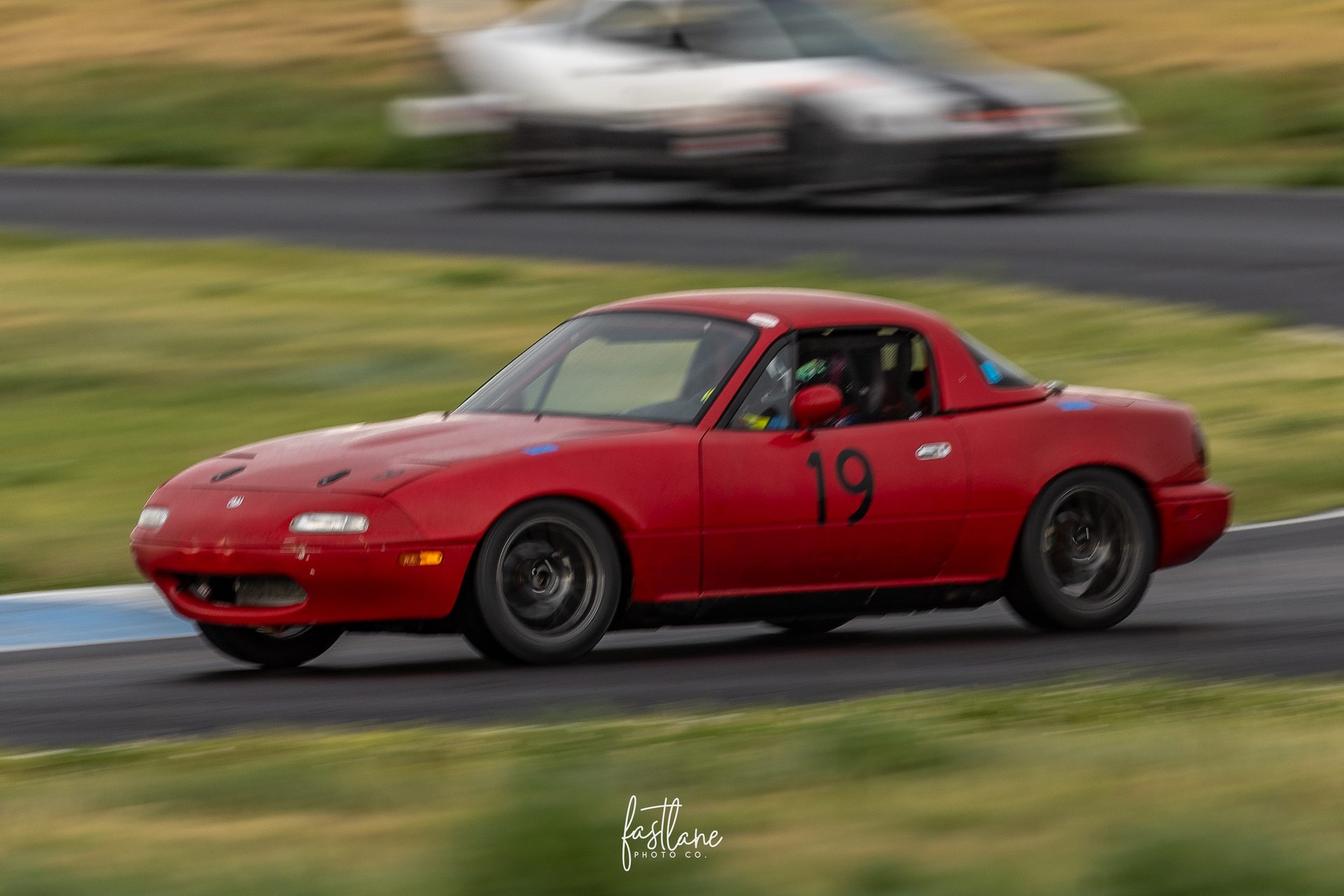 Close company at High Plains Raceway. This is where the bills get written.
Nobody's Insurance Is Buying You a New Nose
Start here, because a lot of new racers get this wrong.
SCCA is direct about it. Their participant accident coverage protects you as a member — and in their own words, it "does not provide coverage for damage to your vehicle." Club racing insurance covers people. It does not cover cars. SCCA does sell a Track Day Endorsement with $10,000 of physical damage coverage, but read the name: it's for track days, not wheel-to-wheel racing.
So when you go door-to-door, you are the insurance company. That's not a reason to be scared. It's a reason to know your numbers. I went deeper on the coverage picture in what racing insurance actually covers.
| Damage tier | What's bent | Rough cost driver |
|---|---|---|
| Body | Fender, bumper cover, mirror, lights | Used and new panels, mostly under $300 each |
| Suspension | Control arms, tie rod, wheel, hub | Cheap parts, expensive diagnosis and alignment |
| Chassis | Frame rails, subframe, cage tube | Shop hours, or a donor shell |
Tier 1: Body Damage Looks Worst and Costs Least
A caved-in nose is the most dramatic-looking damage in this sport and usually the cheapest to solve.
The Miata parts market is deep, because the car has been in production since 1989 and racers have been crashing them for twenty-five years. Ben's Used Miata Parts lists a used bare door shell at $59.95, a front bumper reinforcement bar at $69.95, a hood at $100 for local pickup, and a rear bumper cover at $99.95. On the new side, Moss Miata lists a left-hand front fender for NA cars starting around $202.99, marked down from a $430.39 list.
So the rule in this class is simple.
Replace panels. Don't repair them.
The math isn't close. Body shops charge roughly $60 to $150 an hour depending on your market. Paying three hours of labor to straighten a fender you can buy used is a losing trade on a car nobody is judging at a car show.
Two notes before you order. Spec Miata is a tightly written class, so check the current rules for your sanctioning body before you bolt on anything clever. And Mazda Motorsports discounts stock parts pricing for licensed racers without showing it to the public — if you hold a license, log in before you shop anywhere else.
Tier 2: Suspension Is the Tier That Ends Weekends
This is the tier that quietly costs the most relative to how it looks.
A hard hit on a wheel bends control arms, tie rods, the wheel itself, sometimes the hub. Individually those are cheap parts, especially used. The expensive part is everything after. You now have a corner that doesn't measure the way it did on Friday. Replace the obvious bent thing and go racing, and you'll spend the season chasing a handling problem that isn't in your setup sheet. It's in your geometry.
The honest order of operations:
- Measure before you buy anything. String it, laser it, or put it on a rack. Compare left to right and front to rear.
- Replace what measurement says is bent, not what looks scuffed.
- Re-align and re-corner-weight before the next session, not after you've been slow for two weekends.
- Write it in the logbook. Future you wants the date, and so will a future buyer — that's half the point of keeping a real race car logbook.
Parts might be $150. Getting the corner honest again is the real invoice, and skipping it is the most expensive decision on this page.
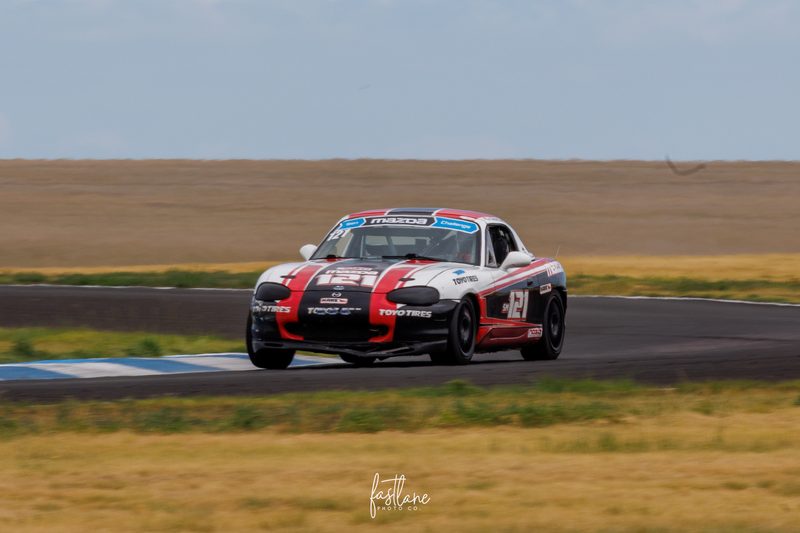 Car #121 on exit. A car that measures straight is a car you can trust on the curbing.
Tier 3: The Chassis Is the One That Can Total the Car
Bent frame rails, a tweaked subframe, or a bent cage tube is a different conversation entirely.
Frame work is shop work. At $60 to $150 an hour on a frame machine, racers report bills from the high hundreds to over a thousand dollars, entirely driven by severity. Nobody can quote this over the phone, and be suspicious of anyone who tries.
A bent cage tube doesn't get straightened. It gets cut out and replaced, because a bent bar changes how the whole chassis behaves. That's real fabrication time. For scale, racers pricing full cage builds on the Grassroots Motorsports forum put pre-bent kits under $1,500, about $700 in raw tubing for an eight-point cage, and roughly 40 hours of labor to install one. You won't pay all of that to fix one tube. You'll pay enough of it to notice.
Weigh that against the car. A race-ready Spec Miata is roughly $10,000 to $35,000 depending on the build. When the shell is genuinely tweaked, the paddock answer is usually to move your good parts onto a straight donor shell rather than pay to make a crooked one straight.
The Costs That Aren't Parts
This is where first-timers get blindsided.
- Your entry is gone. Budget around $500 a weekend, and it doesn't come back because you parked Saturday.
- Your tires are gone too. A mounted race set runs us about $1,200. One session doesn't make it new again.
- Recovery and the ride home. If it can't be driven onto the trailer, somebody gets paid.
- The weekend after. The one you spend under the car instead of on track is a real cost with no invoice.
- The relationship, if there's a sponsor on the door. That's its own playbook — what to do when you damage a sponsor's car.
Those five beat the fender almost every time. Same category as the other hidden costs of owning a race car nobody spreadsheets until season two.
How to Actually Recover
Don't decide anything Sunday night. Photos, notes, go home. Every rebuild decision made in a hot paddock is worse than the one you'd make Tuesday.
Fix in this order: safety, structure, suspension, bodywork. Bodywork is last on purpose. It's the only tier that doesn't change whether the car is safe or fast.
Give the crash a line item before it happens. A racer with a thousand dollars in a crash fund makes calm decisions. A racer without one sells the car.
That fund is where sponsorship earns its keep. A couple of local partners covering consumables is exactly what turns an unplanned repair from a season-ender into a Tuesday. If you want the process we use — the prospect list, the outreach, the one-page pitch — The First Sponsor System is all of it in one place for $67.
Build the spares shelf in the winter. A spare nose, a fender, a set of arms, bought cheap in February, is the difference between missing one session and missing one weekend.
Contact is normal in this class. The fields are close, the cars are equal, and nobody drives away from anybody. That's the fun and the risk, and they're the same thing.
If you'd rather not own that risk while you're learning, that's a legitimate choice. An LFR arrive-and-drive weekend is $5,000 — prepped car, crew, coaching and data every session, fuel, and hospitality. A Driver Evaluation Day is $2,250 if you want a coached test day first. Either way, ask any team you rent from exactly what you're on the hook for if the car gets hit. How straight that answer is tells you who you're renting from.
Own the car and you own the repair. Know the three tiers and you'll never mistake a $200 fender for a season-ending crash again.
Do you believe?
Sources: SCCA — Insurance at SCCA Events: What You Should Know, Ben's Used Miata Parts — Body Panels (NA), Moss Miata — 1990-1997 MX-5 Body Panels, Mazda Motorsports — Spec Miata Parts, Chicago Auto Recon — How Much Do Body Shops Charge Per Hour?, Grassroots Motorsports forum — Roll cage costs. Parts pricing verified against published listings as of September 2026 and changes without notice. Labor, frame-machine, and cage figures are ranges reported by shops and racers, not quotes — severity drives every one of them, and no honest shop will price structural work sight-unseen. LFR entry, tire, and program figures are our own published numbers.