
You bought track day insurance for your HPDE weekends. Good call. Then you finished comp school, got your license, and lined up for your first real race.
That policy stopped working the moment the green flag flew.
Most grassroots racers don't learn this until they're standing next to a bent car with a phone in their hand and a claims rep saying no.
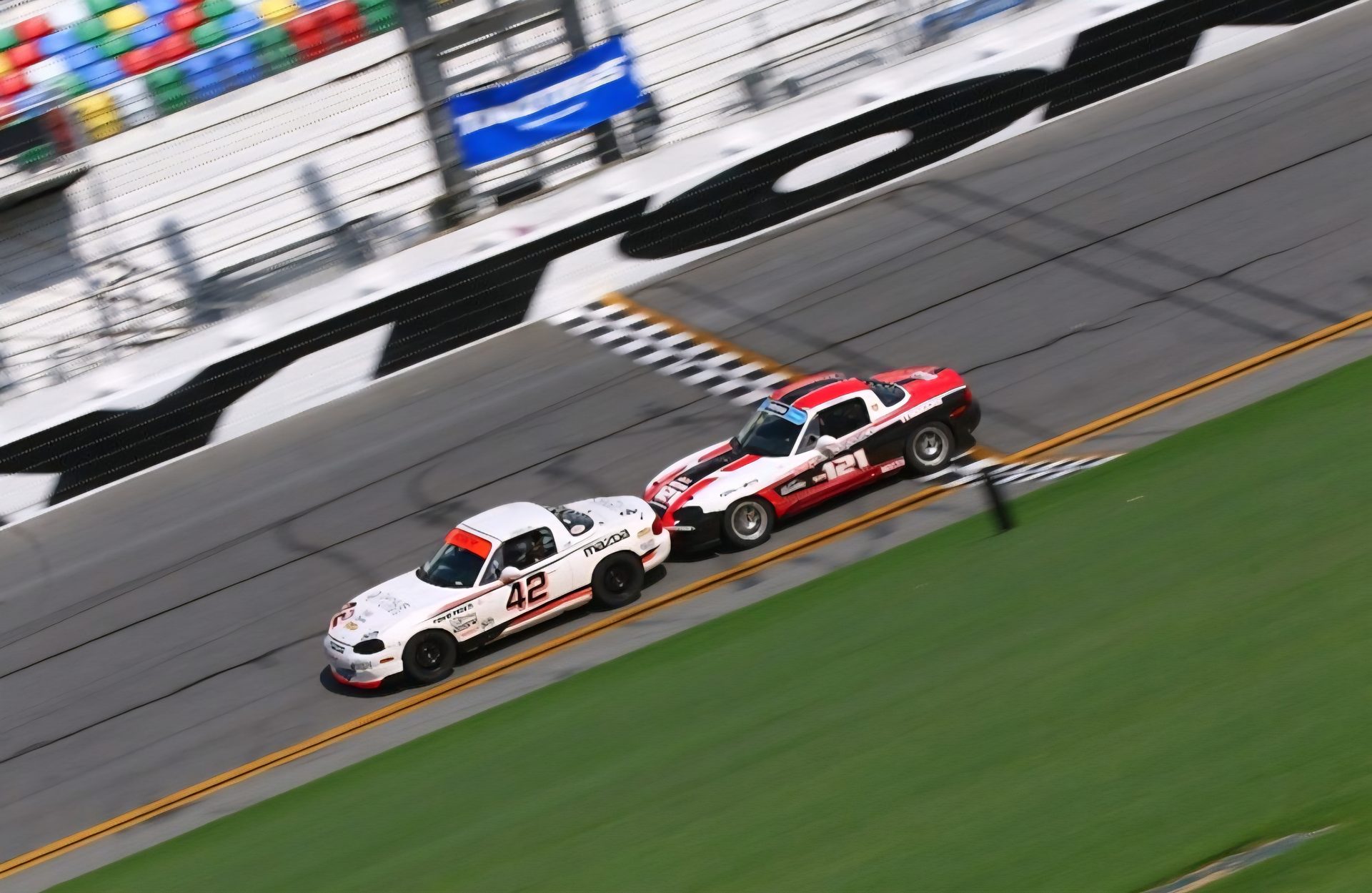 Side by side is where the fun starts and where most track-day policies quietly end.
Track Day Insurance Ends Where Racing Begins
Track day insurance covers physical damage to your own car at driver-education events. Some providers extend it to time trials and autocross. Almost none of them extend it to wheel-to-wheel racing.
Lockton Motorsports, one of the biggest names in the space, writes HPDE, time trial, and autocross. Competitive racing isn't on the menu. Hagerty's track day product is built for non-competition track use, sold per event for up to three days at a time.
This isn't a loophole. It's the whole design of the product. Door-to-door racing is a different risk, and it gets underwritten separately or not at all.
The deductibles tell you how these policies think, too. Lockton's HPDE coverage runs a percentage deductible against the agreed value — 15%, with a $3,500 minimum on cars valued under $100,000. That's built to absorb a written-off car, not a bent fender.
If you're still in the HPDE stage, I broke that whole product down in our post on track day insurance cost and coverage. This post is about what happens after you get your license.
Your Club Membership Covers People, Not Cars
Here's where most of the confusion lives. Racers hear "NASA and SCCA carry insurance" and assume the car is handled.
It isn't. Read what the clubs actually say.
SCCA states that member coverage at sanctioned events includes up to $1,000,000 in medical expense reimbursement, accidental death and dismemberment benefits, emergency medical evacuation, and limited loss-of-income protection. Then it says the quiet part out loud: it does not cover damage to your vehicle.
NASA is built the same way. Membership includes $1 million in excess medical coverage plus third-party liability if someone who isn't participating gets hurt or has property damaged. Excess means it sits behind your own health plan and picks up what your plan doesn't. If you have no health coverage at all, it steps in as primary.
Sanctioning body insurance protects your body and other people. Your race car is on you.
Here's the honest map of who pays for what:
| What goes wrong | Who covers it |
|---|---|
| You get hurt in an on-track incident | Club excess medical, sitting behind your own health plan |
| A spectator or non-participant gets hurt | Club third-party liability |
| Barriers or track property get damaged | Generally the club policy — confirm with your region |
| You crash your own car, wheel-to-wheel | Nobody, unless you bought competition physical damage |
| You and another racer trade paint | Nobody — participants sign mutual releases |
| Trailer stolen from a hotel lot overnight | An off-track policy, if you have one |
| Tools and spares disappear from the paddock | An off-track policy add-on, if you have one |
That fifth row surprises new racers most. Everyone at a club race signs a release, and those releases generally waive claims between participants. It's why a first-lap incident gets settled with a handshake and a beer instead of a claim. Read your event waiver before you sign it — that's the document that governs it.
The Off-Track Gap Nobody Budgets For
Your race car spends maybe twelve hours a year at speed. It spends the rest of the year in a trailer, a shop, a driveway, or a hotel parking lot at 2am in a town you've never been to.
That's where a lot of real losses happen. Trailer overturn. Theft. Something falling off a ramp during loading.
Lockton's off-track policy covers exactly that: physical damage while the car is stored or transported, loss from trailer overturn, damage during loading and unloading, and theft of the vehicle, trailer, and equipment. Deductibles are modest compared to the track-day side — 2% on competition vehicles and trailers with a $500 minimum and $2,000 maximum, and flat $1,000 deductibles on tools and on spares.
Hagerty covers similar ground for race cars in the trailer, in transit, in storage or the shop, and against fire, flood, and theft. Their Motorsports Advantage add-on runs $20 a year and picks up safety equipment, tools, spare parts, and debris removal.
Twenty dollars a year to cover your helmet, your suit, and a toolbox you've spent five seasons filling is the cheapest decision in this entire sport. Do not assume your homeowners policy handles a $1,200 helmet and $3,000 of tools sitting in a trailer 300 miles from your house. Call and ask. Get the answer in writing.
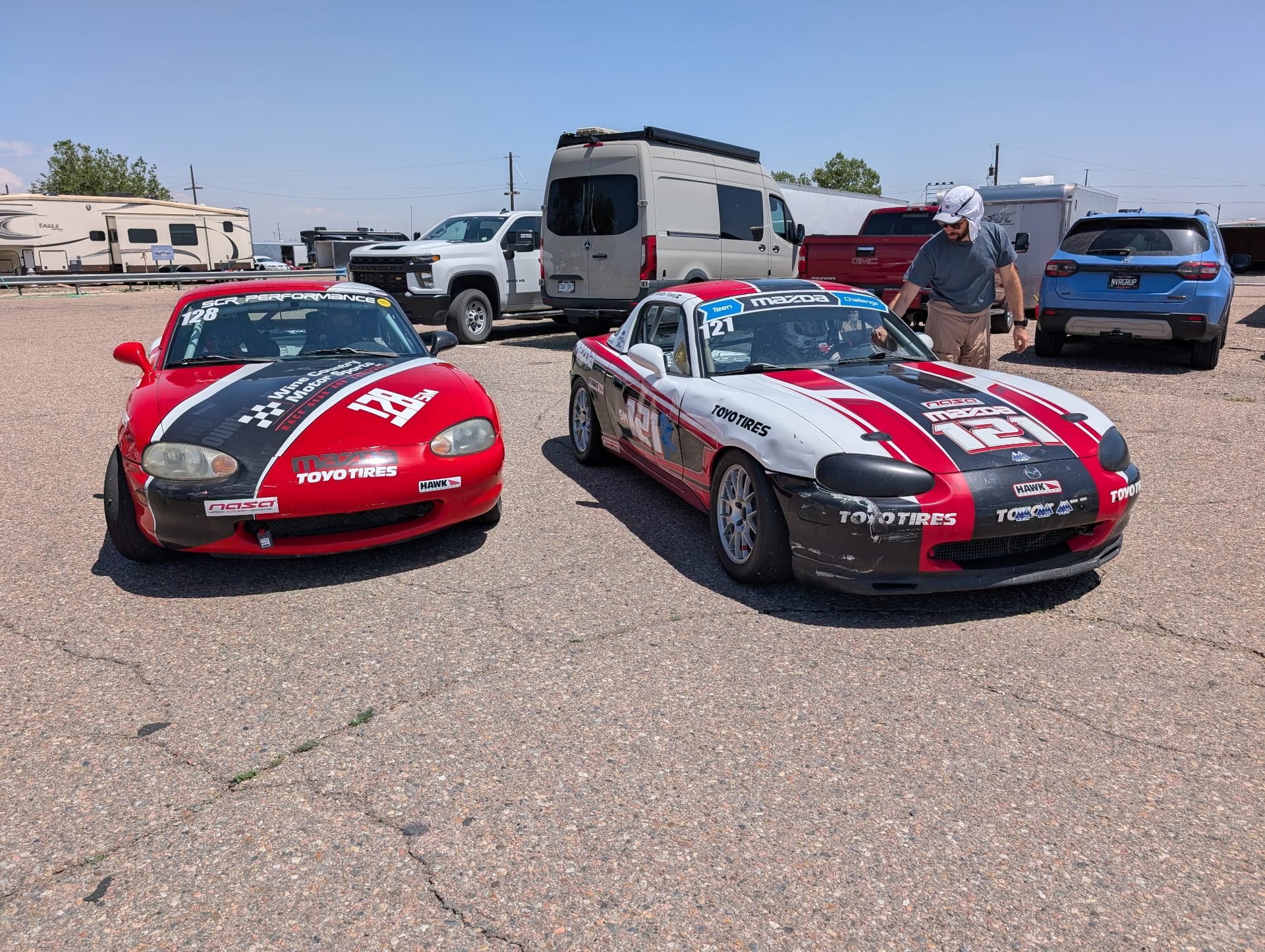 The paddock at night. Most of the year, your biggest asset is sitting still — and that's when a lot of the losses happen.
Three Questions to Ask Before Your First Race Weekend
1. "Does my health plan exclude injuries from organized motorsport?"
Some health plans carry what the industry calls a source-of-injury exclusion, and racing shows up on those lists more often than skiing or cycling do. Club excess medical is designed to sit behind your primary plan, so a gap in your primary plan is a gap you'll feel. Call your insurer, ask specifically about injuries sustained in sanctioned motorsport competition, and get the answer in writing before you need it.
If the driver is under 18, the paperwork stack gets bigger and the parent signs most of it. We walked through that in what parents need to know about racing waivers and contracts.
2. "Can I insure the car during wheel-to-wheel at all?"
Competition physical damage coverage does exist in the specialty motorsports market. It's a separate product with separate underwriting, and availability depends on the class, the car's value, and your record. Get a real quote before you assume the answer either way. Just don't expect your track-day provider to write it.
3. "What's covered when the car isn't on track?"
Trailer, tow rig, tools, spares, safety gear, transit, storage. This is the cheap coverage and the coverage most racers skip. Fix that first.
Self-Insuring Is a Real Answer — If You Actually Do the Math
Most grassroots racers self-insure the race car. That's a legitimate choice, and honestly it's the choice I'd make for a lot of club cars.
But self-insuring means having a number. If you can't write a check tomorrow for what it costs to repair or replace the car, you're not self-insured. You're hoping.
For a Spec Miata, that number is real money. A race-ready car sits somewhere around $10,000 to $35,000 depending on the build, and a hard hit into a barrier can total it. Add the trailer and the tow rig and your exposure gets bigger than most first-year racers have ever thought about. We laid out the rest of that iceberg in the hidden costs of owning a race car.
Here's the uncomfortable part: for most people, the fix isn't a policy. It's a wider budget. A crash fund is the most boring and most useful thing a grassroots racer can build, and the fastest way to build one is money coming in from somewhere other than your own paycheck. That's exactly why we put together the Race-Ready Sponsor List — 50 companies that actually back grassroots racers, for $19, so you're not building a prospect list from a blank page at midnight.
The Short Version
Track day insurance stops at competition. Your NASA or SCCA membership covers your body and other people, not your car. Off-track coverage is cheap and almost nobody buys it. And the car itself, during the race, is usually on you.
None of that should keep you off the grid. It should just stop you from finding out the hard way in turn one of your first race.
Make the three phone calls. Know your number. Then go race.
If the honest answer to "how do I fund a crash fund on top of tires and entry fees" is "I have no idea yet," that's the real problem to solve. The Ultimate Sponsorship Blueprint is $37, and it's the full playbook we use to turn a driver with no contacts into one with funded seasons.
Do you believe?
Sources: SCCA — Insurance at SCCA Events: What You Should Know, NASA NorCal — Why Choose NASA, Lockton Motorsports — Frequently Asked Questions, Lockton Motorsports — Off-Track Insurance, Hagerty — Race Car & Motorsport Insurance, Hagerty — HPDE & Track Day Insurance FAQs. Coverage terms, limits, and deductibles verified against currently published policy pages as of August 2026. Policies vary by state, provider, class, and car value — get a quote and read the actual terms for your exact events before you rely on any of this.