
"Would you sponsor my race season?" is the most expensive sentence in grassroots racing.
Not because it's rude. Because it's unanswerable. No company on earth has a budget line called race season. So the person reading your email has to invent one, defend it, and get somebody above them to sign it.
That's not a yes. That's a project.
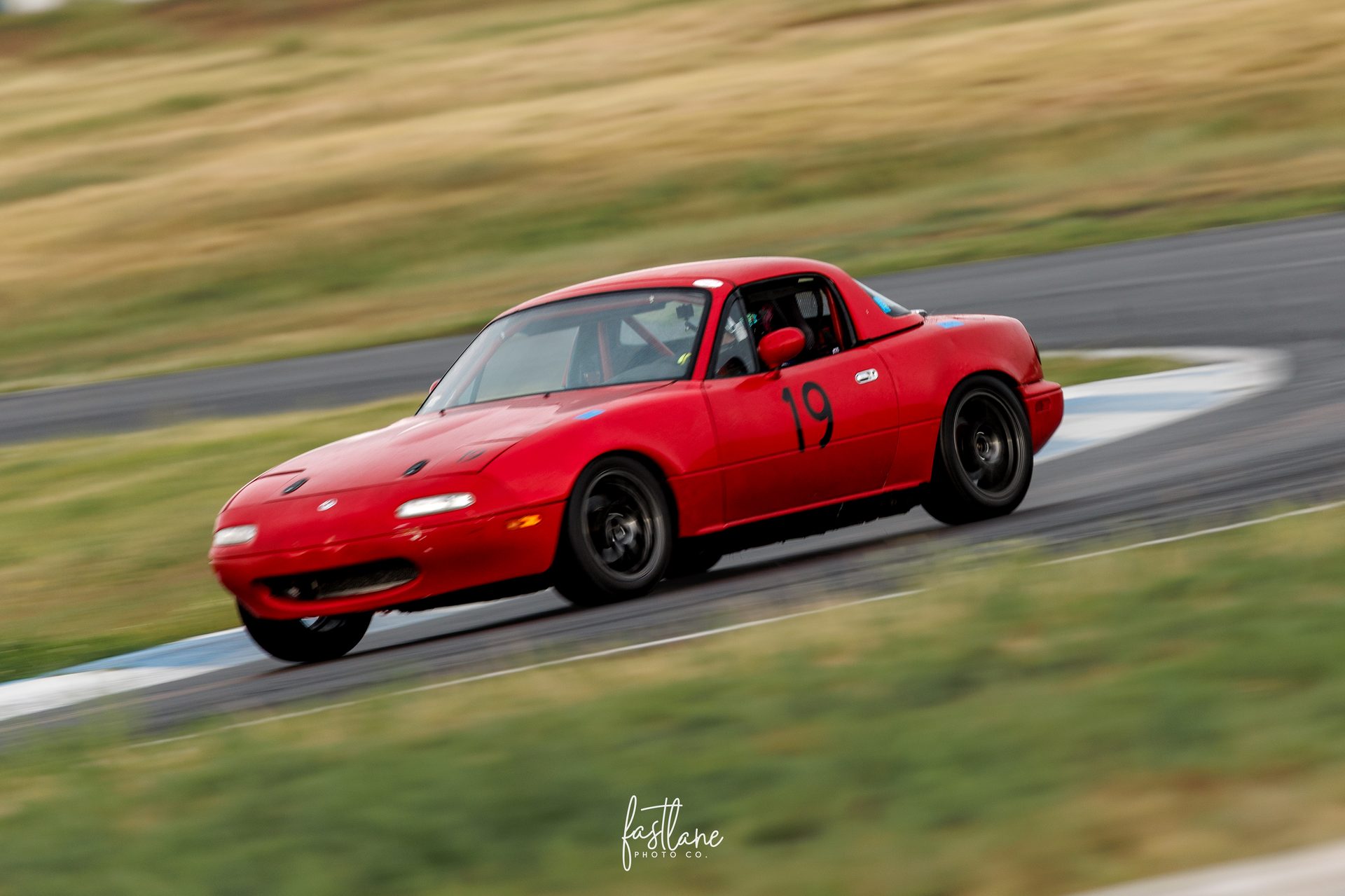 The #19 at High Plains Raceway, August 2026. Photo by Fastlane Photo Co for LeadFoot Racing.
Here's the reframe that changes everything: stop selling your season. Sell one line of your budget.
The Ask You're Making Needs a Meeting
Companies approve money in tiers. The bigger the number, the higher it climbs.
ProcureDesk's published approval-threshold guidance for a 100 to 250 employee company looks like this: under $500 auto-approves against a matching purchase order, $500 to $5,000 goes to a department manager, $5,000 to $25,000 needs a controller or VP of finance, and anything over $25,000 lands on the CFO's desk.
Label that honestly — it's invoice-approval guidance for mid-size businesses, not a motorsports rule. Your local shop with nine employees doesn't run a threshold matrix. But the shape of it is true everywhere, including the shop: small money is one person's decision, big money is a committee.
Now put your ask on that ladder.
A $15,000 season package is a committee, a proposal cycle, and three people who've never met you. A $1,200 set of tires is a manager saying "yeah, do it" and moving on with their Tuesday.
You are not competing against other racers. You're competing against how hard you made it to say yes.
Your Season Isn't One Purchase. It's a Stack of Receipts.
Open your own budget and stop looking at the total. Look at the lines.
For a Spec Miata program, the honest numbers look roughly like this:
| Line item | Real cost | Who it fits |
|---|---|---|
| Race set of tires, mounted | ~$1,200 | Tire shop, auto repair, any local business that wants one obvious decal |
| Weekend entry fee | ~$400–$500 | First-time sponsor, small business, "we just want to help" money |
| Transponder rental for a weekend | $80 | Micro-sponsor, a friend's business, a starter yes |
| A full competitive DIY weekend | ~$2,000–$3,500 | A committed local partner backing one named race |
| An arrive-and-drive weekend with us | $5,000 | A brand buying a finished, reportable event |
Those aren't invented. NASA Rocky Mountain publishes weekend entries at $399 early, $449 late, $499 at the track, with transponder rental at $80 a weekend. A fresh race set runs about $1,200 mounted. A competitive DIY weekend lands around $2,000 to $3,500 once you count tires, entry, fuel, pads and fluids — more if someone else turns the wrenches. Our own arrive-and-drive race weekend is $5,000.
The range is wide because racing is wide. That's fine. What matters is that every one of those lines is a real, checkable price for a real, specific thing — which is exactly what a first-time buyer needs.
Fundraisers figured this out decades ago. Bloomerang's appeal guidance puts it plainly: specific, outcome-tied asks beat vague ones, because "a gift of $50 provides meals for a family for one week" is a decision and "please donate today" is homework. The old underwriting playbook says the same thing from the other side — nearly any discrete endeavor can be pulled out of a general budget and packaged on its own.
Your tire bill is a discrete endeavor. Pull it out.
If you've never mapped your season into fundable pieces before, that's the first exercise inside The First Sponsor System — $67, and it's built around getting one specific yes instead of chasing a season-sized maybe.
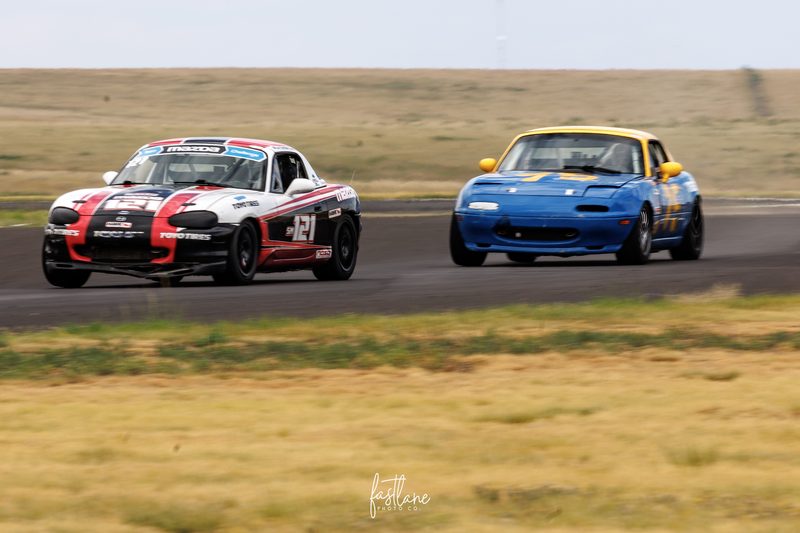 #121 wheel-to-wheel at High Plains Raceway. Photo by Fastlane Photo Co for LeadFoot Racing.
The Industry Already Sells Racing This Way
If line-item funding sounded like a downgrade, look at what the biggest names in the sport already do.
SCCA's 2026 road racing contingency programs are line items with decals attached. Hawk Performance pays product certificates from $150 down to $50. Summit Racing pays $100 down to $50. EBC Brakes pays cash from $50 to $30. Goodyear gives two tires to a winner, Pirelli gives three. Mazda's payouts in select classes run from $600 for first down to $100 for fifth. Every one of them requires the same two things: register in advance, run the decal.
Mazda describes its own program as prize money "valued as low as $100 for a 5th place autocross finish to help keep you on track."
That's a hundred-dollar line item from a car manufacturer. Nobody involved thinks it's beneath them.
The entire contingency model exists because brands would rather buy something small, defined and repeatable than something large, vague and once. Run your pitch the same way.
How to Write the One-Line Ask
Four moves. That's the whole thing.
- Name the item, not the need. Not "support for my season." "One race set of tires for the October weekend at Pueblo Motorsports Park."
- Name the price. The real one. If it's $1,200, say $1,200. A number you can show an invoice for makes you look like a business instead of a fan.
- Name the date. "The tires go on October 9th." A deadline gives the decision a place to land. Open-ended asks die of old age.
- Name what they get, in their language. The decal is the smallest part. Say what they actually receive: the photos, the recap, the named callout, the customers who see it.
Strung together, it reads like this:
"October 9-11 we're racing at Pueblo. The car needs one set of tires for that weekend — $1,200, invoiced direct to you or to the tire shop, your call. In exchange you get the rear quarter panel, your name in the race recap, and licensed photos from the weekend you can use in your own marketing. If it works, we do the same thing in November."
That's 60 seconds to read and one person to approve.
And notice the last sentence. You're not closing a season. You're opening a relationship that can renew four more times.
If writing that paragraph from scratch is the part that stalls you, the outreach templates in The First Sponsor System are already built in this shape — item, price, date, what they get — so you're editing instead of staring.
The Receipt Is the Whole Product
Here's the part most racers skip, and it's the part that turns one $1,200 yes into a real partner.
When they buy a line item, you owe them proof of that line item. Not a generic thank-you post. The actual receipt: here are the tires, here's the weekend they ran, here's what happened, here's the photo with your logo on it, here's the reach it got.
A single specific deliverable is far easier to prove than a season of vague exposure. That's the hidden advantage of the small ask — you can actually fulfill it, completely, and be believed. Then you send the report, and the next ask writes itself. We break down that in-season reporting cadence in what to send a sponsor mid-season.
Two things this post deliberately doesn't do. It doesn't teach you how to value your whole package — how to price racing sponsorship owns that. And it doesn't cover whether to take product instead of cash — product vs. cash sponsorship owns that. This post is only about the shape of the ask.
If you don't know who to point the ask at yet, start with the free Local-Business Sponsorship Workbook. It walks you through finding the businesses within ten miles of you that already spend money on their community.
Make It Small Enough to Say Yes To
The season-sized ask feels bolder. It isn't. It's just heavier, and weight is what kills deals — not price.
Break the budget into lines. Pick the one that's easiest to picture, cheapest to approve, and simplest to prove. Ask for that. Deliver it so well they're annoyed you didn't ask for more.
Then ask for more.
The First Sponsor System is the $67 playbook for exactly that sequence — the prospect research, the line-item package, the email that gets opened, and the report that gets you renewed. It's what I wish someone had handed me before I sent my first pitch and asked for everything at once.
Your tires aren't a dream. They're an invoice. Go get somebody to pay it.
Do you believe?
Sources: ProcureDesk — Invoice Approval Thresholds by Company Size, SCCA — Register for These 2026 SCCA Road Racing Contingency Programs, Mazda Motorsports — Contingency Programs, Bloomerang — Annual Appeal Letters, Raise-Funds — Sponsorships and Underwriting Campaigns. Approval-threshold figures are published guidance for mid-size businesses, not motorsports data, and are labeled as such in the post. Racing cost figures come from NASA Rocky Mountain's published event schedule, current tire pricing, and LeadFoot Racing's own published rates. Verified September 2026.