
Free is hard to argue with. At High Plains Raceway, tent camping in the paddock costs nothing. You show up on a night the paddock is open 24 hours, find a spot, and sleep thirty seconds from your car.
So why does half the paddock still book a room in Bennett?
Because the bed isn't the whole decision. Here's the honest math on both.
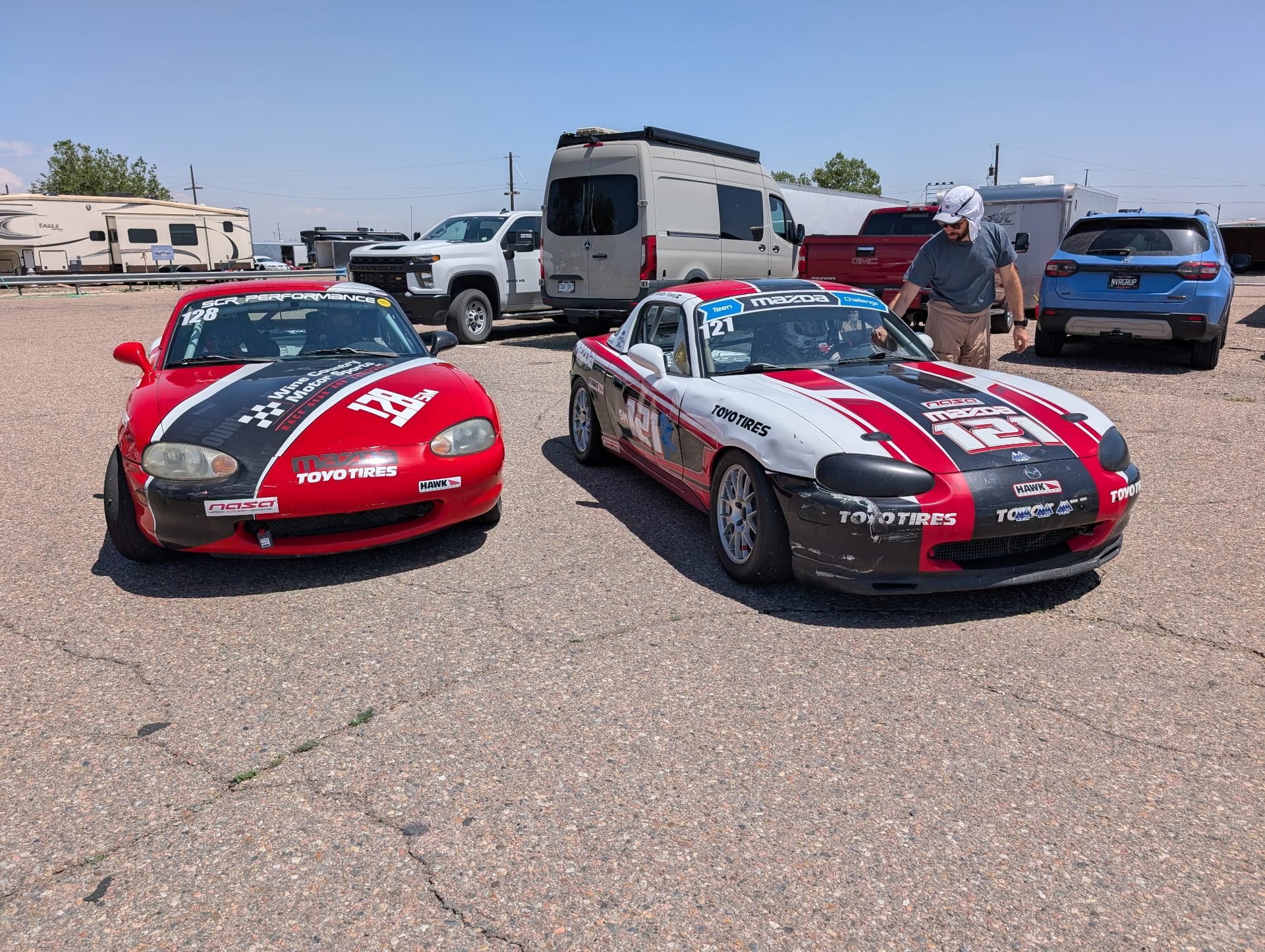
What camping at the track actually costs
At HPR, dry camping is genuinely free. The track publishes about six acres of unreserved paddock for tent and car camping, and they charge nothing for it — though the club hosting the weekend can add its own fee, so read your supps.
Two catches. Overnight use has to be prearranged, and someone has to pay the gate attendant. HPR says the host club usually covers that on Friday and Saturday nights. And you can't drive stakes into the asphalt, so either you're tenting on unpaved ground with permission or you're sleeping in the car.
Want power? That's a rental:
| HPR spot (weekend rate) | Price |
|---|---|
| 30A RV single | $75 |
| 50A RV single | $100 |
| 30A RV pull-through | $150 |
| 50A RV pull-through | $200 |
| 30A carport | $200 |
| 50A carport | $230 |
Those are electricity only. No water, no sewer. The nearest fill-and-dump is a KOA about twenty minutes away in Strasburg.
Pueblo Motorsports Park works the same way for tents — camping in the pit and paddock, no reservation, on nights the paddock stays open overnight. One published PMP event listing prices electrical spots at $25 a day, but confirm that against your own event's registration page rather than trusting a number you read here.
What the hotel actually costs
The room rate is the smallest part of it.
HPR is out in the prairie east of Denver, and the lodging list tells the story. The Longhorn Motel in Byers is fifteen minutes out. The Comfort Inn in Bennett is twenty-seven. Everything else — the DIA-area chains, the cluster in Limon — is roughly forty-five minutes each way.
A hotel near High Plains Raceway isn't really near High Plains Raceway.
Now run that two mornings in a row. Gates open early, grid waits for nobody, and you're setting an alarm for a drive in a truck that gets single-digit mileage. Then you do the same drive back at dusk, after you've been standing on asphalt for twelve hours.
No Money Motorsports puts the hotel add-on at "another $400 into the costs of a track weekend." That's before fuel for the shuttle runs. For context, a competitive Spec Miata weekend already runs a minimum of about $2,500 in consumables — fresh tires, roughly $500 in entry, fuel, pads, fluids. Four hundred dollars of bed is a real line item against that.
Pueblo flips the script. PMP sits inside the city, so the I-25 hotels are minutes away instead of a county away. If you're running our October and November weekends at Pueblo, the hotel argument is much stronger than it is at High Plains.
The part nobody budgets: sleep
Camping only saves you money if you actually sleep.
HPR sits above 5,000 feet on open plain. The sun drops and so does the temperature, faster than flatlanders expect, in June as well as October. Racers on the Grassroots Motorsports forum warn that an uninsulated trailer turns into a refrigerator overnight. Add wind that never quits out there, and a neighbor running a generator forty feet from your head.
A tired driver is a slow driver. Worse, a tired driver is a less safe one, and you're about to go wheel-to-wheel with forty people. Your pre-session warm-up routine can't fix four hours of bad sleep.
So the question isn't "which is cheaper." It's: can you sleep at the track, honestly? Some people can. Some people have tried three times and lied to themselves about it three times.
Who should camp, and who should book the room
Camp if:
- Your trailer or tow rig already has a bed in it. This is the easy yes.
- You're running Friday through Sunday. Three days of commuting is where the drive really stacks up.
- The budget is tight and the tires are old. Four hundred dollars is most of a brake job.
- You genuinely like the paddock at night. That's a real reason, not a soft one.
Book the room if:
- It's your first wheel-to-wheel weekend. You'll be nervous enough. Sleep is worth more than the savings.
- You've got kids along, or a co-driver who has to be sharp.
- The forecast is ugly. Racing in the rain is fine. Sleeping in it isn't.
- You're the one wrenching until 10pm and driving at 8am. You don't get to skimp on both ends.
There's a middle path too. Rent the 30-amp spot for $75, sleep in the trailer or a van with a fan running, and skip the drive without sleeping on the ground.
How to camp at the track without hating it
Most people who swear off track camping did it wrong once.
- Overbuild for cold. A real sleeping pad and a bag rated colder than the forecast. Insulation under you matters more than the bag rating.
- Earplugs and a fan. The fan doubles as white noise against generators. Bring an extension cord if you've got a powered spot.
- Bring your own water. HPR has sinks in the restroom and shower trailers and nothing else — no water for filling buckets, rinsing gear, or washing cars. Plan gallons per person, not sips.
- Check the calendar, not the vibe. Camping is only allowed on nights the paddock is posted open 24 hours. Confirm before you pack a tent.
- Park upwind and away from the generator row. Ten feet of planning buys you two hours of sleep.
- Feed yourself. There's a café on site, but hours vary by event. Cold food that doesn't need a stove has saved more weekends than any tool I own.
We built a free Race Day Ready Pack around this exact problem — checklists for what goes in the trailer and what gets done when, so the stuff you only remember at 9pm on Friday is already on paper. Take it, print it, throw it in the toolbox.
One more thing worth knowing at HPR: paddock speed limit is 10 mph, the sound limit is 103 dBA at the property line, and pets have to be leashed. People are sleeping twenty feet away. Drive like it.
The verdict
Camp most weekends. Book a room the weekends that matter.
For a regular club weekend where the goal is seat time and the budget is tight, the paddock wins — free, thirty seconds from the car, and the community at night is half the reason people race in the first place. For your first race, a long tow like the haul out to HPR, a nasty forecast, or any weekend where you have to be genuinely sharp, spend the $400 and sleep.
And if the $400 is what's actually stopping you, that's the bigger problem. The bed isn't your cost issue. The season is.
The First Sponsor System is the $67 kit we built for exactly that — how to find the local businesses worth pitching, what to send them, and how to turn one yes into a line item that covers entries for the year. Racers are funding tires and entry fees with it. The hotel is rounding error by comparison.
Sources: High Plains Raceway RV/Carport Rental Information, HPR Amenities and Lodging, HPR Facility Rules, Pueblo Motorsports Park listings on MotorsportReg, No Money Motorsports on track camping. Rates verified against published track pages as of September 2026 and can change without notice — always confirm against your event's registration page. Consumable-cost figures are LFR's own season accounting.
Do you believe?