
You're sitting on grid. The car is in gear, belts pulled tight, and there are twenty cars around you that all want the same piece of pavement you do. Your hands are shaking a little.
That's normal. Everybody's first race feels like that. What's not normal is how few people tell you what actually happens next.
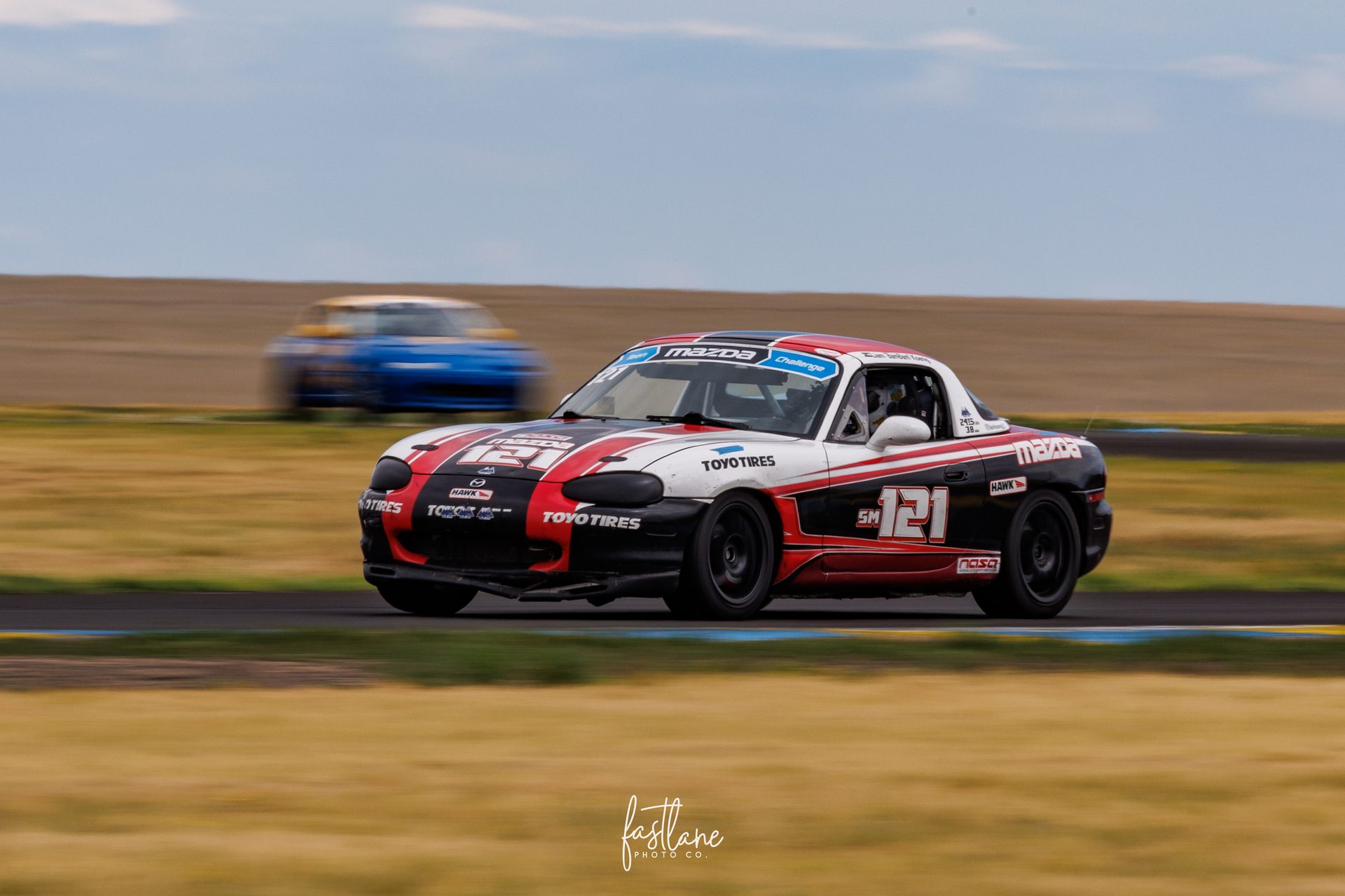 Spec Miata racing keeps your mirrors full. Your first race will feel busier than anything you've done on track.
You're a Rookie on Paper, and the Car Says So
Your first race weekend comes with paperwork that follows you onto the track.
If you go the NASA route, graduating competition school earns you a Provisional Competition License and a Rookie "R" to put on your car. NASA New England spells it out plainly: after four clean races, you earn a full NASA Competition License. After eight races, the "R" comes off the car.
Those two numbers aren't the same thing, and that trips people up. NASA Mid South explains the gap — your provisional book converts automatically once four races are signed off, but the rulebook still calls you a rookie until you've finished eight races without a significant incident.
SCCA works on a similar idea with different math. You race on a Novice Permit and convert it to a full competition license after three successful weekends. Novice identification varies by region, so read your region's supplemental rules before you paint anything on the car.
I wrote the full license walkthrough in how to get your racing license with SCCA or NASA if you're not there yet.
Here's the part I actually want you to hear. That "R" is not a scarlet letter. It's a favor. It tells every experienced driver around you to give you a little more room, and most of them will.
Where You'll Start (Probably Not Where You Want)
Your grid spot comes from qualifying. Fastest lap in the session, in your class, sets the order.
Expect to be near the back. Allen Berg Racing Schools puts it bluntly — new racers should expect to start toward the rear of the field no matter how quick they felt at track days. That's not a knock on you. The people in front have run this track dozens of times and know exactly where the lap is.
Chasing a qualifying position you haven't earned yet is one of the classic rookie mistakes. Qualifying is a traffic and tow game, and I broke that down in Spec Miata qualifying strategy.
For your first one, a good qualifying session looks like this:
- You got a clean lap in without holding anyone up
- You didn't put a wheel off chasing two tenths
- You know roughly where your pace sits in the field
- The car came back with all four corners attached
Starting at the back also has a hidden gift. You get to watch the whole race unfold in front of you instead of having it happen behind you.
The Start Is Louder Than Anything You've Done
Most club sprint races roll off behind a pace car. You form up in your qualifying order, run a lap or two to get heat in the tires and brakes, and the green comes out as the field approaches the line.
Read your region's supplemental rules before the weekend. They define the exact start procedure and where passing becomes legal — and those details differ from region to region.
What nobody can prepare you for is the noise and the compression. Twenty cars accelerate at once. The field concertinas. Gaps you counted on close in half a second.
Your first race is won or lost in the first thirty seconds, and "won" means still being in it.
Do not go hero on lap one. The first corner is where first races end, and it's rarely the fault of the person who ended them — it's the fault of somebody who saw a gap that was never really there. I broke down the specific errors in why new drivers struggle in Turn 1.
Your job at the green is simple. Get through the first corner with the car straight, in one piece, and pointed forward. Then start racing.
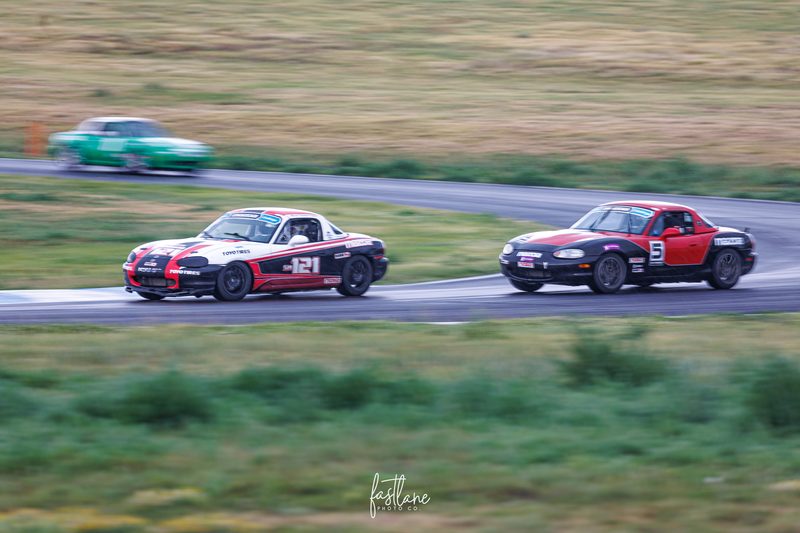 Nose-to-tail is the normal state of a Spec Miata race. Traffic is the class, not an interruption to it.
You're Going to Get Passed, and It's Not Personal
This is the part rookies handle worst.
Somebody will go by you. Maybe several somebodies. Your brain will read that as failure, and you'll start driving angry — braking later than you can support, chasing a car you can't catch, sawing at the wheel.
Allen Berg's guidance is the right medicine: don't take passes personally, and don't run alongside a competitor just to prove a point, because you both lose time doing it. Regroup and drive your own lap.
Two mechanics worth practicing before you need them:
When you're being passed. Breathe the throttle a little before the braking zone and let them go cleanly. You lose a tenth. You keep your car, your fenders, and your reputation.
When you're passing. Present yourself early enough that the other driver can actually see where you are. A pass that surprises somebody is a crash waiting for a slow-motion replay.
And know your flags cold. Getting shown a black flag as a rookie feels like the end of the world, and it isn't — but you do need to know exactly what to do when it happens. Here's what happens when you get black-flagged.
What a Good First Race Actually Looks Like
Let's reset the scoreboard, because the one in your head is wrong.
A good first race has nothing to do with position. It looks like this:
- You finished. Cars that finish get signed off. Cars that don't, don't.
- You were clean. No contact, no off-track excursions, no visit to the steward's trailer.
- Your lap times tightened up. Lap 8 within a few tenths of lap 4 means you're learning the car, not just surviving it.
- You passed at least one car on merit — or defended one cleanly. Either counts.
- You'd get in it again right now. That's the real test.
"One lap does not make a race" is the line Allen Berg uses, and it's true in both directions. One bad lap doesn't ruin your weekend, and one great lap doesn't make you fast.
If you want your first race to be about driving instead of logistics, that's the whole point of our arrive-and-drive program. A prepped Spec Miata, crew, coaching and data every session runs $5,000 for a race weekend, and our $2,250 Driver Evaluation Day exists so you can find out what you've actually got before you buy a car and a trailer. Plenty of people race a full first season without ever owning one.
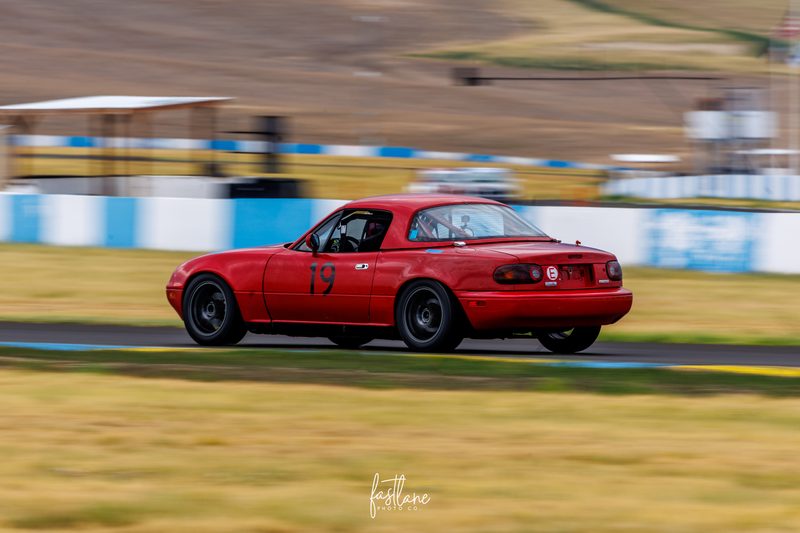 Corner done, on to the next one. That's the whole skill in your first race.
The Hour After Matters More Than the Race
Here's where most rookies waste the most valuable hour of their weekend.
You come in, you're buzzing, you tell the story four times, and then the weekend's over and none of it is written down.
Do this instead. Before you take your suit off, write three things on your phone: one corner you got right, one corner that cost you, and one thing that surprised you about traffic. Then go find your data and see if the car agrees with you.
That's the habit that turns race two into a step forward instead of a repeat. I laid out the full method in the post-race debrief that makes you faster.
Then go get your race signed off. That's how the rookie math starts counting down.
One more thing, and it's the easiest advice in this whole post: don't be up at midnight wrenching. Allen Berg names that as the single worst thing you can do before a first race, and I agree completely. Tired drivers make expensive decisions. If you want the full pre-race timeline, the hour-by-hour race weekend schedule covers it.
Your first race is not an audition. It's the first entry in a logbook that's going to get long.
If you're ready to stop reading about it and go do one, apply to Kart to Car. It's built for drivers coming out of karts and sim racing who want a real race weekend with a crew behind them instead of a project car in the driveway.
Do you believe?
Sources: NASA New England — Competition School, NASA Mid South — Race Licensing, Allen Berg Racing Schools — Getting Ready For Your First Race, GO 4 IT Racing Schools — SCCA Novice Permit Guide. Rookie license rules verified against NASA regional pages as of September 2026; start procedures vary by region and sanctioning body, so always read your event's supplemental regulations. LFR pricing is our own published rate.