
Quarter midget drivers run until they're 16. Spec Miata can start at 13.
Most families never find out those two windows overlap by three full years. They treat 16 like a finish line, sell the car, and then spend a season figuring out a road course from scratch.
Here's the honest audit of what your kid already owns after years on a quarter-mile-scale oval, and what they've never once been asked to do.
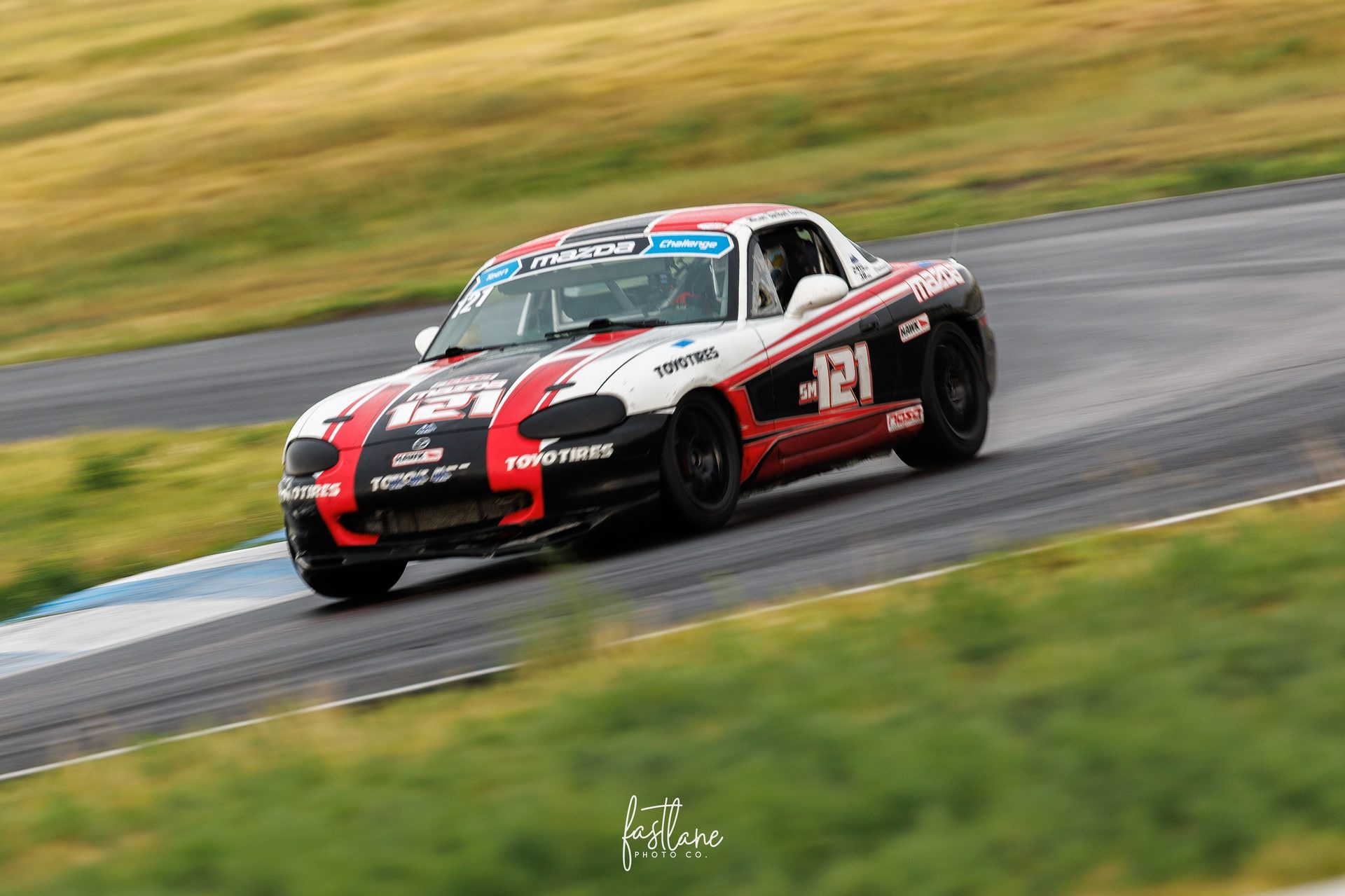 The #121 at High Plains Raceway. Same job as a quarter midget. Almost none of the same inputs.
The Part You Already Paid For
The expensive thing to build in a driver isn't speed. It's comfort in traffic. Quarter midgets build it early and build it hard.
A QMA oval is about 1/20 of a mile, and the line the driver actually runs works out to roughly 366 feet. Average lap: about six seconds. Ten cars are on that piece of pavement at once.
Six-second laps, door to door, all day. Nobody gets a quiet lap to think. As Denise Smutny put it in Performance Racing Industry's karting-versus-quarter-midgets breakdown, "the kids are learning a lot about how to race in traffic."
That's the whole ballgame in Spec Miata. Nobody drives away from anybody. You will spend a 25-minute race inside three car lengths of somebody, and the drivers who panic there are the ones who never learned it young.
Four more things come along for the ride:
- Race procedure. Heats, passing points, lower mains, A main, driver meetings, tech. Published club rules run a full program every race day. A club road racing weekend has the same rhythm — practice, qualifying, race, and paperwork that doesn't care how fast you are.
- Starts and restarts. Forming up, watching the flagman instead of the car ahead, going at the right moment. That skill is worth actual positions in your first car race.
- A car that moves around. Quarter midgets have four-wheel suspension, not a kart's rigid frame. Your kid has already felt a chassis load up, take a set, and step out.
- The family operation. Tow, tools, tech line, entry paperwork, long days. That machine is already built in your driveway.
That list is most of what a rookie racer spends two seasons and a lot of money acquiring. Don't sell it short.
The Four Things That Don't Transfer
Now the honest half.
1. The brake pedal
A quarter midget has a single disc brake on the rear axle. One brake. On the back. On a 366-foot lap where the throttle does almost all of the talking.
A Spec Miata brakes with all four corners, from real speed, into corners that punish a tenth of hesitation. Threshold braking, releasing the brake as you turn in, carrying the pedal to the apex — none of that exists in a quarter midget, and it's the single biggest relearn. We broke the technique down in trail braking explained, and I'd have any oval kid read it before their first test day.
2. The gearbox
Quarter midgets are direct drive. Roller chain, sprocket, no clutch, and the car gets push-started with the driver turning the ignition on once it's rolling.
A Spec Miata is a five-speed H-pattern with a clutch, and you'll be heel-toe downshifting two or three times a lap while also braking and turning. That is a physical skill with a learning curve, and burning track time on it is the most expensive way to learn it.
3. Right turns, elevation, and corners you can't see
On a 1/20-mile oval, you can see the entire racetrack from the seat. Every lap looks like the last one.
High Plains Raceway does not work that way. Neither does Pueblo. There are rights, lefts, crests that hide the apex, and corners that only make sense once you know what's on the other side. Learning a road course is its own skill — here's how we teach the first ten laps at a new track.
4. Race length
Run the math on published numbers. Six-second laps, a main of 15 to 25 laps, and the race is over in about two or three minutes.
A NASA Spec Miata race runs 25 to 30 minutes. In a hot car, in gear, at altitude. It's a different sport for your body, and it's why we push a real fitness plan before anybody's first weekend.
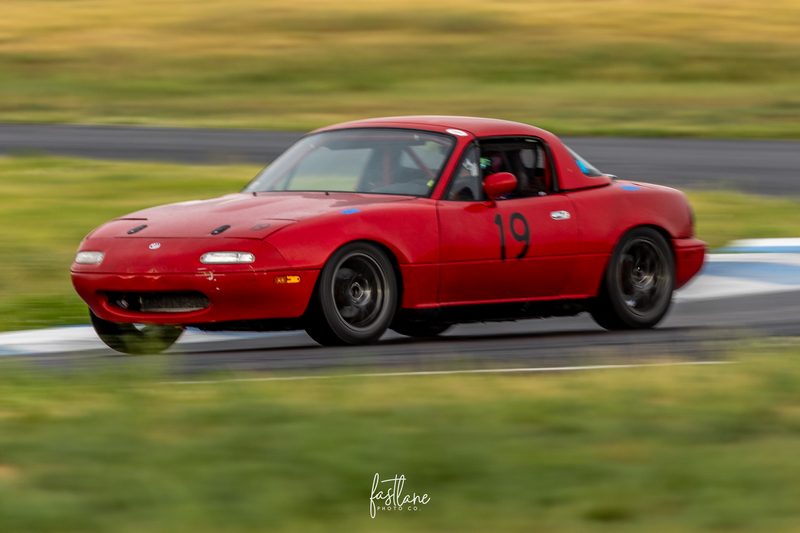 Twenty-five minutes of this. Not two.
| What changes | Quarter midget | Spec Miata |
|---|---|---|
| Track | ~1/20 mile oval | Multi-mile road course |
| Turns | Left only | Both, plus elevation |
| Lap time | ~6 seconds | Minutes |
| Brakes | One rear disc | Four corners, real braking zones |
| Drivetrain | Direct drive, no clutch | 5-speed manual, heel-toe |
| Race length | 15-25 laps | 25-30 minutes |
The Bridge, In Order
If your driver is 13 to 16 and still in a quarter midget, here's the order that wastes the least money.
- Learn the manual gearbox off-track. In a street car, with a licensed adult, somewhere empty. Shifting should be boring before it's ever expensive.
- Build road-course reference in a sim. Not for lap time. For learning what a corner sequence feels like, and for reps at braking points. We laid out how to do that with a purpose in using sim racing to prep for a real weekend.
- Know the age doors. Track days are the one place that gets stricter, not looser — HPDE generally requires 18, or 16 with consent. Wheel-to-wheel through NASA's Teen Mazda Challenge opens at 13. That's backwards from what everyone assumes, and we mapped all of it in what age a kid can start racing cars.
- Get seat time in the actual car, with a coach and data. This is the step families skip, and it's the one that decides whether year one is learning or flailing. Our Driver Evaluation Day is $2,250 — a coached test day in a prepped Spec Miata with a written assessment at the end, and $1,000 of it credits toward a package. It's also the front door to Kart to Car, which exists for exactly this handoff.
- Point at Teen Mazda Challenge. Ages 13 to 25, run inside regular NASA Spec Miata races. Full breakdown in what Teen Mazda Challenge actually is.
Mazda has been running this play for a while. In 2022 they put 30 kart and quarter midget drivers in Spec MX-5s for a two-day coached test with data. The organizers' takeaway was that the car rewards drivers willing to get assertive with it. Oval kids are usually not short on assertive.
What Changes for the Parents
The money changes shape, and I'd rather you hear it now.
Quarter midget equipment is real but small: chassis run roughly $1,500 used to $6,000 new, with engines from a few hundred dollars up to a few thousand. A race-ready Spec Miata is $10,000 to $35,000 for the car alone, before a trailer, a tow vehicle, and somewhere to keep it.
That jump is why so many quarter midget families stop at 16. It isn't a talent problem. It's a math problem, and renting a seat for a weekend instead of buying a program is a legitimate answer to it.
The skills your kid built on a 366-foot oval don't expire. The window to use them while they're still cheap to develop does.
If your driver is aging out and you want a real plan instead of a guess, apply to Kart to Car. We'll tell you honestly where they are, what's missing, and what the next 12 months should cost. If money is the wall, get on the scholarship list — that's what it's there for.
Sources: Quarter Midgets of America, NWOQMRA "What Are Quarter Midgets", Performance Racing Industry: Karting vs. Quarter Midgets, North Georgia QMA racing rules, Mazda Motorsports Spec MX-5 test, and Wikipedia's quarter midget equipment cost figures. Age and licensing details verified against our own 2026 research in what age a kid can start racing cars. Spec Miata costs per our internal cost reference and published LFR pricing. Race-length figures are arithmetic from published lap counts and lap times, not survey data.
Do you believe?