
Somebody at the kart track tells you your kid should "do Teen Mazda Challenge." They say it like you already know what that means. Then they walk away.
Here's the full answer — what it is, who can enter, what you actually win, and what a real season costs. No sales pitch, just the stuff I'd tell a parent standing in our paddock.
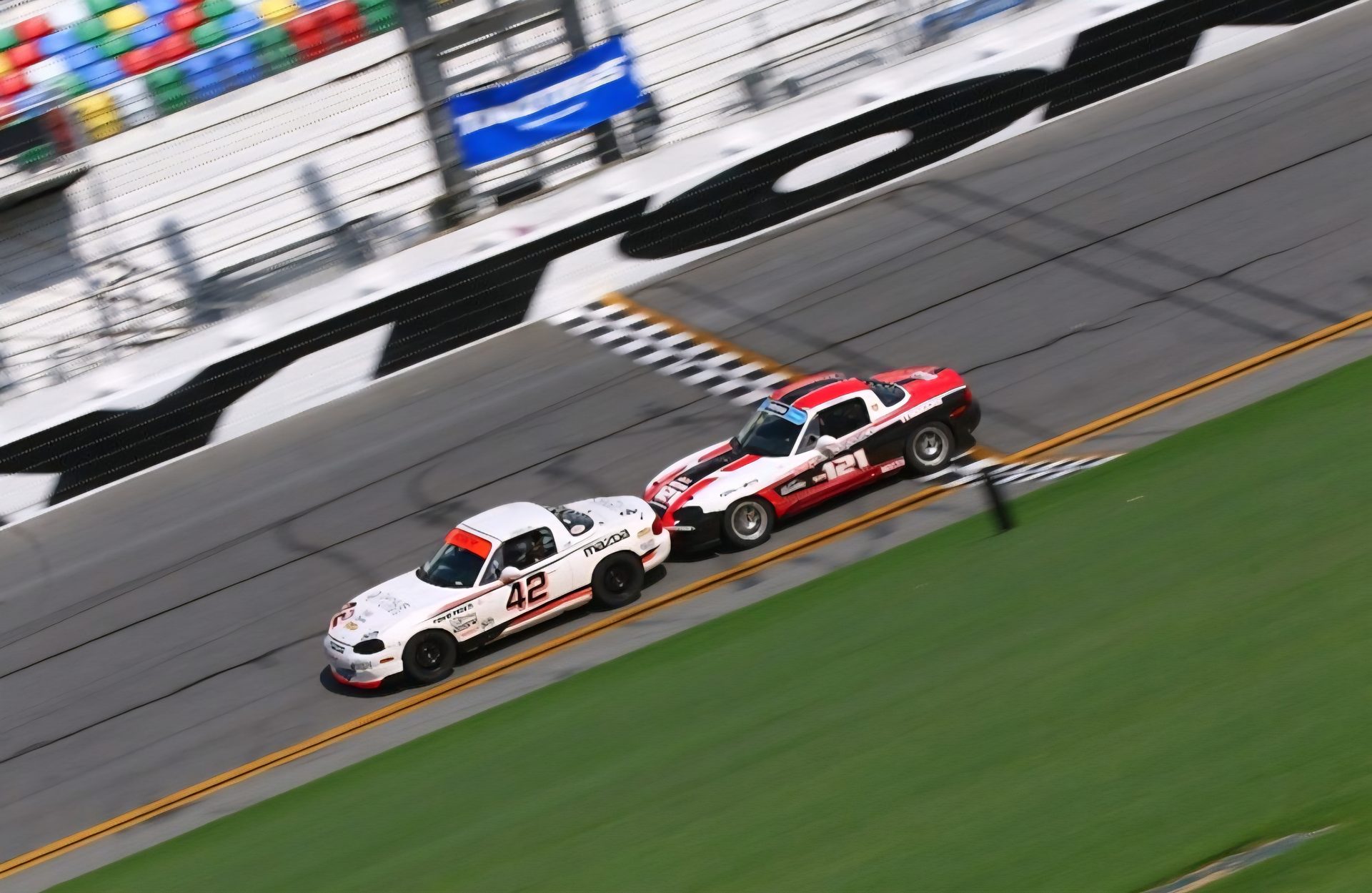 Our Spec Miata, Car #121, racing wheel to wheel. Teen Mazda Challenge runs inside the Spec Miata field.
What Is the Teen Mazda Challenge?
First thing to understand: it is not a separate race.
Teen Mazda Challenge is a young-driver championship that runs inside NASA's Spec Miata race groups. Your kid lines up on the same grid as everyone else — including adults who have been racing for twenty years. Same green flag, same checkered flag.
The difference is the scoring. TMC drivers earn a second set of points on top of the regular Spec Miata results. Those points decide a regional TMC champion in each NASA region, plus a national TMC points champion across all regions.
NASA and Mazda Motorsports built it specifically for drivers coming out of karting who are stepping into full-size cars. It's the most established youth pipeline in American club road racing.
You need a legal, tech-inspected Spec Miata to run it. Nothing else qualifies.
Who's Eligible?
The age rule is the part people get wrong, because it changed.
TMC used to be 13 to 20. NASA has since expanded it to 13 through 25, measured by the start of the first race in your region for that season. Yes, that means a 24-year-old can run a program called "Teen" Mazda Challenge. The expanded window is a good thing — it takes the pressure off families who need two or three seasons to build up instead of one.
The rest of the checklist:
- A NASA membership. Set up a NASA account and buy the membership.
- A NASA competition license. This is the real gate. Your regional director may require one or more HPDE weekends before issuing it. I broke that whole process down in what a racing license actually costs.
- A parental release signed by a parent or guardian for anyone under 18.
- Registration by the deadline. For 2026, NASA kept registration open through midnight on May 1.
Note that last one. TMC registration is a season-long enrollment, not a per-race signup. Miss the window and you're waiting a year.
What Do You Actually Win?
This is where the program gets interesting, and where the internet gets sloppy with numbers.
Regional champions get an automatic nomination to the Mazda MX-5 Cup Shootout. That's the real prize. The Shootout is Mazda's annual scouting event, and the grand prize is a scholarship for a season in the professional Mazda MX-5 Cup series. Recent public reporting puts the top scholarship around $110,000, with two additional awards near $75,000. Those figures have moved year to year, so confirm the current number with NASA or Mazda Motorsports before you build a plan around it.
There's also a national TMC points championship. NASA has published cash awards for the national top three — reported at $2,500, $1,500, and $1,000. National points accumulate across a set number of contingency-paying races through the season, typically two per weekend, running roughly March through November.
Now the honest part.
The scholarship is real. The odds of winning it are long. Build your season around the driver development, not the payout.
Most families who chase TMC purely for the six-figure prize burn out. The families who get value out of it treat the prize as a bonus and the structure as the point. Your kid gets a season-long championship to chase, a national leaderboard to measure against, and a spot in front of the people who actually hand out pro rides.
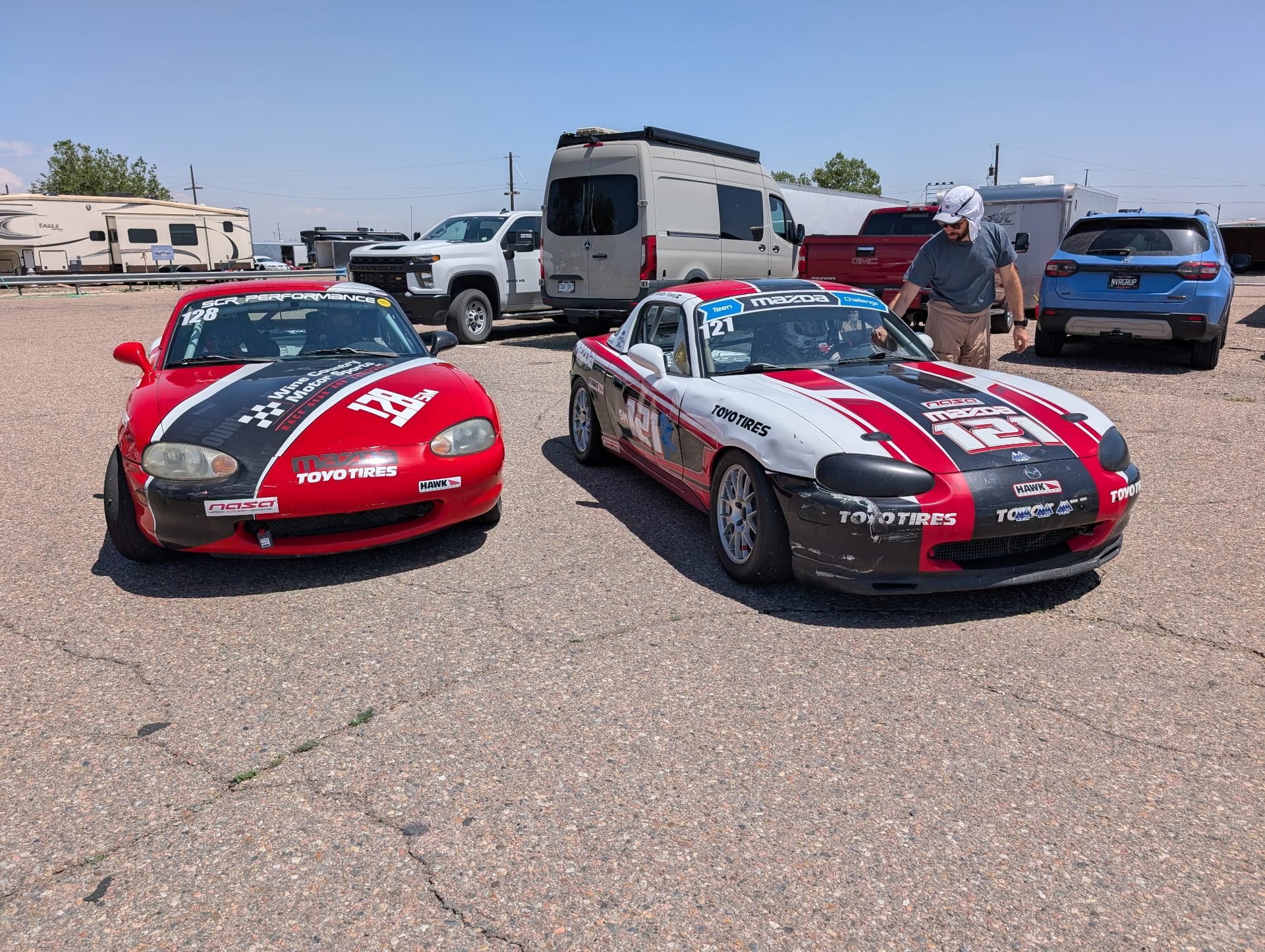 Two Spec Miatas in the paddock at the end of a race day. The car is the real budget line, not the entry.
What Does a TMC Season Actually Cost?
TMC registration itself isn't the expensive part. NASA doesn't publish a standalone TMC fee, so don't budget around a number you found on a forum. The cost is the Spec Miata program underneath it.
Here's the honest stack:
Fixed, small stuff. NASA membership runs about $69 a year. In NASA Rocky Mountain, the published weekend entry has been $399 early, $449 late, and $499 at the track, with a transponder rental around $80 a weekend. Those published rates are a floor — we budget closer to $500 a weekend.
The car — if you own it. A competitive Spec Miata race weekend is realistically $2,000 to $3,500 in consumables when you do your own wrenching. Fresh tires alone are roughly $1,200 a set, and front-runners replace them often. You can get a weekend down to $1,000 to $1,500 on heat-cycled tires with no damage and free labor, but that's the floor, not the norm. Buying in costs $10,000 to $35,000-plus for a race-ready car, before a trailer, a tow vehicle, and somewhere to store it all.
The car — if you rent it. A national arrive-and-drive shop like Advanced Autosports lists around $3,150 for a two-day race weekend. Ours runs $5,000 a weekend, because it includes coaching and data every session, crew, fuel, and full paddock hospitality. Be careful comparing those to the $945-a-day numbers you'll see advertised — those are track-day lapping rentals, not wheel-to-wheel race weekends. Different product entirely.
Add it up and a serious TMC season is a five-figure commitment. I'd rather say that plainly than let you find out in June.
So Should Your Kid Do It?
Yes, if:
- They've run real wheel-to-wheel kart races, not just arrive-and-drive laps. Racecraft transfers. Fast solo laps don't.
- They physically fit the car — pedals, vision, and neck strength for a full session.
- Your family can commit to most of the region's weekends. Points reward showing up. One or two rounds and you're chasing a championship you mathematically can't win.
- They want a path, not just a hobby. TMC is built to feed the ladder.
Not yet, if:
- The budget covers one weekend and a prayer. Run an HPDE or an evaluation day first and learn what you're signing up for.
- They've never raced door to door. A Spec Miata field is one of the deepest in club racing, and the first race weekend is a firehose.
- Nobody in the family has read the rulebook. Tech inspection is not the place to discover your car isn't legal.
The real argument for TMC isn't the trophy. It's that a 15-year-old gets to line up against experienced adults every weekend and be measured honestly. That kind of feedback is hard to buy anywhere else. There's more on the timing and readiness question in our karting-to-cars guide for parents.
The Colorado Version
If you're local, this is easier than you think.
NASA Rocky Mountain runs Spec Miata, so TMC points are on the table right here. The season splits between High Plains Raceway in Byers and Pueblo Motorsports Park. Two tracks, both a drive from the Front Range, no cross-country tow bill.
One local quirk: at 4,700 to 5,400 feet, these cars make noticeably less power than they do at sea level. Everyone's in the same air, so it's fair — but a lap time from Colorado won't line up with one from Florida. Judge your kid against the field they're actually racing.
Our Car #121 has TMC wins on its record, and we run Spec Miata in this region every season. So when I say a young driver can do this here, it isn't theory.
If your driver is somewhere between karts and a real seat, our Kart to Car program is where we help families figure out that next step.
Sources: NASA Teen Mazda Challenge, NASA Speed News, Mazda Motorsports, Advanced Autosports, MotorsportReg NASA Rocky Mountain event listings. Scholarship and award figures reflect recent public reporting and have changed year to year — confirm current-season numbers with NASA and Mazda Motorsports before budgeting. Cost ranges reflect published rates plus our own program's real numbers as of August 2026.
Do you believe?