
You can do a hundred track days and still not be allowed to race.
The door between those two worlds has a name. In SCCA, it's the Drivers School. Here's what it is, what happens, and what it runs you.
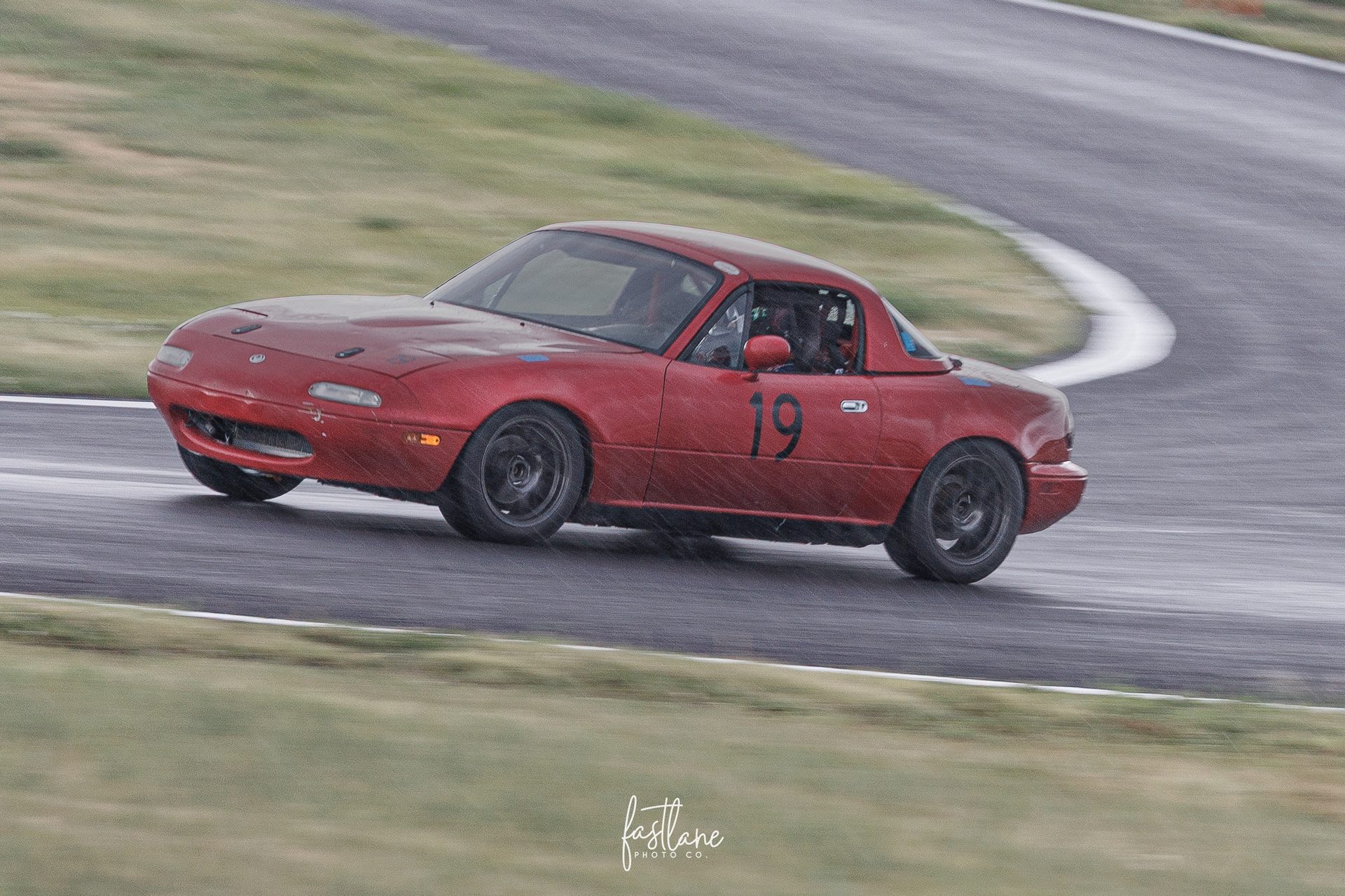 The #19 in the rain at High Plains Raceway. School weekends run in whatever weather shows up — that's part of the point.
What the SCCA Drivers School actually is
It's a sanctioned race weekend built for people who have never raced.
You bring a competition-legal car. You get assigned an instructor. You run sessions, sit through classroom time, and get evaluated. At the end, the school either signs you off or it doesn't.
SCCA calls that sign-off a Certificate of Compliance, and it comes with what they describe as "a clear recommendation of license level." That piece of paper is the whole reason you're there.
Two kinds of schools count. SCCA regions and divisions run their own, and there are independent facilities that hold SCCA accreditation. Both work. They just deliver different amounts of credit.
SCCA lists four credit levels: a full competition license school, a school plus two events, a school plus one event, and a school-only credit. The higher the level, the fewer race weekends you have to run afterward.
One rule catches people. Once you finish, you have 365 days to actually claim your Novice Permit or full license. Sit on it longer than that and the weekend stops counting.
What happens over the weekend
Every region runs it a little differently, so read your school's own packet. But the shape is consistent.
Washington DC Region's 2026 school at Summit Point is a good example of the format. It runs Friday through Sunday. Friday evening is a mandatory classroom session. Saturday and Sunday are wheel-to-wheel sessions and evaluations. Sunday afternoon is practice starts.
Practice starts matter more than new drivers expect. A standing or rolling start with 30 cars around you is nothing like leaving pit lane alone at an HPDE. Schools drill it because it's where rookies get hurt.
You'll also be expected to have read the General Competition Rulebook before you show up. Not skimmed. Read.
Expect an assigned instructor watching your sessions and giving you direct feedback, a written exam, flag and procedure review, and a student packet with track maps and a syllabus. Expect to be graded on discipline, not lap time.
The fastest driver in the group does not automatically pass. The one who holds a line, respects a flag, and doesn't surprise anybody does.
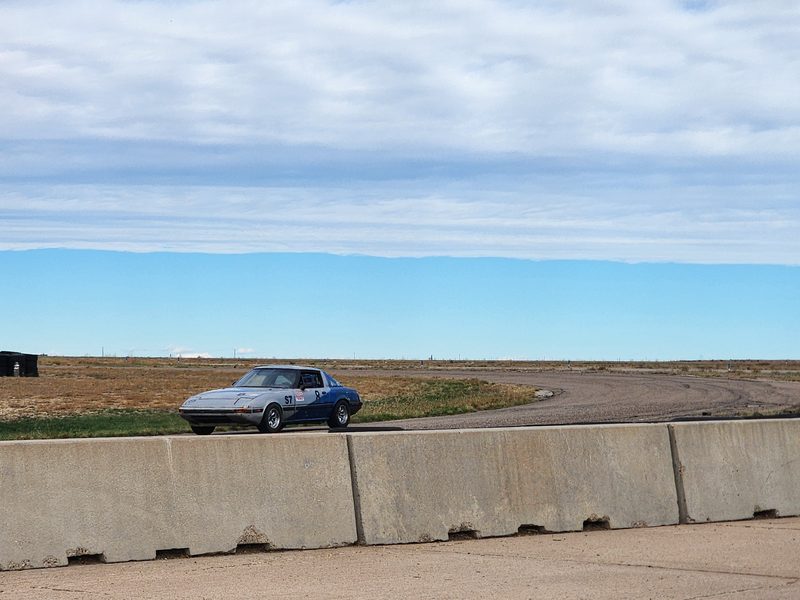 Our old #8 Spec 7 RX-7. We came up through SCCA in these before moving the program to Spec Miata.
Do you need a Novice Permit first?
This trips up more people than anything else, and the honest answer is: it depends on your age and your region.
Look at how two 2026 schools published it. San Francisco Region's school at Thunderhill lists a current SCCA membership plus either a valid driver's license or a Novice Permit. Adults can use either one. Minors who are 16 or older and hold a driver's license can also use either, with the minor waivers signed. Minors who are 14 or 15 and don't have a driver's license still need the Novice Permit.
So for a lot of adults, the permit is now something you buy after the school instead of before it. That's a real change, and it's a good one — you can find out whether you love this before you pay for the credential.
Do not assume it applies to your school. Check the supplemental regs for the event you're entering.
Either way, SCCA's own path asks for a few things up front: a full membership, the online Drivers School modules in My Learning at my.scca.com, a copy of your state driver's license uploaded to your profile, and a medical on file. The medical schedule is age-based — an annual online declaration from the age of majority to 59, a physician-completed form every two years from 60 to 69, annually at 70-plus, and every five years for minors.
What does it cost?
The paperwork is cheap. The weekend is not.
| Line item | Cost |
|---|---|
| SCCA national dues | ~$85/year |
| SCCA regional dues | ~$10-$25/year |
| Novice Permit | ~$110 |
| Permit to regional competition license | ~$75 |
| School entry (SFR 2026, published) | $1,270 |
| Race car rental for the school | ~$500-$2,000 |
Total club paperwork to get licensed is under about $300. The expensive part is always the seat time.
Confirm current numbers at my.scca.com before you budget — fees move, and regional dues vary by region.
And that's before tires, fuel, a tow, a hotel, and whatever the car eats. We broke the full picture down in our post on what a racing license actually costs.
If you don't have a competition car, that's not a dead end. Most schools will tell you rental race cars are available, because the club knows the car is the real barrier. That's the same problem we built our rental program around — our Spec Miatas are legal in both NASA and SCCA, and a Driver Evaluation Day runs $2,250 with $1,000 credited toward a race weekend if you come back. Cheaper than finding out you hate it after you've bought a car.
What happens after you pass
You don't walk out with a full competition license. You walk out with credit.
Take that credit, claim your Novice Permit, and go run regional races. For every one, get the Novice Permit signed off by the Chief Steward at the event. That signature is the entire record.
Run three successful weekends and you can convert the permit into a full competition license. WDCR notes that three is up from two, so if you read an older guide somewhere, that's why the number doesn't match.
Higher-level accredited schools can compress this. Complete a full-competition-license-level school and you may be able to buy the full license without the novice phase at all.
Our step-by-step breakdown of the SCCA and NASA license paths covers both clubs side by side if you're still deciding which one to run.
So should you take one?
Take one if you already have real seat time and you want to race wheel to wheel. That's it. That's the filter.
If you've never been on a road course, a Drivers School is the wrong first purchase. Go do HPDE first, or run a Time Trial season and find out if you're actually fast before you pay for a race license.
But if you're the driver who keeps getting bumped to the top run group and keeps watching the race group go out after you — you're done with track days. You've been done for a while.
The school is not a talent test. It's a discipline test. Show up with a car that passes tech, a rulebook you've read, and the humility to take instruction, and you'll pass.
If you want a structured path from where you are now into a real race car — coaching, sim work, seat time, sponsor help — that's exactly what Kart to Car was built for. And if money is the thing standing between you and that first school entry, get on the scholarship list. We'd rather fund you than watch you quit.
Sources: SCCA — I Want to Road Race, SCCA — Drivers' Schools, WDCR SCCA Racing School, 2026 SFR SCCA Drivers School (MotorsportReg), SCCA NNJR Go Racing. Fees and requirements verified against published club pages as of September 2026. Region rules vary — always read the supplemental regulations for the specific school you enter.
Do you believe?