
There's a whole competition class sitting between track days and real racing, and most drivers never hear about it until someone in the paddock mentions it.
It's called Time Trial. You compete for a trophy. You never trade paint. And your car probably already qualifies.
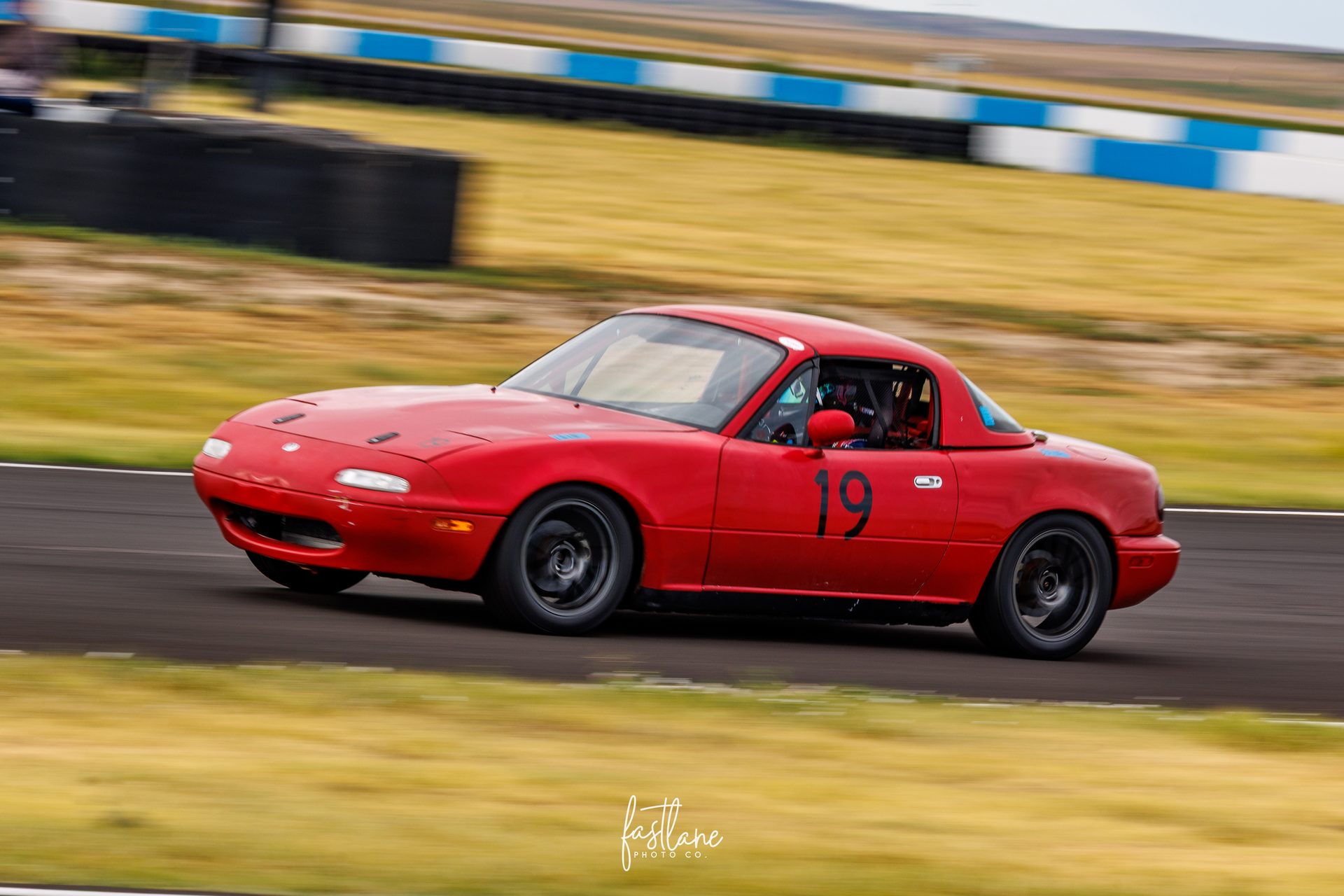 The #19 hooked up and hustling at High Plains Raceway during the NASA August weekend. Time Trial looks a lot like this — one car, one clean lap.
What Time Trial actually is
NASA's own rulebook says it best. Time Trial "allows qualified individuals to compete in a best lap time format in a prepared car in advanced level open-passing sessions, and bridges the gap between NASA HPDE 4 and wheel-to-wheel racing."
That's the whole idea. You go out in a 15 to 30 minute session with other drivers. Passing is open. Nobody is fighting you for a corner. The only thing that matters is the fastest single lap you put down.
SCCA runs its own version and frames it the same way. Their FAQ calls Time Trials "a competition, but not a race" — drivers are expected to give each other the most room possible instead of fighting for position.
So you get a real result. A class. Points. A championship. Without the risk profile of wheel-to-wheel.
HPDE vs. Time Trial vs. wheel-to-wheel
Here's the honest comparison.
| HPDE | Time Trial | Wheel-to-wheel | |
|---|---|---|---|
| Are you scored? | No | Yes — fastest lap | Yes — finishing position |
| Passing | Restricted by run group | Open | Open, plus racing for position |
| Car prep | Street-legal fine | HPDE standards | Full cage, fuel, harness, nets |
| License | None | TT license | Competition license |
| Contact risk | Low | Low | Real |
If you've already read our breakdown of HPDE run groups, Time Trial is what sits at the top of that ladder. And if you want the other end, we covered what wheel-to-wheel racing actually involves separately.
Time Trial is the honest middle. You find out whether you're actually fast without needing a race car.
What it takes to get in
NASA sets the bar at the Regional TT Director's approval. The minimum path is one of these: successfully complete a NASA HPDE 4 event, hold a current NASA competition or provisional race license, hold a comparable time trial or competition license from another organization, or show an extensive verifiable history of open-passing road course events.
Then you buy a Provisional TT License online before your first event. After one full event day, the Regional TT Director either upgrades you to a National TT License, asks for another day of evaluation, or tells you what to fix. The national license is good in any NASA region and expires at the end of the calendar year.
SCCA is more open at the entry point. Their Time Trials program issues a Novice license to drivers with zero or minimal track experience. You need a weekend or full SCCA membership and a valid state driver's license. Moving up to Advanced takes four to six satisfactorily completed events.
That difference matters. If you have never turned a lap, SCCA Time Trials will take you today. NASA wants you to graduate HPDE 4 first.
Your car probably already qualifies
This is the part that surprises people.
NASA's TT rules state that all cars must meet the HPDE safety and car preparation standards in Section 11 of the Club Codes and Regulations. Not the racing standards. The same prep that gets you into a track day gets you into Time Trial.
Convertibles have to meet the CCR roll bar spec for HPDE. Front side windows have to be down on track, and fixed Lexan front windows aren't allowed unless the factory built the car that way. A CCR-compliant fire extinguisher on a metal bracket is strongly recommended, not required.
SCCA says roughly the same thing from the other direction: "for many Street Cars you will not need a roll bar." Helmet is mandatory. Street cars, race cars, and some purpose-built cars are all welcome. No motorcycles, karts, or three-wheelers.
One catch on the NASA side. If you run TT1 through TT6, you have to submit a car classification form with a certified dyno report, because the classes are built on weight-to-power. TTU, TTGT, and TTEV competitors skip the form.
You also need a MyLaps transponder. NASA's rules are blunt: no other method of lap timing is valid for TT competition. Most regions rent them by the weekend, and we broke down the rent-versus-buy math in our transponder guide.
The rules that will take your lap away
Time Trial is safer than racing partly because the penalties are brutal about anything sloppy. Learn these before you enter.
- More than two wheels off course during an incident, or both fronts or both rears off at once, kills your time for that session.
- A spin greater than 80 degrees, or any loss of control that would have put a nearby car in danger, kills the session too.
- Passing under yellow costs you every timed lap in that session at minimum, and repeat offenses can cost the license.
- Blocking to slow the car behind, or prolonged drafting with another car, draws what the rulebook calls harsh penalties — up to expulsion from TT competition.
- Skipping the download meeting after a session can cost you lap times, and repeated absences can revoke the license.
There's also an impound routine. Once you exit the track you go straight to impound, no work in the hot pits, no touching tire pressures until officials release you.
And one detail worth knowing: your first session of the weekend is a warm-up and doesn't count. Cars grid by their previous best lap, the field paces out at 45 mph, and open passing starts after the last corner of the first hot lap.
NASA also auto-enters every TT car into a class called TTT, where the winner is whoever is most consistent between their fastest lap and the next three. Nothing to buy, nothing to build. It just rewards repeatable driving, which is the whole point.
Running Time Trial in Colorado
NASA Rocky Mountain runs all three programs — HPDE, Time Trials, and wheel-to-wheel racing — at High Plains Raceway in Byers and at Pueblo Motorsports Park. That's a rare thing. You can start in HPDE, move to Time Trial, and step into racing without ever changing clubs or leaving the state.
Budget-wise, NASA membership runs about $69 a year, and Rocky Mountain's published weekend entries have sat in the $400 to $500 range depending on how early you register. Treat that as a floor and check the current schedule before you plan a season.
We run our own cars in the NASA Rocky Mountain paddock at both tracks, so if you show up for a Time Trial weekend, come find us. We'll tell you what we know about the place.
Time Trial won't tell you if you can race. It will tell you if you're fast, for a fraction of the money and none of the contact. That's a real answer, and most drivers never go get it.
If you'd rather skip the build entirely and find out in a prepped car with a coach in your ear, that's what our arrive-and-drive program is for.
Sources: NASA Time Trial Official 2026 National Rules, SCCA Time Trials Basics, SCCA Time Trials FAQ, NASA New England Time Trial, NASA SoCal Get Started in Time Trial, NASA Rocky Mountain. Rules quoted from the 2026 TT rulebook, version 23.1. Entry and membership figures are published club rates and change — verify before you register.
Do you believe?