
Everyone talks about the kid burning out. Almost nobody talks about the parent who is quietly running on empty by round four.
You're the one who pays, packs, drives, and stands on the fence for a final that lasts eight minutes. If you're the engine of the whole program, you need a plan for your own fuel too.
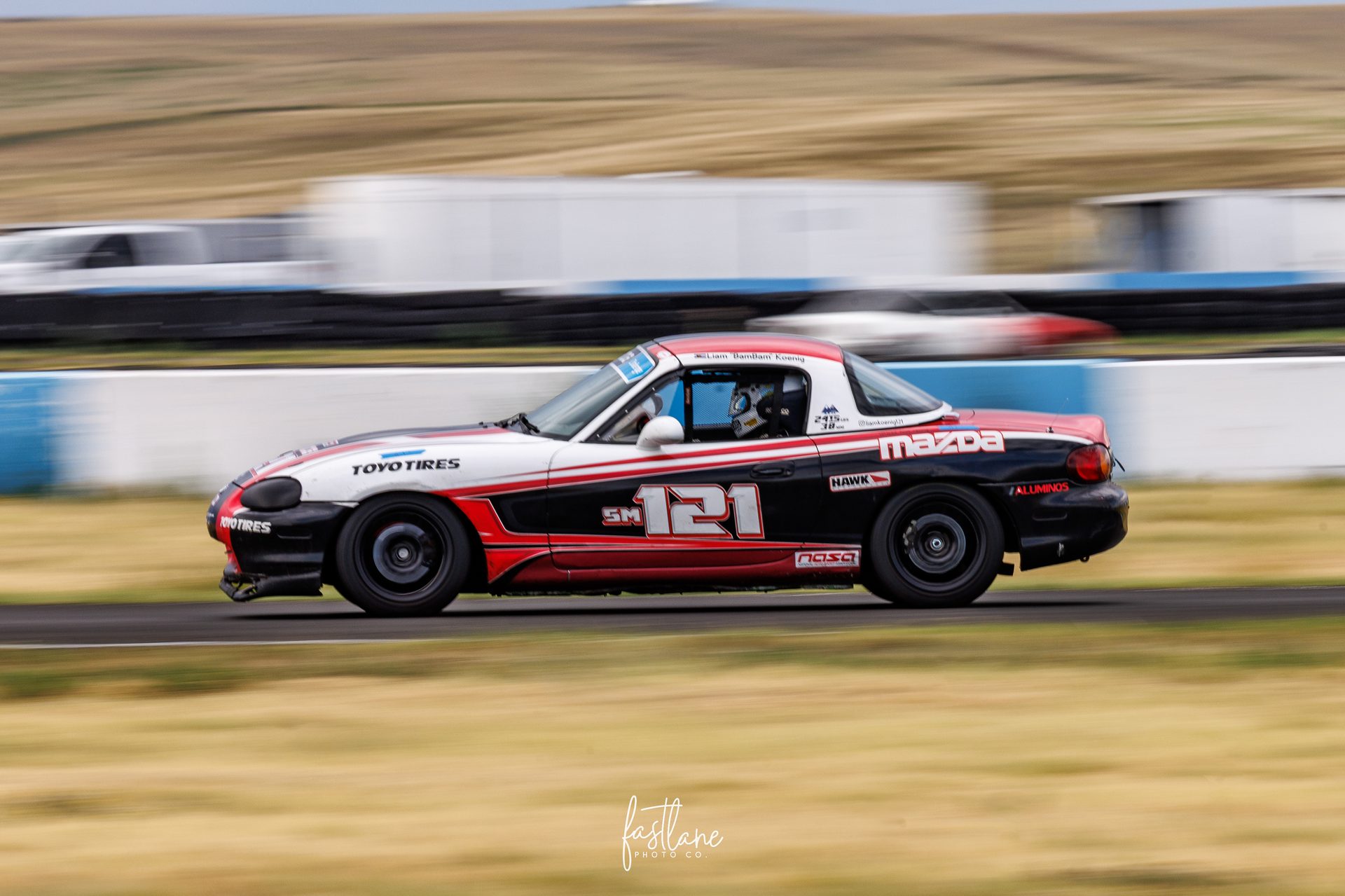 Our #121 at High Plains Raceway. Behind every car in that paddock is a family that gave up a weekend to be there.
What the research says (and doesn't)
Be honest about what we know. There's no big study of burnout in racing parents specifically. There is good research on sport parents in general, and it lines up with what you see in any paddock.
A 2019 study in Frontiers in Psychology surveyed 135 parents of junior tennis players. Parents named their top stressors. Finances (about 25%) and time (about 22%) led the organizational list. Both beat every competitive stressor on the list.
Racing is tennis with a trailer. Your costs and your calendar are bigger, so expect the same two stressors to hit harder.
A separate 2018 study of 214 sport parents, by DeFreese and colleagues, found that warmth in the parent-child relationship was linked to lower burnout. Conflict was not a significant predictor. In plain words: a good relationship with your kid protects you.
Why burnout happens: risks outweigh resources
Parental burnout researchers Moira Mikolajczak and Isabelle Roskam describe it as a chronic imbalance. Risks pile up faster than resources. Their 2018 study followed 923 parents and found that imbalance predicted burnout well.
Burnout is not just being tired. It looks like three things together:
- Overwhelming exhaustion tied to the parent role
- Feeling emotionally distant from your child
- A sense that you're not doing it well
That second one matters here. If you catch yourself dreading the drive to the track, or snapping at a kid you love, that's your signal. Don't wait for the third sign.
Their work also flagged a few risk factors that fit racing parents well: perfectionism, poor stress-management skills, and very high parenting standards. A parent who wants every lap, every setup, and every result to go right is carrying a heavy load.
The four drains on a racing parent
Here's where the imbalance usually builds. Know them by name.
1. The money
The bill arrives in lumps. Tires, entries, fuel, travel, repairs. The karting money cliff is real, and it catches families who budgeted for the kart and forgot the rest.
Money worry also leaks into the car ride home. A kid who senses that a bad weekend "wasted" a few hundred dollars will feel it.
2. The calendar
Race weekends eat Fridays through Sundays. Siblings get shuffled. Your own friends and your own rest disappear. In the tennis study, limited family and partner time was the biggest time-related stressor parents named.
3. The sideline
You can do nothing while your kid drives. That helplessness is its own kind of stress. Parents in the tennis study reported anxiety and anger as their top emotions, and other parents were a named stressor.
4. The hero job
Many parents become driver, mechanic, coach, sponsor hunter, and team manager all at once. Nobody can hold all five jobs for a full season without something breaking.
How to not burn out
Research doesn't hand us a racing-specific cure. These steps come from the findings above, plus what I've watched work around the paddock.
Set the level before the budget, and write both down. One kart-racing coach's parent guide says to decide the level first, then the budget, and agree on both at home before the season. A club season is a full sport. You don't need the all-in route.
Pick races, don't enter everything. In the tennis study, selective tournament entry was one of the better-rated coping tools, and budgeting scored well too. A shorter schedule you can afford beats a full one that makes you resentful.
Share the load on purpose. Give your kid real jobs: pack the bag, check tire pressures, write the post-race notes. We cover that in karting parent year one. It also builds a better driver.
Protect the car ride home. Keep the first ten minutes quiet. Our guide on helping your young driver after a bad race walks through it. Warmth is what the research says protects you.
Protect one weekend a month. No racing talk, no tire shopping. Do something your other kids and your partner choose. Balancing school and racing has more on keeping the family system healthy.
Take the money pressure off
Money is the top stressor, so go after it. A local business can cover part of a season, and you don't need a big pitch to ask. We built the free Local-Business Workbook to walk you through finding and approaching your first local sponsor. Even a small yes lowers the stress at home.
Also know when to step back. Goal withdrawal rated lowest as a coping tool in the tennis study. But a planned break or a lower-cost season isn't quitting. It's a decision made before you hit the wall instead of after.
What to do this week
- Write down what this season costs, honestly, and what you can spend.
- Name the one drain from the list above that hits you hardest.
- Cut or share one job you do alone right now.
- Ask your kid one question: "What do you love about racing?" Then listen.
If you're early in the journey and want the whole picture of costs, gear, and race days in one place, the Karting Parents Pack is built for exactly your situation. It's $39.
The parents who last aren't the ones who give the most. They're the ones who pace themselves and keep the kid's joy ahead of the results.
Do you believe?
Sources: Harwood et al., "Advancing Our Understanding of Psychological Stress and Coping Among Parents in Organized Youth Sport," Frontiers in Psychology, 2019, DeFreese, Dorsch and Flitton, "The Parent-Child Relationship and Sport Parents' Experiences of Burnout and Engagement," Journal of Clinical Sport Psychology, 2018, Mikolajczak and Roskam, "A Theoretical and Clinical Framework for Parental Burnout: The Balance Between Risks and Resources (BR2)," Frontiers in Psychology, 2018, PURPL junior karting parents guide. Study percentages come from a survey of British junior tennis parents, not racing parents; no racing-specific burnout study was found. Verified as of November 2026. Anything else here is based on these sources plus my own racing experience.