
The thing that ends a rookie's race weekend usually isn't the part that broke. It's the tool that never got bought.
No torque wrench, so the lugs got guessed at. No pyrometer, so the tire pressures were guessed at too. Then something goes loose or greasy at the worst possible moment, and a $500 entry fee turns into a tow back to the paddock.
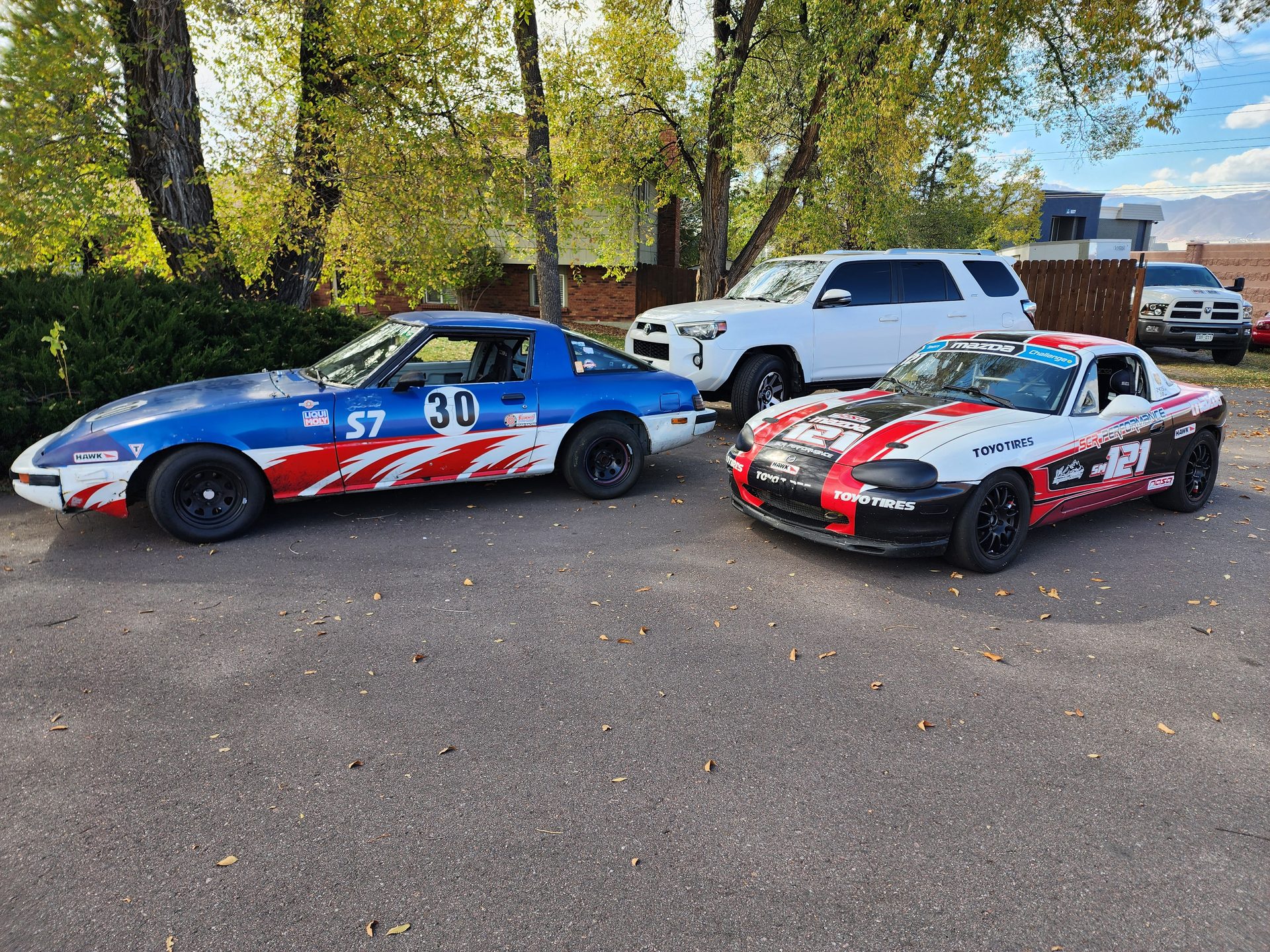 The LFR paddock. Most of what makes a weekend go right happens here, not on track.
Buy in this order, not all at once
Tools are the cheapest line item in racing. A competitive Spec Miata weekend runs roughly $2,000 to $3,500 all-in once you count tires, entry, fuel, pads and fluids — and that's doing your own wrenching. Against that, a good torque wrench is a rounding error.
So the goal here isn't "build a shop." It's five tools that let one person run a weekend without borrowing from the guy two trailers down every hour.
Here's the order I'd buy them in.
1. A torque wrench you actually trust
This is the first purchase. Not the coolest one. The first one.
Wheels come off cars at track speed because somebody guessed. Your car has a published spec — on a 1999 NB Miata it's in the neighborhood of 66 to 86 ft-lb, but check your own manual and use that number, not mine.
A 1/2-inch click-type wrench in the $40 to $150 range is plenty for a grassroots program. Buy it, and then use it right:
- Snug the lugs by hand or with an impact, but do the final tightening with the torque wrench — never the gun.
- Star pattern. Every time.
- Re-torque after your first session. Wheels settle. This one habit prevents most of the horror stories.
- Dial it back to its lowest setting before it goes in the box. That's what keeps it accurate.
The wrench isn't the point. The routine is.
2. A tire pressure gauge good enough to argue with
Tire pressure is the biggest free lap-time lever you own. A couple psi changes how the car rotates, how the tire wears, and how long it stays alive in a 25-minute race.
Two rules. First, buy one decent gauge and use that same gauge all season. Cheap gauges can disagree with each other by a few psi, so consistency matters more than lab-grade accuracy — you're chasing a repeatable number, not a certified one.
Second, check pressures hot, right as the car comes off track. Cold readings in the morning tell you where you started. Hot readings tell you what the tire actually did.
If you want the starting numbers and the hot targets we work from, I broke those down in our Spec Miata tire pressure post.
3. A low-profile jack and real jack stands
Race cars sit low. A parts-store jack that fits your daily driver often won't slide under a Spec Miata on race rubber.
You need to get the car up for pad swaps, for a quick look at a suspected leak, for a nut-and-bolt check on Saturday night. A low-profile aluminum floor jack and a pair of proper stands cover almost everything a solo racer does at the track.
Never put any part of yourself under a car held up by a jack alone. Stands, every time, no exceptions.
Add two wheel chocks. They're ten dollars and they're the difference between a car that stays put and a very bad afternoon.
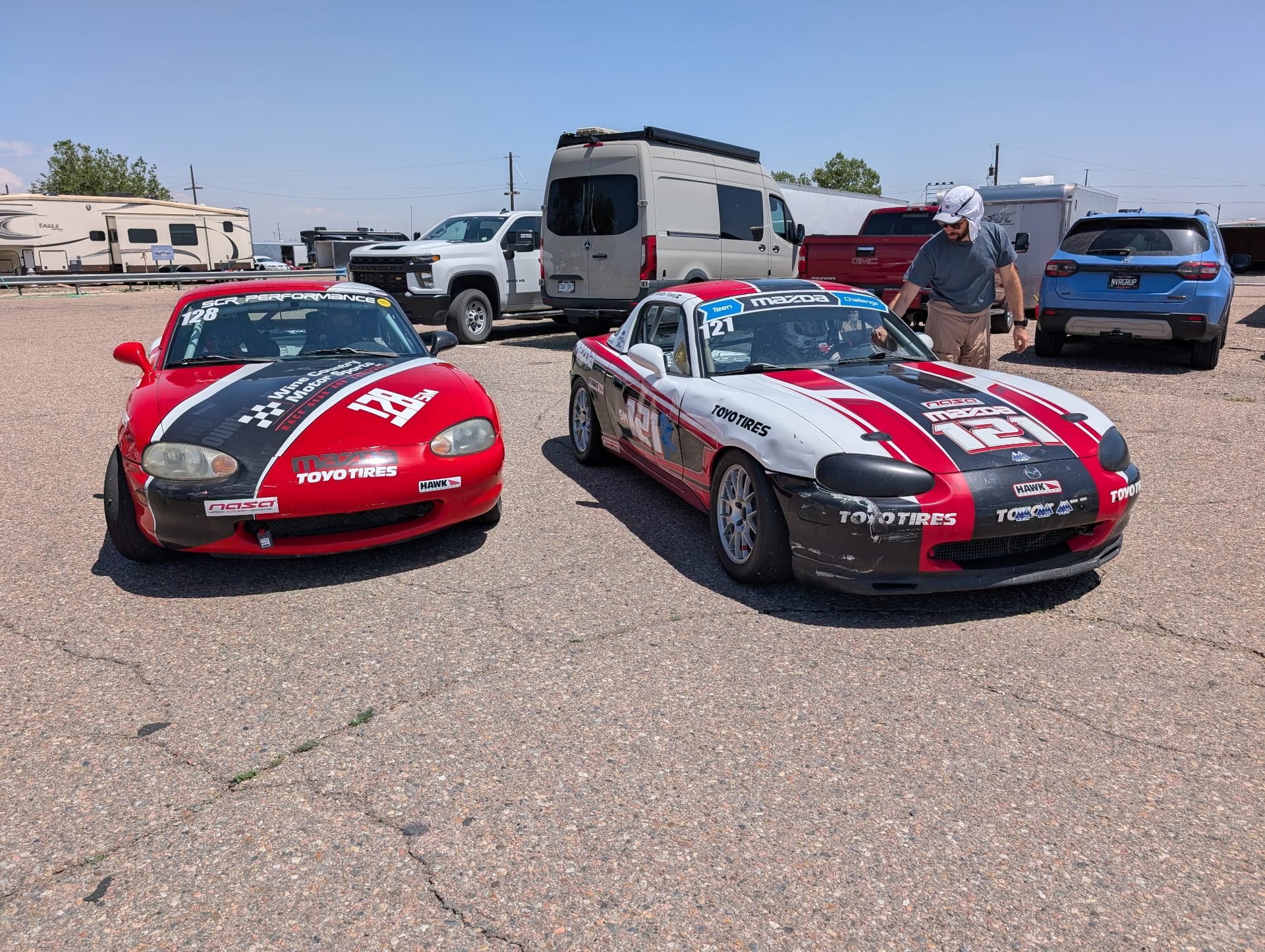 Saturday evening nut-and-bolt check. This is where the jack and stands earn their money.
4. A probe tire pyrometer
This is the tool that separates guessing from tuning, and most grassroots racers skip it for years.
Get a probe pyrometer, not an infrared gun. Infrared reads the surface, and the surface cools within seconds of the car stopping. The probe pushes into the tread and reads what the tire is actually doing.
Take three readings per tire — about an inch and a half from the outside edge, the middle, and about an inch and a half from the inside edge. Same depth, same spots, every tire, every time. The spread across those three numbers tells you whether you need more camber, less camber, or a pressure change.
Quality probes and complete pyrometer kits from the usual racing suppliers run roughly $155 to $200. If you want the read-it-like-an-engineer version, we walked through the whole process in how to read tire temps.
5. A lap timer you'll actually look at
You don't need a $1,500 data logger in year one. You need a phone, a decent mount, and an app.
RaceChrono Pro runs about $18. Harry's LapTimer starts around $9 and climbs to roughly $28 for the full analytics tier. Either one gives you lap times, segment splits, and a data overlay you can burn onto GoPro footage — which pairs nicely with using a GoPro to actually improve your driving.
Feel lies. Segment times don't. The first time you see that you're losing three tenths in one specific corner, every session after that gets more productive.
What you don't need yet
Skip these until the basics are handled and paid for:
- A giant rolling toolbox. A tote and a socket set cover 90 percent of trackside work.
- An impact gun. Nice to have, not required, and it can't set final torque anyway.
- A pro data system. Your phone is enough until you're consistently within a second of the front.
- Alignment equipment. Borrow, or pay a shop, until you're doing it often enough to justify the kit.
And there's an honest third option here: don't own any of it. That's exactly what our arrive-and-drive program exists for — the car, the crew, the tools, the coaching and data every session, rented by the full season (six events, paid in full before the season starts, no damage deposit), with pricing that depends on the car and package. Some drivers want to learn to wrench. Others want every minute of the weekend spent driving. Both are legitimate.
The tool that isn't a tool
The best-run one-person operations I've seen at High Plains all have the same thing in common, and it isn't gear. It's a routine.
Same box. Same layout. Same order of operations every session: pressures, temps, torque, fuel, fluids, driver. Written down, so a tired brain at 4pm on Sunday doesn't have to remember anything.
If you want a head start on that list, we built a full race weekend packing checklist you can copy straight into your notes app.
Buy the five tools. Build the routine. That's a race team, even if it's just you.
Tools are the cheap part — it's the tires and entry fees that empty the account. If you'd rather have somebody else help carry that, the Race-Ready Sponsor List is 50 companies that actually sponsor grassroots racers, with the contact angle for each, for $19. It's the fastest way to turn "I can't afford another set of tires" into a real conversation with a brand.
Sources: Grassroots Motorsports — what tools to take to the track, Longacre Racing pyrometer tips and pricing, 949 Racing SuperMiata pyrometer guide, Miata Nuts NB torque specs, Miatafy lap timing app comparison. Prices checked against published listings as of August 2026 and stated as ranges because they move. Always confirm torque specs against your own service manual.
Do you believe?