
Racing Costs
How Much Does Pro Racing Cost? The $7M Ladder Most Don't Finish
Jett Johnson7 min read
The short answer
- Karting to F1 runs $7M or more (RaceFans): up to $2M of karts, then F4, F3 and $3M+ of F2.
- One Indy NXT season was about $1.2M in 2025; the top scholarship covered under half.
- Each rung doubles or triples the bill, with no seat promised: the 2026 F1 grid has one rookie.
Pursuing pro racing on the open-wheel ladder costs millions, not thousands. One respected F1 columnist put the climb from karting to Formula 1 at $7 million or more, and that money still doesn't guarantee a seat.
That's the scary number. Stay with me, because the useful part is why it gets that big, and what that means for a kid racing karts or a Miata right now.
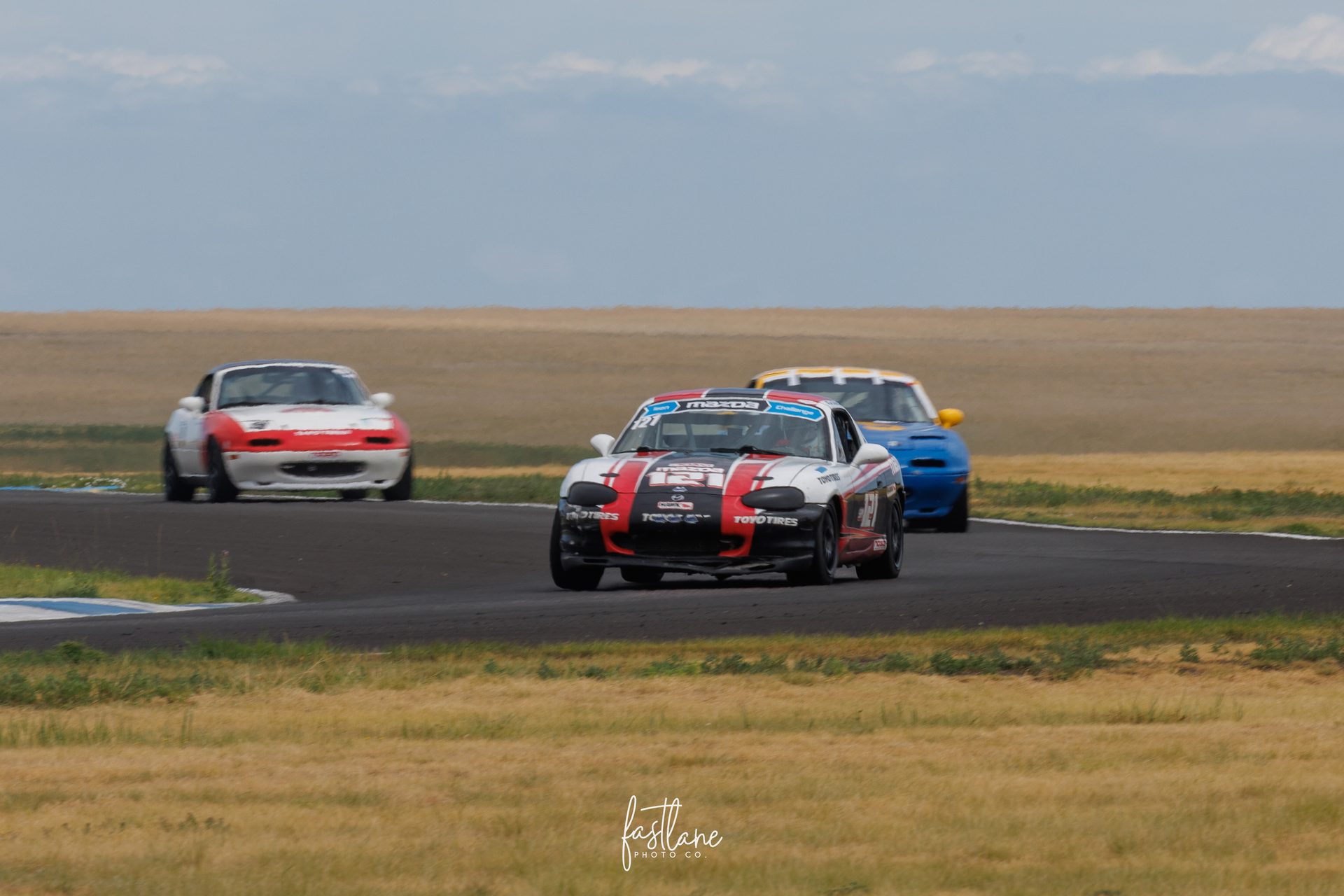 Our #121 heading a three-car train at High Plains Raceway. Every pro you can name started in a field like this one.
How much does it cost to become a pro racing driver?
Nobody publishes an audited bill for a whole career. What we do have are numbers from people inside the sport. Here's the open-wheel climb as RaceFans columnist Dieter Rencken laid it out in 2021, plus the US figure for Indy NXT.
| Rung | Reported cost | Source |
|---|---|---|
| Karting, about six years | up to $2M total | RaceFans (2021) |
| Formula 4 (European-style program) | about $500,000 per season | RaceFans (2021) |
| Formula 3 | about $1M | RaceFans (2021) |
| Formula 2 | $3M plus | RaceFans (2021) |
| Total before an F1 seat | at least $7M "in most cases" | RaceFans (2021) |
| Indy NXT (US), one full season | about $1.2M, expected to rise toward $1.5M | US Open Wheel Nation (2025) |
Other insiders land in the same zip code or higher. Ralf Schumacher, a former F1 driver, reportedly put the path to F1 at €13 to €15 million. He said a pro international karting program alone runs about a quarter of a million a year.
The US F4 series publishes a much lower season budget than the European figure above. We covered it, and the US scholarship ladder, in our karting to pro racing ladder guide, so I won't repeat it here.
Why does the cost multiply at every step?
Here's the pattern most families don't see coming. The bill doesn't grow a little each year. It jumps.
Look at the table again. F4 to F3 is roughly double. F3 to F2 is roughly triple. Each rung brings faster cars, bigger teams, more travel and more testing, and somebody pays for all of it.
The scholarships grow too, but not as fast. For 2025, the USF Pro 2000 champion's scholarship was worth $546,500 toward Indy NXT. US Open Wheel Nation pointed out it covers less than half of most Indy NXT rides. That's the best possible result in the series, and the champion still needs another six figures to move up.
Winning a rung doesn't pay for the next one. It pays for part of it.
This is also why the jump from karts to any car is where so many careers stall. We wrote about that gap in the karting-to-cars money cliff.
Why do most drivers never make it to the top?
The honest answer is math, and then money.
The seats are few. The 2026 Formula 1 grid has 22 drivers across 11 teams, and Formula 1's own season preview counted exactly one rookie. Kids start in karts all over the world every year. One new driver got in this year.
Most F2 drivers don't graduate. Rencken put the drop-out rate from F2 to F1 at "around 90%," unless someone pays for a seat. That's the last rung, where drivers have usually spent millions already.
Even well-funded drivers say it's brutal. F1 driver George Russell said his father "probably spent over a million pounds" on his career. Russell added that this "doesn't even get you halfway to F1." His dad sold his business to keep him racing.
Champions stall too. US Open Wheel Nation listed several USF Pro 2000 champions who didn't make the jump to Indy NXT. It noted another driver who stepped away from car racing for two years to regroup financially.
The cost starts young. In remarks reported in 2024, FIA president Mohammed Ben Sulayem asked, "Who pays 250,000-300,000 for a ten-year-old to race for a season?"
 Our #19 in traffic at High Plains Raceway. Club racing is where most racers actually race, and where real skills get built.
Is there a cheaper way to race professionally?
Yes, and it's the one nobody advertises. The sports car route runs through club racing in Mazda-powered cars and into the Mazda Shootout, where scholarships go to drivers who race well in cars regular families can afford. We broke down that ladder in the pathway guide, and two real drivers who climbed it in our Mazda ladder case study.
It's also worth knowing what "pro" means. A fully paid driving job is rare at every level, and lots of "pro" drivers still bring money to the team. We laid out who pays whom in club racing vs pro racing.
So the real question isn't "can I afford F1?" It's "which ladder fits our budget, and how do we fund the next step?"
What we actually do
LeadFoot Racing races Spec Miatas in NASA Rocky Mountain club racing. We are not a pro team, and I won't pretend we are.
Our real numbers are club numbers. A competitive Spec Miata race weekend runs $2,500 or more in consumables alone: a fresh set of tires around $1,200, an entry near $500, plus fuel, pads and fluids. We break the whole season down in what Spec Miata racing actually costs.
We don't pay for all of that out of pocket. We work with partners like Les Schwab, OG Racing and Engine Ice. In 2022 we were one of three businesses awarded $50,000 each in the Spark the Springs grant. None of that came from waiting. It came from asking, pitching and following up.
That's the skill the pro ladder quietly rewards. Every rung above club racing is paid for by a family, a scholarship or a sponsor, and sponsorship is the one anybody can learn. If you want the whole funding plan built out, sponsor list, pitch, proposal and follow-up, The Funded Season Kit is the full program we built for it.
What should a young racer or parent do with these numbers?
Don't let $7 million scare you out of the sport. Use it to plan.
- Pick the ladder that fits your money. Open-wheel is faster and far more expensive. The sports car route is slower and cheaper.
- Keep racing something. A gap year with no seat ends more careers than slow lap times.
- Budget the next rung, not just this one. Expect the bill to double or triple when you move up.
- Chase every scholarship you qualify for. Our free guide, How to Win a Racing Scholarship, covers how to put together a strong application.
- Start raising money a year early. Sponsors set budgets well before the season starts.
Talent gets you noticed. Funding keeps you on the ladder. You can work on both.
If you want to start on the funding side tonight, The First Sponsor System is $47. It's the sponsorship method, templates and tools we use to fund our own cars, built so a teenager and a parent can run the same play.
Sources: RaceFans, "Is F2's $3 million admission price good value for aspiring F1 drivers?", US Open Wheel Nation, "Indy NXT's rising costs put scholarships and ladder to the test", PlanetF1, Ralf Schumacher on the price of the pathway to F1, Sports Illustrated, George Russell on the cost to make it in F1, DIVEBOMB Motorsport, FIA president on the cost of karting, Formula 1, "Who are the 2026 Formula 1 drivers?". Career-cost figures are insider estimates, not audited budgets, and they're dated by source year. Club numbers come from our own Spec Miata program. Verified as of November 2026.
Do you believe?
About the author
Jett Johnson
Founder of LeadFoot Racing, a Spec Miata race team in Colorado Springs that races in the NASA Rocky Mountain region. Jett holds degrees in mechanical engineering, mathematics and aerospace engineering, has raced since 2022 and has spent years working with sponsors in motorsport. What you read here comes from building the team's race cars, running race weekends and writing real sponsorship proposals.
Meet the team