
The temp needle is climbing. Or a warning just lit up the dash and the car feels flat. You're mid-session, there's a car in your mirror, and you have about ten seconds to decide what to do.
Here's the honest answer: back off now, cool it on track, and get into the pits. Then figure out why. The engine you save is your own.
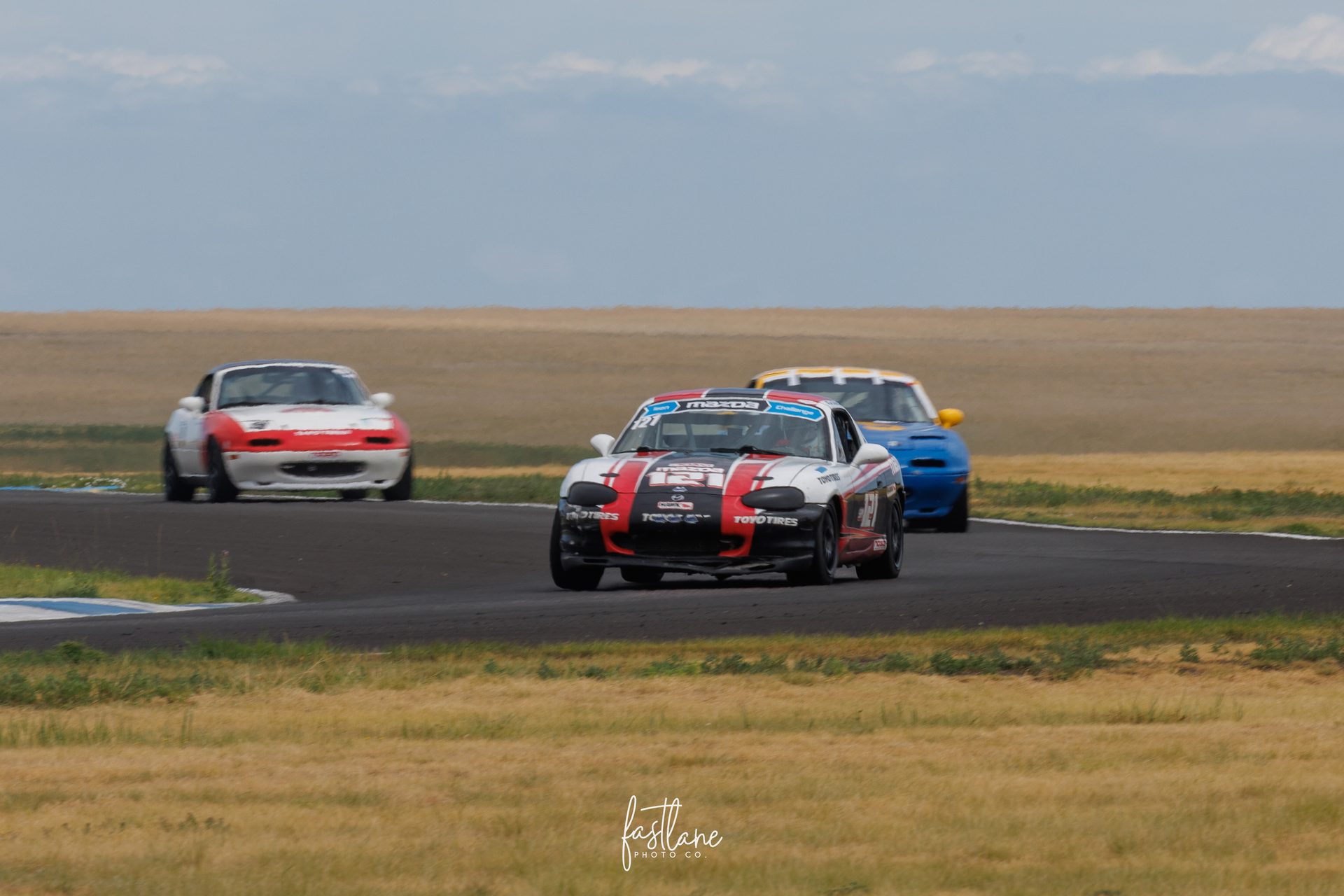 Running nose-to-tail at High Plains Raceway in August. Following close in summer heat is exactly when temps creep.
How to tell your car is overheating
Track driving is hard on a cooling system. The engine sits near full load for lap after lap, which a street commute never does. Exoracing's beginner guide puts it simply: coolant temps creep because the engine is working harder for longer.
Watch for these signs:
- The temp gauge climbs past where it normally sits. Know your normal before you go out.
- A warning light, or the car drops into limp mode. Modern cars protect themselves by cutting power. Exoracing notes the ECU pulls timing, and power, when things get hot.
- The car feels down on power for no other reason.
- Steam, or a sweet coolant smell, in the cabin or out the hood.
- Coolant on the ground in the paddock after a session.
One catch. Some stock gauges don't move until things are already bad. On one Mazda forum thread, an owner's scan tool read 225 to 240°F. His stock gauge barely moved. If you track a car often, a real readout is worth having.
What to do the moment it gets hot
This is the order I'd follow:
- Lift. Back way off the throttle and stay off the redline. Short-shifting drops the load right away. Owners suggest it again and again on track forums.
- Kill the A/C. It adds heat to the radiator.
- Turn the heater on full, fan on high. The heater core is a small second radiator. The Drive's overheating guide says it pulls engine heat into the cabin. Crack a window so you don't cook too.
- Give point-bys freely. You're slow now, and that's fine. Let traffic go using the normal HPDE passing rules.
- Get clean air. Back off from the car ahead. Running in someone's draft feeds your radiator hot, slow air.
- Come in. Don't finish the session hoping it settles. Signal and pit at the next safe chance. If the gauge is pegged or you see steam, get off the racing line and stop where corner workers can see you. Your driver's meeting will tell you exactly how your event wants that done.
That's basically a cool-down lap, just earlier.
In the pits: what to do and what never to do
Park, pop the hood, and let the heat out. Exoracing calls this "bonnet management," and it cuts heat soak.
Should you shut it off or let it idle? Sources split here. If the fan is running and the needle is dropping, a short idle with the hood up keeps coolant moving. If it's still climbing, or anything is steaming, shut it off.
Then, the hard rules:
Never open the radiator cap or reservoir on a hot engine. The system is under pressure. The Drive calls opening it "a one-way ticket to the ER for a scalded face."
- Don't pour cold water into a hot engine. Wait until it cools, then top up.
- Don't go back out "to see if it was a fluke." Driving hot can warp metal parts and take out a head gasket.
Once it's cool, check the coolant level, look for wet spots and split hoses, and make sure the fan comes on.
Why cars overheat on track
Most track overheating comes from a short list:
| Cause | What to check |
|---|---|
| Low coolant or a leak | Level, hoses, clamps, the radiator itself |
| Air trapped in the system | Common right after a coolant change. Bleed it properly. |
| Tired radiator cap | It can't hold pressure, so coolant boils sooner |
| Blocked airflow | Grass, bugs, or gravel packed in the radiator after an off |
| Fan not working | Fan, relay, or sensor |
| Old or wrong coolant mix | Exoracing warns a weak mix lowers the boiling point |
| A stock system at its limit | Some cars just aren't built for 20-minute sessions |
That last one is real. Some street cars run out of cooling on track no matter what you do. The usual fixes are a bigger radiator, an oil cooler, better fans, or a shroud. One owner on that Mazda thread got his temps under control after adding shrouded fans.
Colorado: altitude shrinks your margin
High Plains Raceway and Pueblo Motorsports Park both sit near 5,000 feet. That matters twice.
The air cools worse. Thinner air carries less heat through your radiator, which we covered in our post on horsepower loss at altitude.
Coolant boils sooner. Water boils at 212°F at sea level and about 203°F at 5,000 feet, per ThermoWorks' altitude table. A radiator cap holds roughly 14 to 15 psi above outside air. HyperPhysics says that raises the boiling point about 45°F. But that pressure is added to whatever the air gives you. Less air pressure means a lower starting point, so your margin is a few degrees smaller up here.
Add a 90-degree August afternoon, and Colorado is where a marginal cooling system shows itself.
Prevent it before your next event
- Learn your normal temps on a cool morning session.
- Fresh coolant, bled properly, and a new cap if yours is old.
- Clean the radiator front and back.
- Check the fan works before you load up.
- Plan short sessions on hot days. Skip the noon run if your car is borderline.
One more thing for racers. If you move to wheel-to-wheel, NASA racing bans glycol antifreeze. Most racers run water plus an additive instead, which carries more heat anyway. We wrote that up in can you run antifreeze in a race car.
What I couldn't verify
There's no single published "danger temperature" for every car. It depends on the engine, the coolant mix, and the cap. The number that matters is in your owner's manual or from people who track your model. Some forum fixes, like Water Wetter, worked for some owners and did nothing for others. Treat those as things to test, not guarantees.
If you want a simple way to log your temps, pressures, and between-session checks, grab the free Race Day Ready Pack. It's built for exactly this kind of day.
Sources: Exoracing — 5 Common Track Day Heat Problems for Beginners, The Drive — What To Do (And Not Do) When Your Car Overheats, HyperPhysics (Georgia State University) — Automobile Cooling Systems, ThermoWorks — High Altitude and Its Effect on Cooking, Mazdas247 forum — Overheating at Track. Forum posts are owner experience, not tested data. Verified as of November 2026, plus my own time at Colorado tracks.
Keep it cool out there, and keep coming back. Do you believe?