
There's a car in your mirror. It's been there for half a lap. You know it's faster, and you know you're holding it up.
On the highway you'd move over and wave. On a race track you can't. Every new driver gets this moment wrong at least once, and the fix is one hand signal called a point-by.
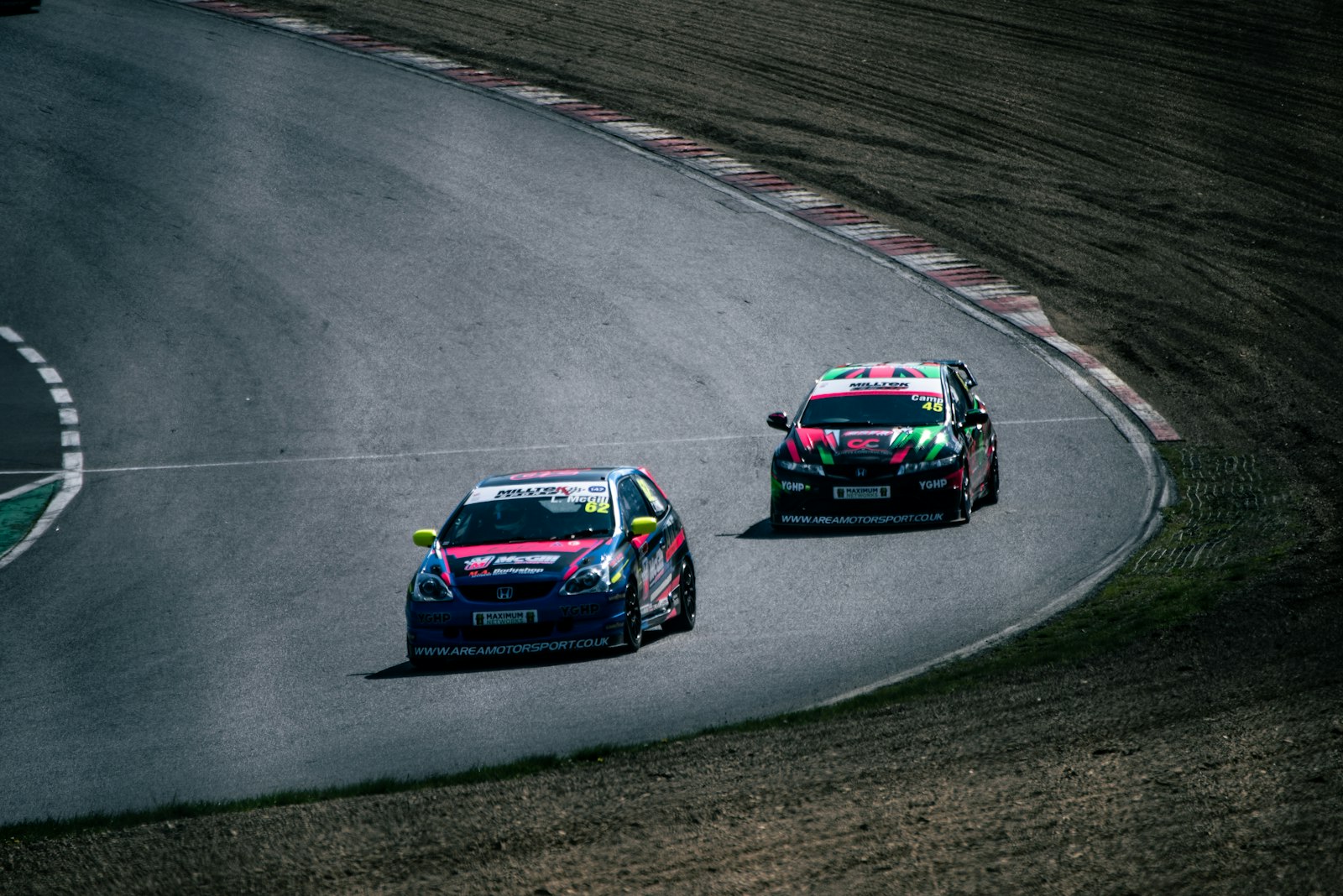 Photo by Julia Fiander on Unsplash.
No point, no pass
In a beginner run group, you may not pass another car until the driver ahead gives you permission. Not when they're slow. Not when they're obviously in your way. Not when there's a quarter mile of empty pavement in front of you.
That single rule is what makes it possible to put thirty strangers in thirty different cars on the same track and have everyone drive home. NASA, SCCA Track Night in America, and nearly every independent HPDE provider build their novice groups around it.
Pass without a point and you get black-flagged. Do it twice and your day is over. If you're fuzzy on the flags, read this first.
How to actually give one
Put your arm out the window. Not a wave from inside the car.
The driver behind you is looking through two windshields, glare, and a helmet visor. Your hand inside the cabin is invisible. The arm has to be outside, and it has to be obvious.
Then point to the side you want them to pass on:
- Left arm straight out the window — pass me on the left.
- Left arm up and curled over the roof, pointing right — pass me on the right.
You're not just saying "go ahead." You're telling the other driver exactly where you expect them to be for the next four seconds. That's the whole point. Predictability is the safety system.
The order of operations most people get backwards
This is the part nobody explains until you've already done it wrong.
- Signal first. Arm out, clear point.
- Hold your line. Most organizations want you steady and predictable, not swerving off the driving line to "make room."
- Glance at the mirror. Confirm they've actually pulled out and committed.
- Then lift.
Do it in the other order — lift, then signal — and you've just decelerated in front of a car that had no idea it was coming. That's how people get rear-ended at a track day.
Signal, hold, check, lift. In that order, every time.
Lifting matters, though. Easing off the throttle gives the passing car room to finish the move before the braking zone instead of arriving at the corner three-wide with nowhere to go.
When you're the one doing the passing
The pass belongs to you. If it goes wrong, it's on the overtaking driver, and every organization writes it that way.
Close up, but not too close. A good working distance is one where you can still see the rear tires of the car ahead and the pavement under them. Any closer and you can't react.
Watch for the mirror tap. Some drivers tap their inside rearview mirror to tell you "I see you, I'll point you by at the next zone." That's an acknowledgment, not permission. Wait for the arm.
No point, no pass — even if it's obvious. Back off, reset, try again next lap. If a driver never points anybody by, mention it to your instructor or the group leader in the paddock. That's literally what they're there for. Don't handle it on track.
Finish before the braking zone. If the pass isn't done by then, abort it and set up again.
The corner after the pass is the dangerous one. You just arrived at a turn from a spot on the track you've never entered it from. Slow your hands down and re-establish the line.
Where the rules loosen up
The point-by doesn't disappear as you climb the ladder, but the leash gets longer.
| Group | Where you can pass | Point-by |
|---|---|---|
| HPDE1 / HPDE2 (Novice) | Designated straights only | Required |
| HPDE3 (Intermediate) | Anywhere on track | Required |
| HPDE4 (Advanced) | Anywhere on track | Preferred, not required |
In NASA's novice groups, the pass has to begin after the lead car has clearly exited the corner onto the passing straight and be complete before the next braking zone. SCCA's Track Night keeps Novice and Intermediate inside marked passing zones and opens Advanced up to anywhere it's safe. Same ladder, different labels — the full breakdown is in our run groups guide.
Here's the part that trips people up in Colorado: the designated zones aren't fixed. High Plains Raceway and Pueblo Motorsports Park both have obvious long straights, but which ones are open for your group on your day comes out of the drivers' meeting and the event supplementals. They change. Sit near the front and write them on your hand if you have to. If you've never been to one of these, here's what the whole day looks like.
Once the point-by stops feeling like homework and starts feeling automatic, you've crossed the line most drivers never do. That's usually when people start wondering about wheel-to-wheel. If that's you, our arrive-and-drive program is one way to find out without buying a race car first.
Do you believe?
Sources: NASA HPDE program, NASA Speed News — Passing in HPDE 1 and 2, SCCA Track Night in America rules, Passing — High Performance Driving Education, SpeedSF — Passing Etiquette. Passing rules and run-group definitions verified against currently published NASA and SCCA guidance as of August 2026. Rules vary by region, by event, and by track — your drivers' meeting is always the final word.