
Bring a car that makes 100 horsepower at sea level out to High Plains Raceway and you'll be driving about 85. Nothing broke. The air just isn't there.
This is the question we get most often from people who fly or tow into Colorado for a track weekend. They've heard the mountains eat power. They want to know how much, and whether it's worth worrying about. Here's the honest version.
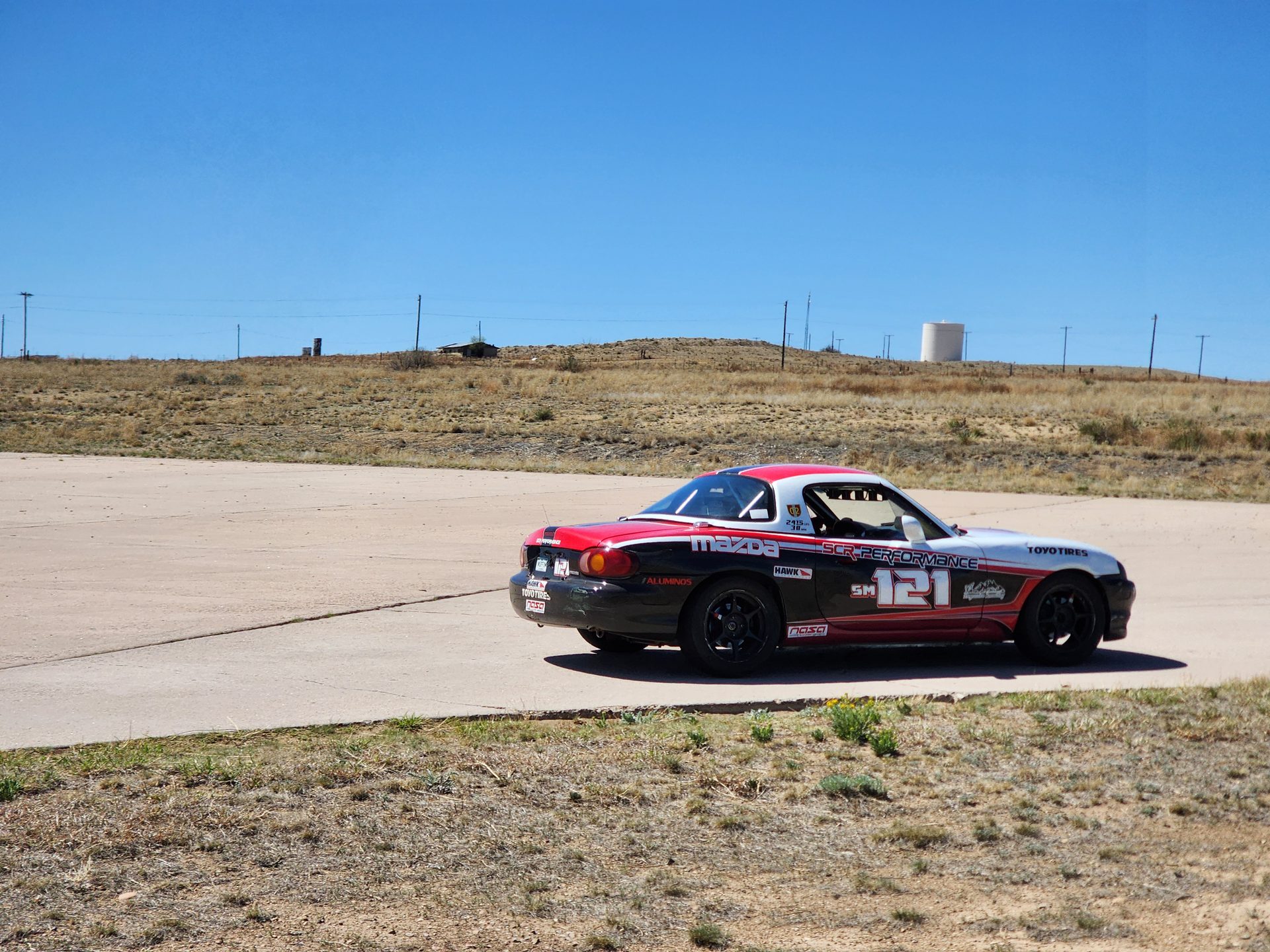 Our #121 Spec Miata. Every lap it turns in Colorado is run about 15 percent down on sea-level power.
The short answer: about 3 percent per 1,000 feet
The widely used rule of thumb for a naturally aspirated engine is a 3 percent power loss for every 1,000 feet of elevation. It's an approximation, not a law, but it holds up well in the range most of us race in.
Run that against the tracks in our region:
| Track | Elevation | Rough NA power loss |
|---|---|---|
| La Junta Raceway | ~4,100 ft | ~12% |
| Pueblo Motorsports Park | ~4,900 ft | ~15% |
| High Plains Raceway | 5,054 ft at its high point | ~15% |
| Pikes Peak International Raceway | ~5,300 ft | ~16% |
So a 130-horsepower engine is giving you closer to 110 at Pueblo. A 300-horsepower car shows up as a 255-horsepower car.
Turbocharged and supercharged cars get off much easier. A blower or turbo can compress the thin air back toward sea-level density, and the common estimate is around 1 percent loss per 1,000 feet instead of three. The turbo just has to spin harder to do it, which shows up as more heat and more work for the intercooler.
One more wrinkle: elevation isn't the only input. Heat matters too. On a hot August afternoon at a 5,000-foot track, density altitude — what the air actually feels like to your engine — can climb past 7,500 feet. Same track, same car, and it's down another chunk of power just because it's 95 degrees.
Why the air takes your power
An engine is an air pump. It makes power by burning fuel with oxygen, and the amount of oxygen it can get is set by how dense the air is.
Go up in elevation, atmospheric pressure drops, and every intake stroke pulls in less oxygen. Less oxygen means less fuel can be burned. Less fuel burned means less power. That's the whole story.
This is also why dyno numbers come with a correction factor. Standards like SAE J1349 normalize a measured number back to standard conditions using pressure and temperature. In one published worked example, an engine that measured 425 horsepower on a Denver-area dyno corrected out to roughly 495. Same engine, 70 horsepower of difference, all of it in the math.
If your car is fuel injected, it handles the mixture side automatically. The MAP or MAF sensor sees the thinner air and pulls fuel to match. You still lose the power, but the engine runs clean.
If you're running carburetors, you have work to do. A carb jetted at sea level delivers too much fuel up here and runs rich, and a common starting point is dropping one to two jet sizes per 1,000 feet of elevation gain. Vintage guys towing into Colorado — this one's for you. Bring jets.
What altitude changes besides horsepower
Power is the headline. It isn't the only effect.
Cooling gets worse. Thinner air means less mass moving through your radiator and your brake ducts. Everything runs hotter than the same lap would at sea level. Watch coolant and oil temps closely in July and August, and don't assume the cooling package that worked at your home track will be enough here.
Drag drops too — and that's the interesting part. Aerodynamic drag depends on the same air density your engine is missing. Power is down 15 percent, but so is drag, and those two roughly cancel at the top end. Terminal speed down a long straight ends up close to what you'd see at sea level. You just take a lot longer to get there. The loss shows up in acceleration, not in top speed.
Downforce drops with it. For a wing car this is a real problem. F1 teams at Mexico City, sitting above 7,300 feet, run their highest-downforce wing packages and still make roughly a quarter less downforce than the numbers suggest. For a Spec Miata or a street car on track, there's so little aero to lose that you'll never feel it. Mechanical grip is mechanical grip.
What altitude does not change
Here's the part that calms most people down: everybody around you lost the same 15 percent.
Altitude is a fixed condition of the venue, not a handicap applied to you. If you're racing a Colorado club weekend, the entire field is down the same amount. Nobody is getting an advantage. The competition is identical.
Where it actually bites people is expectations. A driver watches an onboard video from a sea-level track, or runs a track in the sim, then shows up at High Plains or Pueblo and finds their car pulling the hill slower than they expected. Then they start hunting for a mechanical problem that doesn't exist.
Your reference points shift a little too. Less thrust means you're on the throttle earlier and braking a hair later than the same car would at sea level. Not dramatically. Enough to notice in the first session.
Tire behavior deserves a mention. The thin, dry air here doesn't change grip much, but hot dry days move pressures around fast, so check them every session. We wrote about why your first lap is slow if you want the full version of that.
The part nobody warns you about: the driver
The engine loses 15 percent. So do you.
Most people start feeling altitude around 5,000 feet, which is exactly where our tracks sit. If you fly in from sea level, expect to breathe harder and tire faster in a hot car. Endurance athletes commonly see meaningful drops in sustained output during their first days at elevation.
The air out here is also very dry, which pulls water out of you faster than you'd guess. A common recommendation for athletes at altitude is an extra liter to a liter and a half of water per day on top of normal intake. In a race suit, in August, on the eastern plains with no shade, that number goes up.
Three practical moves if you're coming from low elevation:
- Start hydrating two days before you travel, not the morning of the drivers meeting.
- Get in the day before if you can. A night of sleep and a normal dinner beats stepping off a plane into a helmet.
- Treat your last session like your most dangerous one. A tired, dehydrated driver makes bad decisions right at the point in the day when they're finally going fast.
Altitude doesn't make Colorado racing harder to be good at. It makes it a little harder on your gear and a lot harder on your body. Plan for both and it's a non-issue.
If you'd rather learn our tracks in a car that's already sorted for the elevation, with a crew watching temps and a coach in your ear, that's what our arrive and drive program is for. And if you're just starting to map out the path, getting started in road racing in Colorado is the place to begin.
Sources: Garrett Motion — Turbocharging at Elevation, MotoIQ — How Dynos Lie and When to Believe One, Holley — Tuning Your Carburetor for High Altitude, Colorado Region SCCA — RMDiv Tracks, High Plains Raceway — Track Info, Williams Racing — How Altitude Affects a Formula 1 Car, Precision Hydration — Does Altitude Cause You to Dehydrate Faster?. Elevation figures and power-loss rules of thumb verified against these sources as of August 2026. Everything about how it feels from the seat comes from our own Colorado seasons.
Do you believe?