
Your race car's cooling system is full of water. Not coolant. Water.
That's not a shortcut. It's the rule. It works great until the forecast says 24 degrees and the car is parked in the paddock overnight. Here are the questions we get about it, answered straight.
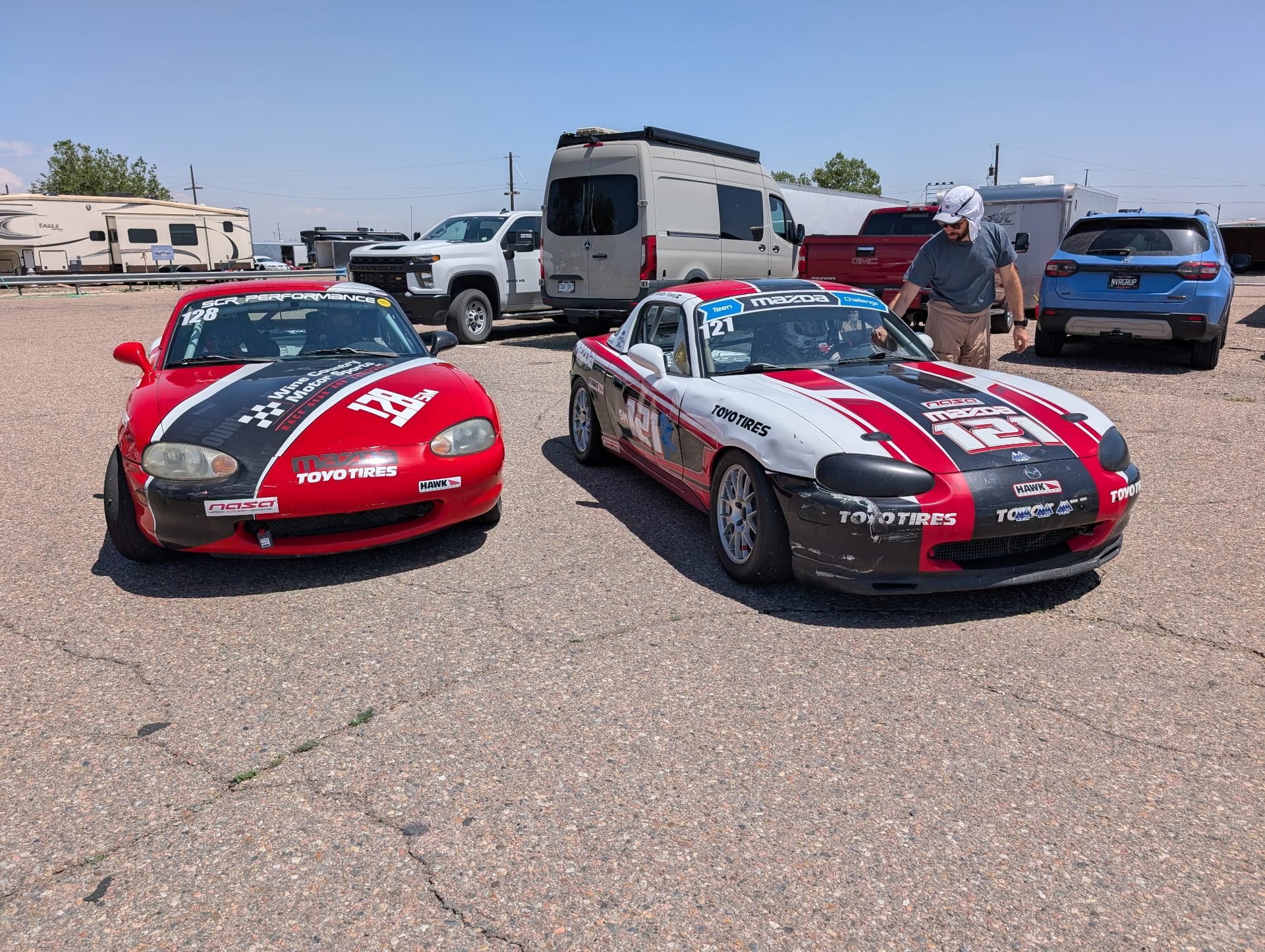 The #128 and #121 at the end of a long day. Once the sun drops, the cooling system is the thing to worry about.
Can you run antifreeze in a race car?
In NASA wheel-to-wheel racing, no. The rulebook (CCR 15.18) bans "glycol-based antifreeze and other additives that may cause a slippery condition if spilled on track." The same rule allows water additives like Red Line Water Wetter.
The reason is the track, not your engine. If a radiator lets go in Turn 1, spilled water dries off. Spilled glycol coats the racing line for everyone behind you.
That rule sits in the racing section. NASA's HPDE and Time Trial car rules don't carry the same line. But clubs and tracks set their own coolant rules, so read the event's supplemental regulations before you assume.
Isn't plain water worse for cooling?
It's better. Water carries more heat than a glycol mix. Engineering Toolbox lists water's specific heat at about 4.19 kJ/kg·K. A 50% glycol solution is about 3.53. That's roughly 16% less heat moved per pound of fluid.
Most racers add a wetting agent and corrosion inhibitor to the water. We run Engine Ice's ICE Water concentrate in our cars. Engine Ice is a sponsor, and we'd run it anyway.
Here's the catch. The product listing says it outright: ICE Water "contains no freeze protection." Neither does plain water. That's the real problem.
What happens if the water freezes?
Water grows about 9% when it turns to ice, per the University of Illinois physics department. That's a lot of force inside a sealed engine.
It can split a radiator, push out a freeze plug, or crack a head or block. You might not find out until morning. The car won't hold water, or the oil looks like a milkshake. That's a big repair, found at 7am on race day.
Is this actually a problem in Colorado?
Yes, and earlier than people think. The National Weather Service in Pueblo puts the normal low at 28 degrees on November 1. By the end of the month it's 17.
Our season finale runs at Pueblo Motorsports Park in November. High Plains Raceway near Byers sees freezing nights in spring and fall too. If you're camping at the track, your car sits out in that all night.
How do you protect a water-cooled race car overnight?
Here's our crew's rule. It kicks in any night the forecast low is 34 degrees or colder, at the track or at home. We use 34, not 32, because forecasts miss.
Option 1: Keep it warm. Put an electric coolant heater or oil-pan heater on each car. Run it on shore power or a generator. Keep the generator at least 20 feet from any door, vent, or trailer opening. Never run a fuel-burning heater in a closed trailer.
Option 2: Take the water out. No power? Drain the cooling system into labeled jugs. Hang a bright tag on the wheel: "NO COOLANT, DO NOT START." Someone will try to fire it in the morning. The tag stops them.
The morning refill. Refill with pre-mixed distilled water and additive. Wear gloves and goggles, because the concentrate is corrosive. Bleed the air out and check for leaks before grid.
The proof. A cheap refractometer with a glycol scale should read 0%. That confirms no glycol is in the system, and it proves you're legal if tech asks.
What we don't do is pour in antifreeze for one cold night mid-event. Glycol is hard to flush out completely in a paddock. You'd race the next morning with a banned fluid still in the engine.
What about storing the car all winter?
That's a different job. NASA's own magazine ran a winterizing guide. Its advice: drain the water and fill with a 50/50 glycol mix for the winter. In spring, flush it and go back to distilled water plus additive. A heated garage is the other answer. The same article calls trailer heaters a weaker option.
If you go the glycol route, the spring flush is not optional. Flush until the refractometer reads zero.
That guide also flags brake fluid soaking up moisture over the winter. We covered that in racing brake fluid, explained. The full off-season plan covers the rest of the car.
The honest summary
Water is the right coolant for a race car. It cools better, and it won't turn the track into an ice rink if something breaks. The price is that it freezes like water. Treat every cold night as a line on the checklist, not a thing you'll remember.
We built that kind of checklist into our free Race Day Ready Pack. Put "forecast low?" on your evening list, and the morning goes a lot better.
Sources: NASA Club Codes and Regulations 2026.3, section 15.18, NASA Speed News: Into Hibernation, Winterizing a Racecar, Engineering Toolbox: Ethylene Glycol Heat-Transfer Fluid, Engine Ice ICE Water product listing (Cycle Gear), University of Illinois Physics: Volume of Water After Freezing, NWS Pueblo: November 2020 Preview. Rules and figures checked against these sources as of October 2026. The overnight protocol is our own crew's rule.
Do you believe?