
Here's a line from a veteran racing columnist that stuck with me: the race officially starts at the green flag, but "the real race started at least half a lap ago."
He's talking about the rolling start. It's how most club races begin, and it's nothing like the standing start you've seen on TV. If your first wheel-to-wheel weekend is coming up, this is the part nobody walks you through.
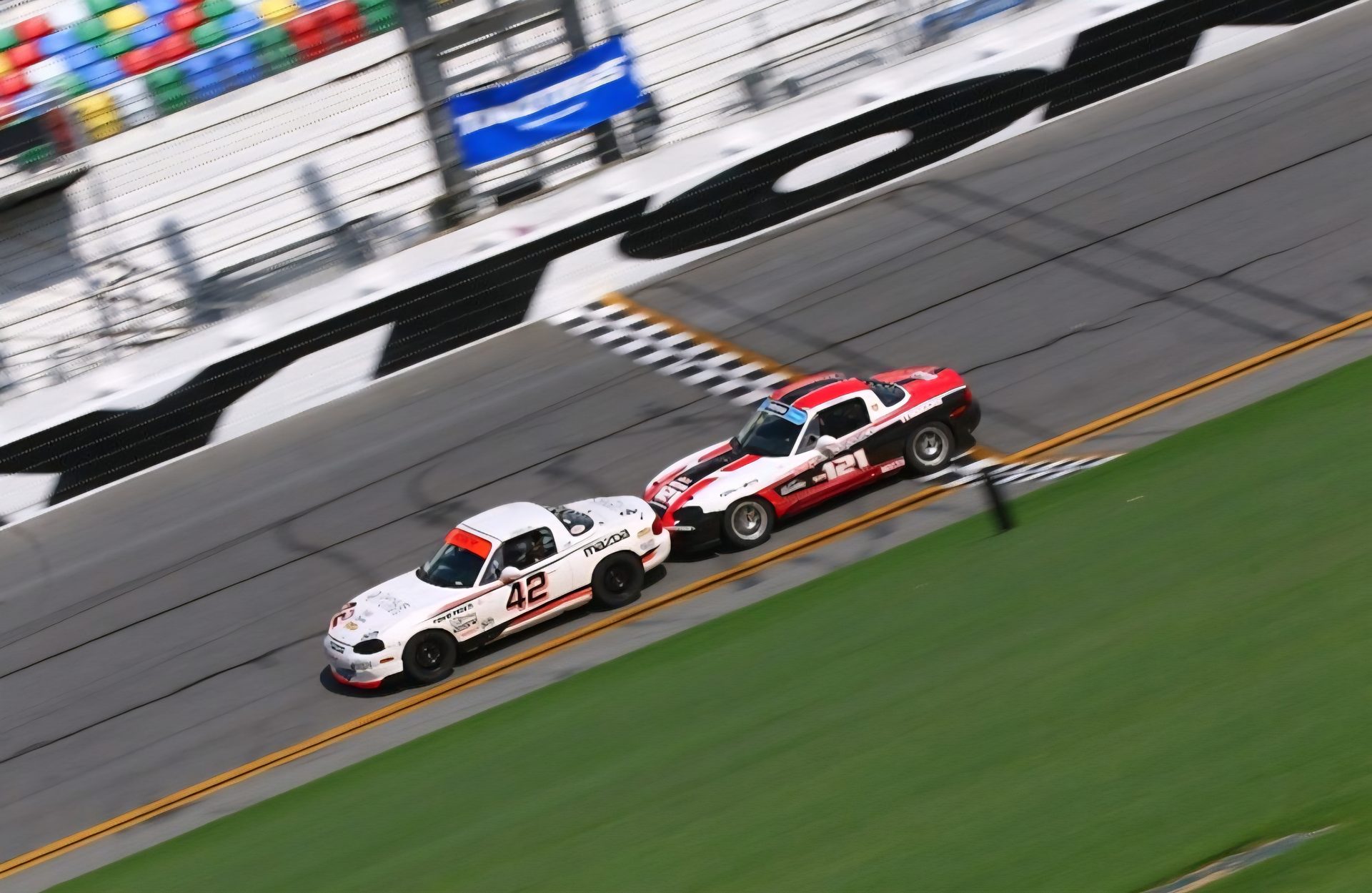
Rolling start vs. standing start: the short version
| Rolling start | Standing start | |
|---|---|---|
| Cars at the green | Already moving, in formation | Stopped on the grid |
| Who sets the pace | Pace car, then the pole car | Nobody, lights or flag decide |
| Skill that matters most | Pace-lap prep, spacing, timing the throttle | Clutch launch, wheelspin control |
| Where you see it | SCCA, NASA and most amateur racing | Formula-style series, some pro races |
| Restarts | Almost always rolling | Not used |
Wikipedia's rundown of the two says restarts are nearly always rolling because they're faster to organize. Formula series tend to use standing starts for the opening start, and a closely packed rolling start can overheat engines and raise crash risk in very fast cars.
For club racing, plan on rolling. Your event's supplemental regulations are the final word, so read them before you travel.
How a rolling start works, step by step
Every event tweaks the details. The pattern is the same.
- The grid forms up. Cars line up in qualifying order, in rows.
- The pace car leads a lap. It leads the field around at a set pace speed. The number of pace laps depends on the event.
- You get a few seconds of freedom. You can weave and scrub tires while the pace car lights are on.
- The lights go out. Now you form up in tight rows and columns and hold your spot.
- The pace car pulls off. It exits into the pit lane, and the pole car now controls the speed of the field.
- The green comes out. The starter shows it, usually near the start line. Then, and only then, you go.
Here's the real wording from one SCCA event. A chief steward wrote it into the 2023 Jim Starke Memorial driver notes:
"You may scrub tires on the race track only as long as the Pace Car lights are flashing. Once they go out, you need to form up in perfect columns and rows. There will be no speeding up and slowing down, moving out of line or any other actions that could be considered racing tactics. You are not racing until the Starter displays the green flag."
That same notice says the SCCA standard rolling start is defined in section 6.5.3 of the club's General Competition Rules (GCR). It also gives the pace speed for that event, between 35 and 45 mph depending on the race group. Another event's notice from the same steward gave 30 to 40 mph. That tells you something useful: the numbers change by event. The principle doesn't.
I couldn't pull the current GCR or NASA Club Codes and Regulations (CCR) text for this post, so I'm not quoting rule numbers beyond that. A NASA Speed News column pointed to the CCR's start procedures section. Ask your region or read the supplement.
What you do on the pace lap
The pace lap isn't a parade lap. It's your last chance to get the car ready.
- Clean your tires. Weave a bit on clean pavement to scrub off pickup. Stay out of the dusty or debris-covered areas.
- Heat your tires and brakes. Lateral scrubbing helps. So do a few hard accelerate-then-brake pulses, as long as you stay inside the rules and don't surprise the car behind you. The NASA column's advice is blunt: "Clean and heat your tires on the pace lap!"
- Pick your gear. Most drivers want to be in the gear that pulls well at pace speed, with revs near where the engine makes good torque.
- Look around. Know who's beside you, who's behind, and what the cars ahead are doing.
This is where cold tires versus warm tires matters most. A cold car on a green start is a slow car, and slow cars get passed in turn one.
What the pole car and the rest of the field do
The pole car holds the pace car's speed after it leaves. The NASA column says the pole driver can choose lateral placement as long as the outside car has room. It also notes that pole drivers often come out of the last corner wide, because many drivers drift toward the middle.
Everyone else has one job: stay in your row. The same column warns that creeping ahead of the pole car risks a black flag or an aborted start. If you want the details on what that flag means, I wrote up what happens when you get black-flagged.
Don't "jump" the start either. Wait for the green flag, watch the starter, and don't rely on the car ahead. The same article is just as clear on restarts: stay close and "do not wait for the car ahead to accelerate."
Standing starts: the exception, not the rule
A standing start is the old-school launch. You sit on the grid with the engine running. The signal drops, you dump the clutch, and everybody goes at once.
It takes a different skill set. The NASA column's launch advice: learn the RPM range that works for your car, avoid slipping a competition clutch, and accept that a little early wheelspin is okay.
You probably won't need it. If an event does run one, the supplemental regs and the driver's meeting will say so. What happens at a driver's meeting covers why you never skip it.
Five rolling-start mistakes new racers make
- Racing for the win before turn one. A veteran starter's line says it all: "You can't win the race in the first turn, but you sure can lose it."
- Braking too early out of habit. Pace speeds are low, so turn one may need little or no braking. If you brake from your normal point, you cause a pileup behind you.
- Letting the gap open up. If you lag, the car behind jumps you. If you rush, you risk a penalty. Stay close and steady.
- Staying mid-track on the pole. The outside line gives you room to defend the first corner.
- Having one rigid plan. Watch for cars moving sideways, wheelspin or a late dive down the inside. Be ready to lift and hold your spot. The NASA column says it plainly: waiting for another chance beats a spin or a crash.
For more on what happens once you arrive at that first corner, read why new drivers struggle in turn 1. And if you haven't yet raced wheel-to-wheel, what to expect at your first wheel-to-wheel race covers the rest of the weekend.
What I couldn't verify
I found no controlled data on how much time a good rolling start gains. It's all coach and driver advice. I also couldn't read the current GCR or CCR start sections, so the rule specifics here come from event notices and a NASA instruction column, not from the rulebooks. Your supplement and your starter beat anything I write.
If you want to see what you'd be signing up for, the free Race Day Ready Pack has a pre-race checklist you can print for your first weekend.
Sources: NASA Speed News: Leap of Faith, how to make the most of race starts (2013, refers readers to the NASA rules section on starts), SARRC Jim Starke Memorial SCCA event notice, chief steward letter, 2023 and a second SARRC event notice, 2024, Wikipedia: Rolling start, Winding Road: Speed Secrets, a starter's perspective (quote read through search results only, since the site blocked a direct fetch). Checked November 2026. Pace speeds and procedures change by event and region, so treat these as examples, not rules. Your supplemental regulations and driver's meeting are the authority.
Do you believe?