
Your first fast corner in a real race car, your helmet tries to leave the car. It leans toward the door, and your neck has to hold it back. Then you hit the brakes and your body slides forward into the belts.
A sim can't give you that. So let's talk about what it actually feels like, and how to get ready before you're strapped in.
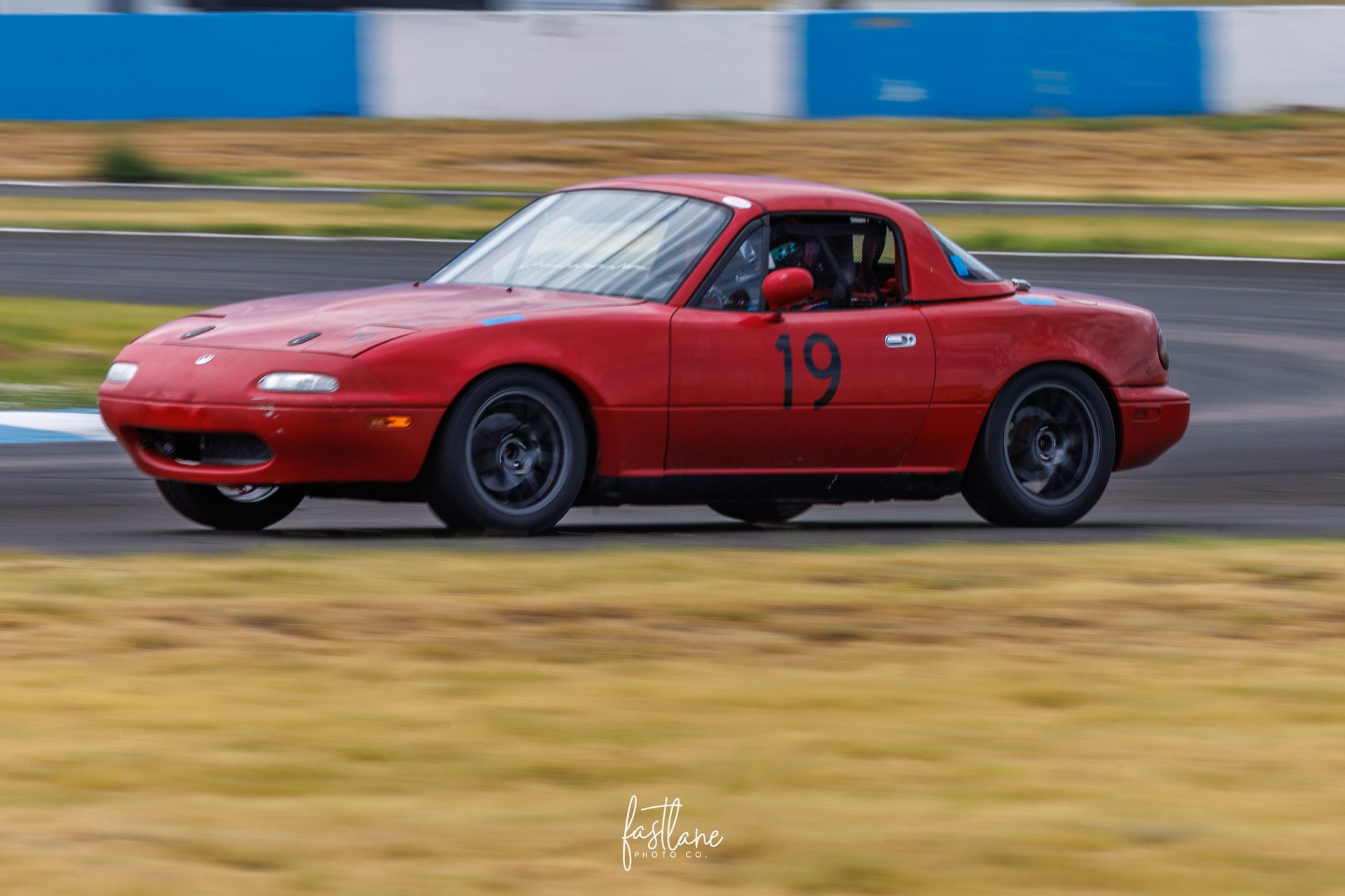 The #19 loaded up in a corner at High Plains Raceway. In there, the driver's neck is doing real work.
Why your sim rig can't fake this
A g-force is just acceleration measured against gravity. At 1g sideways, your body gets pushed toward the outside of the corner as hard as gravity pulls you down.
To feel that for more than a split second, you have to actually move through space. A home rig stays in one spot. Motion makers like D-BOX say it plainly: g-forces need large distances to be strongly felt, so a motion seat uses quick cues and tilts to trick your brain instead.
Those cues help. But the push fades in a moment. In a real car, the push lasts the whole corner.
How hard does a real car pull?
It depends on the car. Here's the honest range.
- A Miata on track tires: Roughly 1g in fast corners, a bit more at peak. One Miata builder logged about 1.1g sustained with a 1.3g peak in a fast sweeper, in a car with aero added. Treat that as a ballpark, not a spec.
- Formula 1: A different planet. Formula 1 reports sustained cornering loads of 4 to 5g, with peaks near 6g.
So 1g doesn't sound like much next to F1. Here's why it still gets your attention.
At 1g sideways, your head and helmet pull toward the door with their full weight. Every corner. Every lap.
A physio writing in the British Journal of Sports Medicine blog puts the head at about 7% of body weight and a helmet at about 1.2 kg. For a 150-pound driver, that's roughly 13 pounds of head and helmet. At 1g, that's about 13 pounds of sideways pull your neck has to hold, corner after corner.
Do that for a 20-minute session and you'll feel it the next morning.
Five steps to get your body ready
None of these need a gym membership. Do them in order.
Step 1: Train your neck, gently
Your neck is the first thing that gets tired. Start light. Daniel Ricciardo has said you don't want to start by hanging heavy plates off your head.
Use a resistance band or just your own hand. Push your head forward, back, and to each side against light resistance. Hold a few seconds each way. Flow Racers' neck training guide warns that direct neck work can cause damage if done too hard, so build up slowly. If you have any neck history, ask a physio first.
Step 2: Build your core
Your core keeps your upper body planted when the car tries to throw it sideways. Planks and side planks do most of the job. Our no-gym racing fitness plan has a full weekly routine if you want one.
Step 3: Get your seat and belts right
A loose seat makes g-forces feel twice as bad. If your body slides around, your arms end up holding you in place instead of steering.
You want your hips locked in the seat and the belts snug. Our guide to the right racing driving position walks through it in order.
Step 4: Expect your eyes to work harder
This one surprises people. That same BMJ article links poor head control to worse depth perception, and worse depth perception to earlier braking. When your neck tires, your head tilts, and your braking points get fuzzy.
So in the car, keep your eyes level and look far ahead. Let your head lean into the corner a little rather than fighting it.
Step 5: Ramp up across the day
Don't try to hit your sim lap time in session one. Your body needs a session or two to learn the new loads.
Drive at maybe 80% early. Notice where your neck and shoulders tense up. Breathe out through the long corners. By the afternoon, most of the strangeness fades and the driving comes back.
The first time is the best part
Honestly? Feeling real grip for the first time is the moment most sim racers get hooked. It's not scary once you're ready for it. It's the thing the sim was pointing at all along.
Our post on taking sim racing to real racing covers the rest of the jump. And if your nerves are the bigger worry, read our sim racing mental prep guide next.
If you'd like to feel real g-forces for the first time in a prepped Spec Miata, with a crew and coaching around you, our full-season arrive-and-drive seats are open for 2027. Request a call and we'll talk it through.
Before your first real weekend, grab our free Race Day Ready Pack. It has the checklists and packing list so your body is the only new thing you have to deal with.
Sources: Formula1.com: How to train like an F1 driver, BJSM blog: Training for extreme G-force loads on the neck, D-BOX: How racing simulators replicate g-forces, Flow Racers: Race driver neck training, Jalopnik: How F1 drivers train for g-forces, Targa Miata build diary. The head-and-helmet math uses the BJSM figures. The Miata g number comes from one builder's logged lap, so it's a ballpark. Checked October 2026, combined with my own racing experience. This isn't medical advice.
Do you believe?