
Nobody has ever been black-flagged for sitting wrong. That's the problem. You drive a whole season a little too far from the wheel, a little too reclined, and nothing ever tells you it's costing you.
It shows up as a car that feels vague. It shows up as arms that are cooked by lap twelve. It shows up as a slide you felt half a second too late.
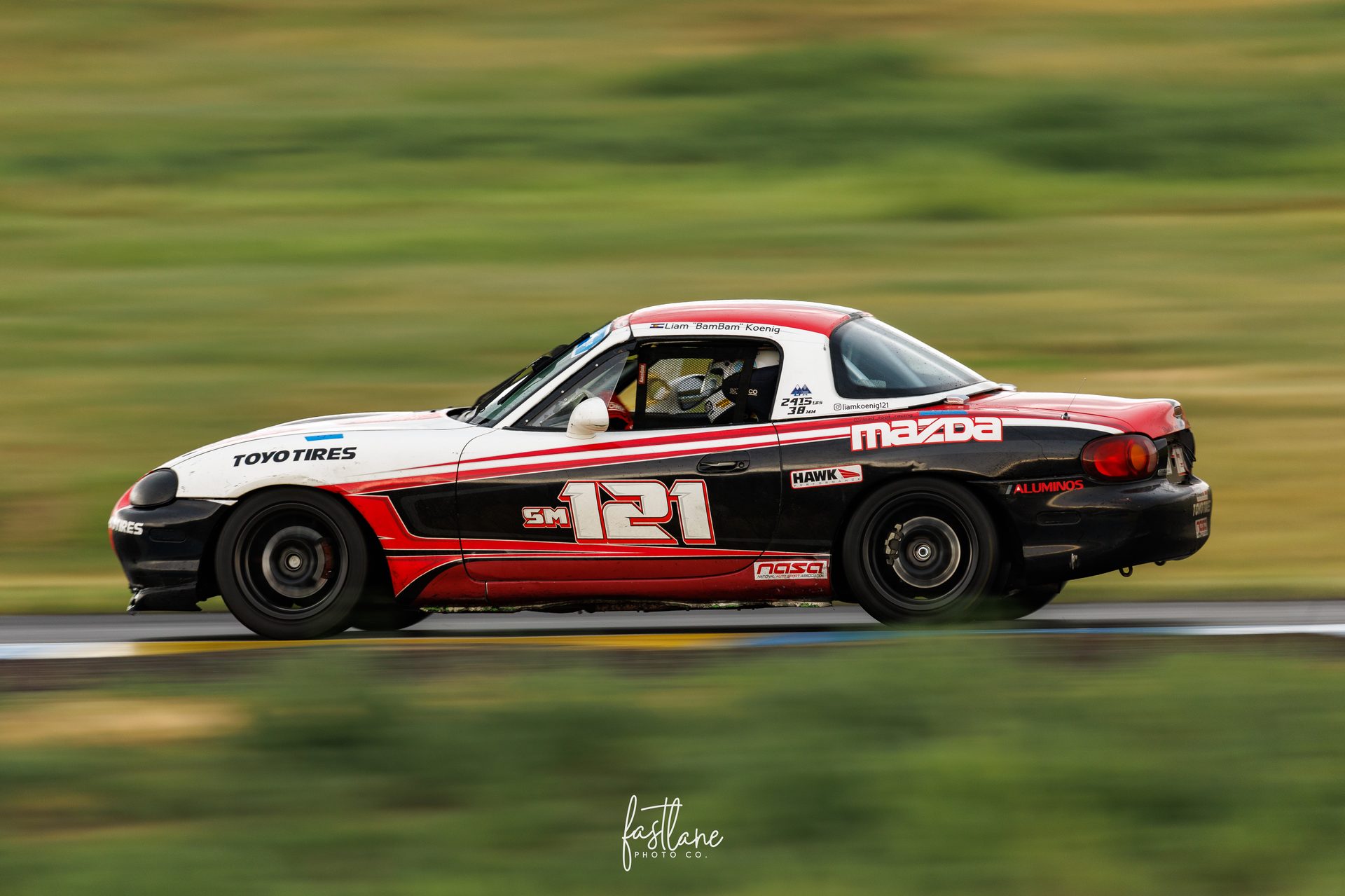 The #121 on the exit line at High Plains Raceway. Everything the driver knows about that corner arrived through the seat.
Position Is a Performance Item, Not a Comfort Item
Here's the part most people get backwards. You don't feel the car through your hands. You feel it through your back and your hips.
Weight transfer, the rear starting to rotate, the front washing out — all of that arrives as pressure against your body first. Your hands get the news later.
So if you're loose in the seat, or holding yourself up with the wheel, you've put insulation between you and the information. The car goes quiet on you.
The best drivers aren't gripping harder. They're braced better, so their hands are free to be gentle.
There's a second reason, and it's the one that matters more. A straight leg is a leg that breaks in a crash. Skoda Motorsport's own driver-coaching material says it plainly: your legs should never be fully stretched, even when a pedal is on the floor. Position is safety equipment you set for free.
Set It In This Order
Order matters. Fix the pedals first and everything downstream falls into place. Do the reverse and you'll chase your own tail.
1. Feet first. Slide the seat so you can put the brake pedal all the way to the floor with a clear bend still left in your knee. If your leg locks straight, you're too far back. If your knee is folded up into the wheel, you're too close.
2. Backrest next. More upright than you drive on the street. Sitting up gets your shoulders into the seat, improves your view over the nose, and keeps you from steering with your elbows pinned against your ribs.
3. Wheel distance last. With your shoulders pressed flat against the seat back, your elbows should hold a real bend — roughly 45 degrees is the number coaches use. If your car has a telescoping column, this is what it's for.
4. Height, if you have it. Low is good for center of gravity, but not at the cost of sight. The common guideline is to sit low enough that you just barely see the top of your hood. Lower than that and you're guessing at apexes.
5. Hands at 9 and 3. Thumbs resting on the rim or the spoke face, not hooked around the back. From 9 and 3 you can steer nearly 180 degrees each direction without ever letting go, which covers every corner you'll meet on a road course.
Three Checks That Take Ten Seconds
Do these in the paddock, in your gear, before the first session. Not while rolling to grid.
The wrist test. Shoulders on the seat, arm straight out. Your wrist should rest on top of the wheel without you leaning forward to reach it. Leaning means you're too far away.
Full-lock knee sweep. Turn the wheel lock to lock. Your knees should never touch it and your elbow shouldn't slam the door card. If it does, you need a smaller wheel or a different position, and you'd rather learn that now than mid-corner.
Helmet clearance. Put the lid on and sit up. You want an inch or two between your helmet and the roof or the roll bar. Anything tighter and a bump becomes a headache — which is exactly why the same check belongs in your first HPDE prep routine.
One more: do all three wearing what you'll actually wear. A race suit, gloves, and a head-and-neck restraint change every one of these numbers. A position set in a t-shirt is not the position you'll drive in.
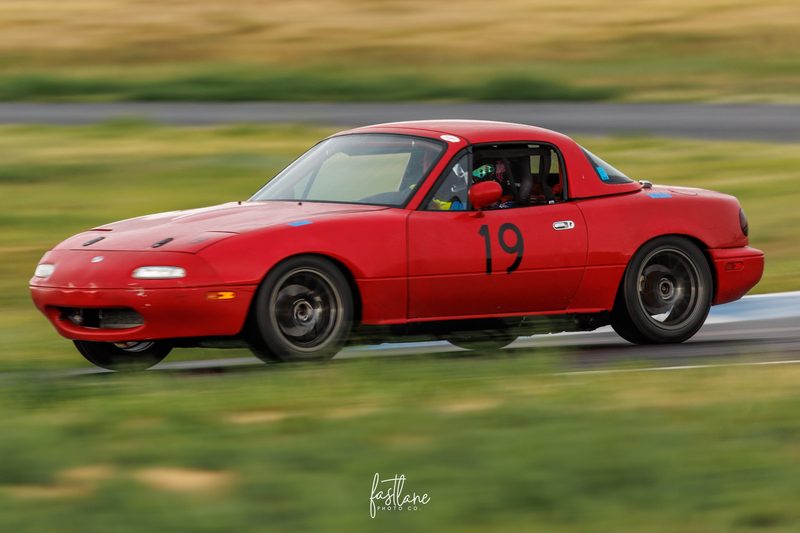 The #19 through a sweeper at High Plains Raceway. Long, loaded corners are where a bad seating position quietly costs you.
If Your Seat Doesn't Adjust
Fixed-back race seats don't slide, don't recline, and don't care about your preferences. You adjust everything else instead.
- Brackets and sliders. Most seats mount on a bracket that offers a few hole positions, and you can add a slider if your class allows it. Getting the base right is worth more than any amount of foam.
- Dense foam, not soft foam. Thin high-density foam behind your back or beside your hips closes a gap without adding squish. Soft cushions compress under load and give you the vague feeling you were trying to fix.
- Harness geometry. This is the one people skip. SFI's published seatbelt installation guide calls for shoulder belts mounted 0 to 20 degrees down from the top of your shoulders. Lap belts want a much steeper angle, roughly 45 to 65 degrees down from the hip. Shoulder belts that pull upward are not a setup preference — they're a hazard.
If you're running a head-and-neck restraint, harness geometry gets stricter still, and most drivers move to two-inch shoulder straps so the belts sit correctly on the device. The full breakdown is in our HANS device explainer. Always check your own harness manufacturer's instructions, because the numbers vary a little by brand.
The Mistakes I See Most in the Paddock
Straight-arm driving. Sitting way back looks fast on TV and is terrible in a car with real steering effort. You lose leverage, you can't feel loading, and you fatigue quickly.
The lounge chair. Reclined so far you're looking at the sky through the top of the windshield. You can't see the apex and you're sliding around in the seat.
The death grip. If you're squeezing the wheel to hold your body in place, the seat is doing none of its job. Brace with your left foot on the dead pedal and let your hands relax.
Setting it once and never again. New seat insert, new suit, thicker socks, a different helmet. Re-check.
Adjusting on track. Reaching for a seat lever at 90 mph is how people go off. Get out, fix it, come back.
The Colorado Version of This
Our NASA Rocky Mountain weekends at High Plains Raceway and Pueblo Motorsports Park run long, hot sessions with a lot of loaded, sweeping corners. HPR in particular is not a smooth track. If you're loose in the seat, twenty minutes of that will beat you up and your last three laps will be your worst.
That's the honest tell. When drivers say they "fade" at the end of a session, position is the first thing I check — before tires, before fitness, before anything in the track guide.
Get it right and the car starts talking to you. That's not a metaphor. You genuinely feel more.
If you'd rather skip the fabrication project and just go drive, that's what our arrive and drive program is for. You climb in, we fit you to the seat, and the only thing left to work on is your driving.
Sources: Drivingfast.net — Driving Position, Track Manual — Proper Driving Position, Skoda Motorsport — Sitting Like a Racing Driver, SFI Foundation — Seatbelt Installation Guide, Behrents — Racing Harness Guide. Harness angles cross-checked against two independent published installation guides; confirm final numbers against your own harness manufacturer's instructions, since specs vary by brand. Everything else here is from coaching drivers in our own cars.
Do you believe?