
Skipping a new set of race tires feels like the smartest money move in the whole budget. It's about $1,200 you don't have to spend this weekend.
Here's the problem. Everything else on that weekend still costs full price. Old tires don't cut the bill. They cut what you get for it.
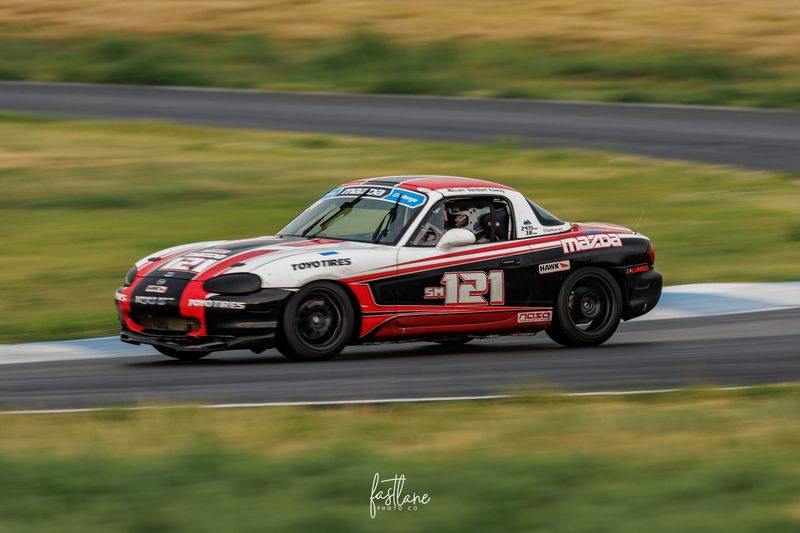
 Car #121 at High Plains Raceway. Corner exit is where tired tires tell on you first.
The Math Nobody Runs
Start with what a competitive Spec Miata weekend costs. Our floor is about $2,500 in consumables. That's a set of tires around $1,200 mounted, an entry around $500, plus fuel, brake pads, fluids and the small stuff.
Now take the tires out. You "saved" $1,200. But the other $1,300 or so is still due. NASA Rocky Mountain's published entry alone runs $399 to $499 depending on when you sign up. Fuel still burns. Pads still wear. The tow still costs what it costs.
So the real question isn't "can I afford tires?" It's this:
What am I buying with the $1,300 I'm spending anyway?
If the answer is "two days of sliding around, learning nothing," that money is gone. That's the false economy. You didn't save $1,200. You wasted $1,300.
This is simple arithmetic from our own budget numbers, not a survey. Your split will be different. The shape won't be.
Four Ways Old Tires Cost You More
1. They waste the entry fee
The entry is the one cost you can't shrink. It's the same whether you show up on stickers or on tires from two seasons ago.
On worn-out rubber, you're paying full price for a weekend where the result was decided before you unloaded. That's fine if you went to practice. It's a bad deal if you went to race.
2. They poison your data
This is the hidden one, and it's the one I care about most as an engineer.
Every session is supposed to teach you something. Did that pressure change help? Was that new brake point faster? You can't tell on a dead tire. The tire is the biggest variable on the car, and if it's falling off, every other change gets buried under it.
You leave with a weekend of lap times you can't trust. Then you make setup decisions off bad numbers. That costs you again next time.
3. You can't see what you're buying
Old race tires don't look old. That's what makes them a trap.
Hoosier's own technical guidance says aging is sped up by heat, cold, sunlight, solvents and fluids, and that poor storage and infrequent use speed it up too. In an SCCA SportsCar feature on tire storage, Hoosier's Tim Gilvin put it plainly: "From the day it's made, the clock starts ticking." A Tire Rack rep in the same piece said R-compound tires raced and then stored over winter won't perform at the same level next spring.
None of that shows up on the tread. A tire can have plenty of rubber left and still be done. That's why a cheap used set from a stranger is a gamble. You don't know how many heat cycles it has, how it was stored, or how old it really is.
4. They raise the odds of the expensive day
Less grip means less margin. The tire lets go sooner, and it gives you less warning.
I'm not going to invent a crash statistic for this. But anyone who's watched a car slide off at the end of a weekend knows the math. One trip into the wall can cost more than a whole season of tires. We broke that down in what Spec Miata crash damage actually costs. Read that one before you decide tires are the place to save.
How Old Is Too Old?
There's no single number. But there are a few honest guideposts.
- Hoosier's line: new (sticker) tires should go into service within 2 years of purchase. Used tires have a shorter service life than new ones.
- One racer's real-world test: the No Money Motorsports blog found a dry Toyo race tire stayed good for about a year after its first heat cycle, then dropped off. After two years, the author said "it would be quite a stretch to call them competitive." He doesn't recommend running any tire older than five years on track.
- Check the date code. Every DOT tire has a four-digit code on the sidewall. The first two digits are the week, the last two are the year. A code of 3324 means week 33 of 2024. Look before you buy used.
Storage matters as much as age. We covered that in how to store race tires over winter. A set kept in a freezing shed can age out faster than its date code says.
 Grip you can't see is grip you can't plan around.
When Cheap Tires Are Smart
Cheap tires aren't always a mistake. Here's where they make sense.
Practice and test days. Nobody hands out trophies on Friday. Running scrubs in practice and saving your good set for qualifying and the race is just smart. Used Spec Miata tires at three-quarter tread sell for around $100 each from used-tire sellers. We go deep on that two-set system in what Spec Miata tires actually cost per weekend.
Rain tires. The same No Money Motorsports write-up raced rain tires that were 8 years old and called them fine. Rain tires mostly move water. They don't live on heat the way dry tires do.
Your very first events. If you're there to learn the track and get your license, you don't need fresh stickers. You need seat time.
The false economy kicks in when you take tired tires to a weekend where you need them to be good. Race day. Qualifying. The session where you're testing a setup change.
The Better Fix: Get Someone Else to Pay for Rubber
If the honest answer is "I can't afford fresh tires," the fix isn't to race on dead ones. It's to find the money.
Tires are one of the easiest things to get sponsored. They're a clear, real cost with an obvious number on it. Les Schwab handles our mounting, balancing and disposal, and at our tire volume that saves us real money every season. It's a local business, a clear ask, and a clear return. I walk through how to make that pitch in how to ask a sponsor to buy your tires.
The weak spot for most racers is the pitch itself. If you've written one and you're not sure it's ready, The Pitch Inspection is $39. We mark it up line by line before it ever reaches a sponsor.
The Bottom Line
New tires cost money. Old tires cost money too. They just hide the bill inside your entry fee, your data and your risk.
Budget tires like you'll pay full price for a race set. Use scrubs where scrubs belong. And if the number still doesn't work, go get it funded instead of going without.
If you want the whole funding process in one place, The First Sponsor System is the set of documents we use to fund our own cars, from the first list to the signed deal.
Sources: Hoosier Racing Tire — Technical Information, SCCA SportsCar — "Bag It" (tire storage feature), No Money Motorsports — Does race tire age really matter?, UsedRacingTires — 205/50/15 Hoosier SM7.5, NASA Rocky Mountain event listing on MotorsportReg. The tire and weekend figures are our own budget numbers for a mounted race set and a competitive weekend; the "$1,300 you spend anyway" is arithmetic from those numbers, not survey data. Tire age guidance varies by compound and maker, so check with the maker of your own tires. Checked as of October 2026.
Do you believe?