
You pick your favorite photo of the season for the pitch. Rear three-quarter, sun flaring off the decklid, everything blurred but the car.
It's a great picture. It's a terrible pitch slide.
The person reading it is trying to find one thing in that frame, and they can't: their logo.
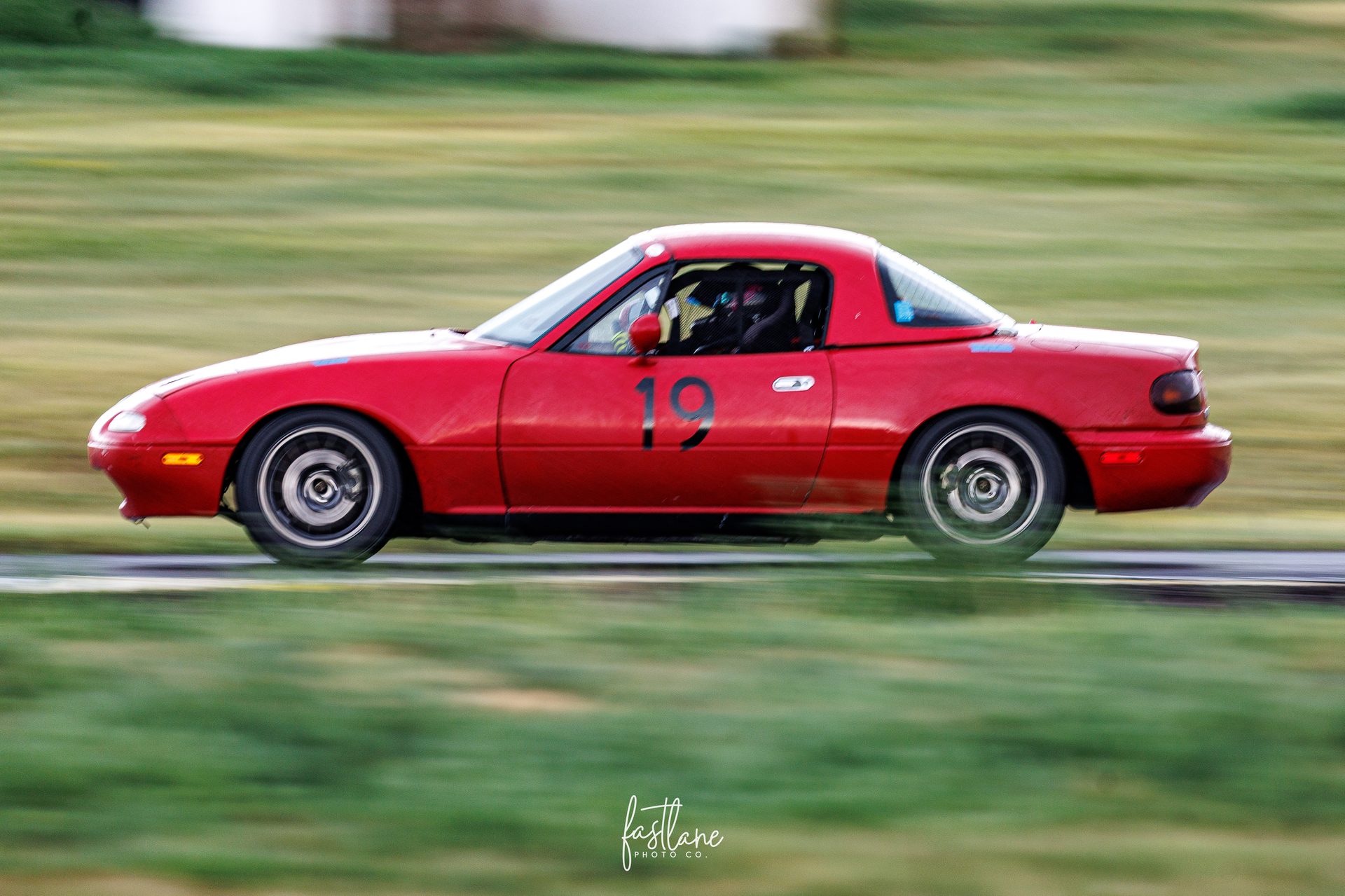 The #19 at full flight at High Plains Raceway, NASA August weekend. Shot by Fastlane Photo Co. This is the frame a sponsor wants — the whole side of the car, sharp, every decal readable.
Sponsors don't want your best photo. They want theirs.
You choose photos like a racer. You pick the frame where the car looks fast and you remember the lap.
A marketing manager chooses photos like a buyer. They ask one question: can I use this?
RTR Sports, a motorsport sponsorship agency, publishes a visibility breakdown from MotoGP. Over a race weekend, the rider generates roughly 48% of total brand visibility. The bike gets 27%, the staff 13%, the garage 7%. That's MotoGP, not a Colorado club race, and the percentages won't carry over cleanly. The direction does.
The human is the asset. The car is the backdrop.
People stop scrolling for faces. Brands know it. Which is why the photo of you with your helmet off, sweaty, holding the product, will outwork the panning shot almost every time.
The five shots that belong in a pitch
Pro teams don't leave this to chance — commercial motorsport shooters build their brief straight off the sponsor contract, so the required angles get captured during the session instead of being begged for afterward. You can do a smaller version of the same thing with five frames.
| The shot | What it proves | Where it goes |
|---|---|---|
| Clean side profile at speed | Their logo is legible and in a real environment | Deck cover, deliverables page |
| Driver portrait, helmet off | There's a person attached to the money | Your bio page, their social |
| Product in actual use | The partnership is real, not a sticker | Recaps, their product pages |
| People around the car | You have an audience they can reach | Audience/reach page |
| One story frame | Emotion — rain, traffic, a bad day | Opening slide |
A few notes on getting each one right.
The side profile has to be sharp on the car and the decals, even if the background is a blur. Ask your photographer for that specific frame. Most shooters have it. Nobody ever asks.
The product shot is the one most racers skip, and it carries the most commercial value. Coolant going into the radiator. A crew member in the sponsor's shirt torquing a wheel. If a brand gave you a thing, photograph the thing doing its job.
The people shot doesn't need a grandstand. A paddock crowd, a kid sitting in your seat at a show-and-shine, a business owner standing next to the car — all of it counts. That's the closest thing a grassroots racer has to audience proof, and it pairs with the numbers in your media kit.
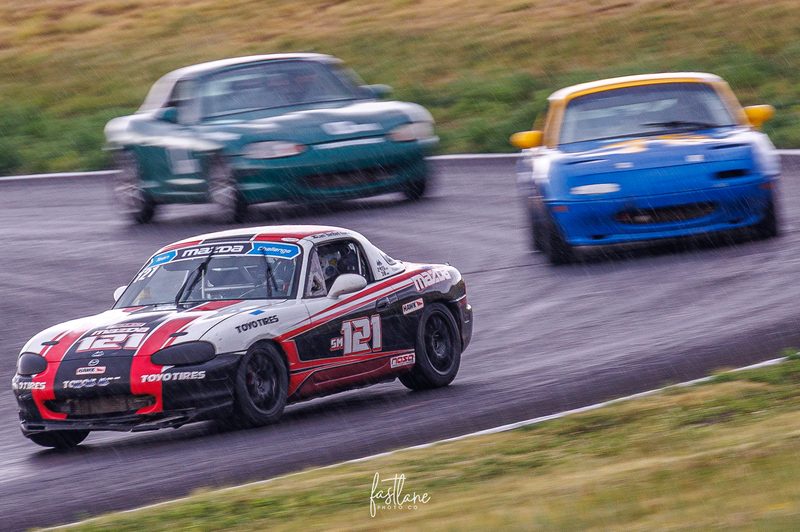 Rain at High Plains Raceway, #121 leading the train through the corner. This is the story frame — it doesn't sell a logo, it sells the weekend.
Caption every photo like it's getting reposted
A photo with no caption is a photo a brand has to do homework on. Most won't.
Write three lines under every image you send. Same format, every time:
What and where: [Car number] leading the Spec Miata field, [corner], High Plains Raceway, [date]. The sponsor line: [What their product actually did that weekend, in one honest sentence.] Credit and rights: Photo by [photographer]. Licensed for [your team] and partner use, credit required.
That third line matters most. The photographer owns the frame unless you've licensed it, and handing a brand a photo you don't have rights to is how a good partnership becomes their legal problem. I wrote the whole thing up in who owns the photo of your race car — read it before you attach anything.
Keep the sponsor line honest, too. If the product didn't do anything remarkable, say something true and small instead of inventing a result.
Send files they can actually use
The Privateer's Story puts it plainly: don't send a link to a folder of hundreds of unorganized images. Select the best ones, label them clearly, identify the photographer, and confirm the sponsor has permission to use them.
So do this:
- Send 5 to 10 images. Not 300. Flow Racers recommends the same range for post-weekend sponsor content.
- Name the files.
LFR-121-HPR-Aug2026-sidepan-EngineIce.jpgbeatsIMG_4471.jpg. When their marketing person searches the drive in March, your name is in the filename. - Send the full-resolution original. They may need print. Let them downsize.
- Include one crop at 1080 x 1350. That's the 4:5 portrait size Hootsuite lists for Instagram feed, and vertical is what Meta favors now. Add a 1080 x 1920 for Stories and Reels and you've removed the last excuse not to post it.
- Use JPEG. WebP is widely accepted in 2026, but JPEG opens everywhere without a conversation.
Curated, captioned, named, licensed, cropped. That's what a sponsor means when they call a racer easy to work with, and it's what gets quoted back at renewal time.
The media kit and activation documents we use to do this on our own cars ship inside The First Sponsor System — including The Live Media Kit, so you're not rebuilding this every weekend.
What to cut
Short list. These hurt you.
- Stock photos. A generic racing image on your deck tells a brand you don't have your own. Worse than a blank page.
- Crash photos. Unless the story is a comeback and the sponsor already knows, a bent car in a pitch is a risk slide.
- Instagram screenshots. Low resolution, someone else's interface baked in, unusable on any of their channels.
- Any frame where the car is a blur. You love it. They can't read it.
- Photos you can't license. Covered above. Not worth the deal.
Results are the weakest thing you're selling anyway — same argument behind ranking every sponsorship asset on your car. The decal isn't the product. The content is.
Then reuse them. Every photo in a pitch should show up again in a recap after the weekend, in the format that gets shared, so the brand watches the same asset work twice.
Before your next pitch goes out, have someone read the whole thing — copy, structure, and the photos attached to it — the way a marketing manager would. That's the Sponsorship Proposal Review: $147, you upload your actual deck or proposal, and it comes back in five business days marked up, with a recorded walkthrough and your two weakest pages rewritten.
You already shot the photos. Make them do the work.
Sources: RTR Sports — Sponsor logo placement in motorsport sponsorship, The Privateer's Story — The race is over, your work for your sponsors is not, Flow Racers — How to get sponsored for racing, Hootsuite — Social media image sizes guide, SuperHub — Motorsport photography. Image dimensions verified against published guidance as of September 2026. The MotoGP visibility split is RTR Sports' published figure for that series, not a grassroots measurement — treat it as direction, not a number for your own deck.
Do you believe?