
You get a nudge in the middle of a corner. Both cars keep going. You finish the race thinking nothing of it.
Then you roll into impound and somebody hands you a form. Now a stranger is going to watch your video and decide whether that was racing or whether that was your fault.
Most new drivers have no idea what happens in that room. Here's the whole process.
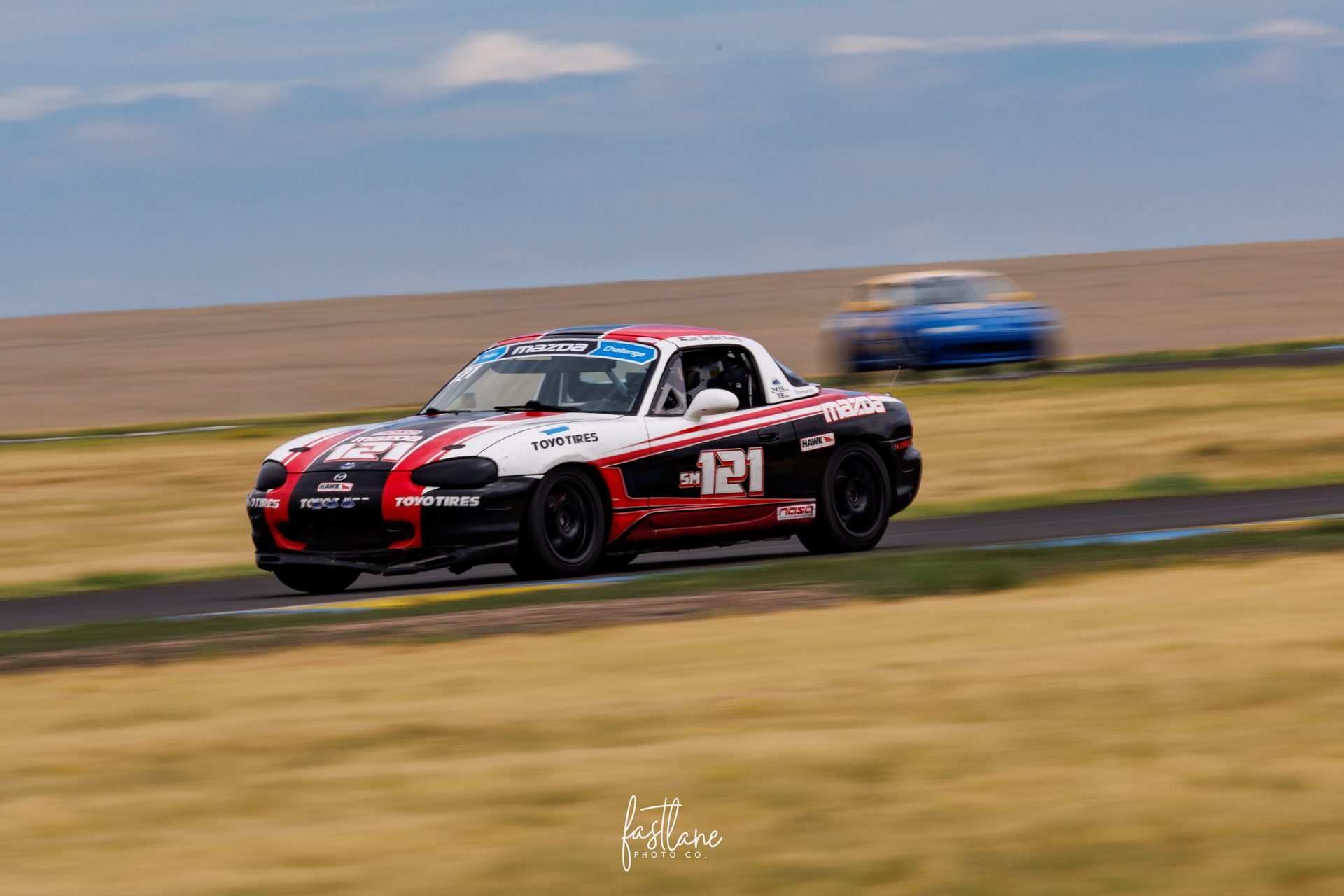 Every close pass is a potential incident review. Knowing the standard changes how you make them.
The review starts before you're off the track
You are never the first person to report an incident. The corner workers are.
SCCA describes its flagging and communications crew plainly. They stand trackside at every turn, they run a race control radio net, and they are the first response to incidents on track. The second your car touches another one, that station is already talking to race control.
By the time you take the checkered, race control usually has three things:
- A worker's account of what they saw, from a fixed position with a clean view
- A timing and scoring record of where every car was on that lap
- A note of which car numbers were involved
Then there's impound. NASA requires drivers to report there within 30 minutes of the checkered flag under CCR 17.1. That's where the paperwork starts, and where most first-timers realize this is a real process with real deadlines.
None of that is designed to punish you. It exists so the people deciding have facts instead of two angry drivers telling two different stories.
Who actually makes the call
This is the part that confuses people, because the two big clubs are set up differently.
At NASA, the Race Director decides. The Race Director controls the competition and the competitors, reviews the incident, and issues the penalty. NASA's own rules give the Race Director latitude here — CCR 27.11 lets them issue a penalty for an infraction, and the expectation is that they stay close to what the rulebook publishes. A decision stands unless it goes to an Executive Appeal.
At SCCA, it's split. The Chief Steward is the senior official running the event, and has the power to put a driver on probation. But protests go to a panel called the Stewards of the Meeting, and the SOM is the body that holds the hearing and hands down the judicial penalty.
One person you can talk to at the track. One panel that formally rules. Know which one you're standing in front of.
The other thing worth knowing: penalties follow you. NASA tracks incident points under CCR 27.12, and hitting 10 points in a season triggers a review of your competition license. Race Directors also keep running notes on repeat offenders and on drivers who keep getting hit. One incident is noise. A pattern is a file.
The evidence they actually use
Video wins arguments. That's the short version.
NASA Race Director Shawn Meze has described reviewing collisions frame by frame, using footage from the cars involved and, when that isn't enough, footage from uninvolved cars that happened to catch the moment. NASA requires a forward-facing camera under CCR 15.22 for exactly this reason. CCR 27.3 also gives the Race Director the power to collect data from another competitor or an official when it's needed to settle a case.
So the evidence pile usually looks like this:
- Your camera. Forward-facing, running, with a memory card that isn't full.
- The other driver's camera. Which will show the pass from the angle you can't see.
- Third-party video. The car two positions back often has the cleanest wide shot of the whole thing.
- Corner worker reports. Written from a fixed vantage point, usually within minutes.
- Timing and scoring data. Sector times and positions, which quietly confirm or destroy a story about where cars were.
Two practical takeaways. Run the camera every single session, not just races — we wrote up how to actually use that footage to get faster, and the same habit protects you here. And don't wipe the card until the weekend is over and impound has released you.
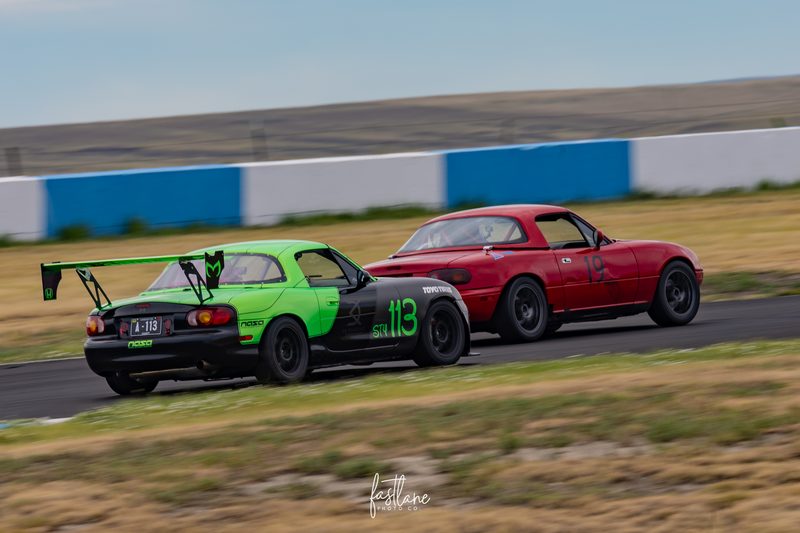 Traffic like this is where fault gets argued. Overlap at the moment of turn-in is what the review is really measuring.
The standard they judge against
Here's what surprises new drivers: officials are not asking "who was rude." They're asking a narrower question about position and space.
NASA publishes the overlap standard in CCR 25.4.3, "Right to the Line." The car in front may choose any line, as long as that isn't blocking. The car behind earns the right to the line once its front wheel is alongside the other driver. Once that overlap exists, the trailing car has a right to be there.
And the car being passed owes the other car room. NASA defines racing room as three quarters of one car width. Not a lane. Not a comfortable buffer. Three quarters of a car.
That single definition decides a huge share of incident reviews:
- Front wheel not yet alongside at turn-in, contact happens? That usually lands on the car behind.
- Clear overlap and the other car still comes across? That usually lands on the car in front.
- Two cars, ambiguous overlap, both lifted late? That's often a racing incident with no penalty at all.
The passing driver still carries responsibility for completing the pass cleanly. "I had overlap" is not a license to make contact. It's the thing that gets you a fair hearing instead of an automatic penalty.
Rules and wording change between clubs, regions and years. Pull your own sanctioning body's current rulebook and read the passing section before your first race weekend — and pay attention when it comes up at the drivers' meeting, because that's where the region tells you how they interpret it.
This is exactly the stuff we coach inside Kart to Car. Not just lines and braking points, but where you're allowed to put your car, and how to make a move that survives a video review.
What to write on the form
NASA uses a Body Contact Report under CCR 27.4.1. Most clubs have some version of it. You write what happened from your seat.
Meze's advice on filling it out is the best guidance I've heard: "Just be intellectually honest about what happened. What is your perspective about what happened?" He's also pointed out that honestly reporting your view doesn't hurt you, even if video later shows something different.
Write it like a witness, not a lawyer:
- Corner number and lap number
- Both car numbers and which was where
- What you saw in your mirrors before the contact
- What part of your car hit what part of theirs
- Your phone number, so they can reach you
What kills drivers is exaggeration. If your report says the other car "swerved into me" and the video shows a gentle drift to the normal line, you've just told the Race Director your account isn't reliable. Now everything else you say gets discounted.
Calm and specific beats dramatic. Every time.
What if you disagree
You have real options, and they run on a clock.
In SCCA club racing, a protest is filed with the Chief Steward and heard by the Stewards of the Meeting. The deadlines are tight — generally within 30 minutes of the action for an on-track protest, and no later than one hour before the start of the race for a mechanical protest. There's a fee. SCCA's General Competition Rules set it in section 8.3.1.D, and Central Division publishes that number as $75 for all event types.
Three things nobody tells first-timers:
The burden is on you. The Stewards of the Meeting won't go investigate for you. You bring the video, the witness names and the statements. They rule on what's in front of them.
The Chief Steward can start it without you. A Request for Action lets the Chief Steward push an incident to the SOM, and the SOM handles it the same way it handles a protest.
An appeal is not a do-over. Appeals go to a Court of Appeals within a defined window — commonly 10 days, and as short as 48 hours at some national races. The court doesn't re-run the hearing. It looks for new evidence or a procedural failure. The appeal fee is higher than the protest fee, and the exact number lives in the current GCR and the event supplementals. Check before you assume.
Honest advice? Most incidents aren't worth protesting. Protest when a penalty is genuinely wrong and you have video that proves it. Otherwise, take the ruling, learn the corner, and go win the next one. Reputation with officials is currency, and you spend it fast by fighting everything.
If your penalty was a black flag rather than a post-race review, here's what that conversation looks like. And if you haven't raced wheel-to-wheel yet, start here.
Learning all this from inside your own car is expensive. Bent bodywork gets real, fast. Our arrive-and-drive race weekend is $5,000 and puts you in a sorted Spec Miata with a crew who has sat in these reviews and knows what officials want to hear — or start with a Driver Evaluation Day at $2,250 if you want a coached read on your racecraft first.
Sources: NASA Speed News, "First Contact: Proper Procedures After Contact on Track" (CCR 17.1 impound, 15.22 camera, 27.3 data collection, 27.4.1 body contact report, 27.11 penalties, 27.12 points, and Race Director Shawn Meze's quotes), NASA Speed News, "Leaving Racing Room" (three quarters of a car width), NASA Club Codes and Regulations section 25.4.3 as published and summarized by NASA regions, Go Ahead Take The Wheel, "A Driver's Guide to Protests" (SCCA protest and appeal procedure), Central Division SCCA protest fees (GCR 8.3.1.D, $75), and Texas Region SCCA race officials (flagging and communications as first response). Verified against currently published material as of September 2026. Procedures, fees and wording vary by sanctioning body, region and year — your current rulebook and event supplementals are the final word.
Do you believe?