
You can be an iRacing Class A driver with a safety rating that would make a steward weep with joy. Walk up to a NASA registration table with that, and they'll hand you a form.
Not a license. A form.
That's not an insult to sim racers. It's just how the two systems work. They measure different things for different reasons, and once you see that, the real path gets a lot less confusing.
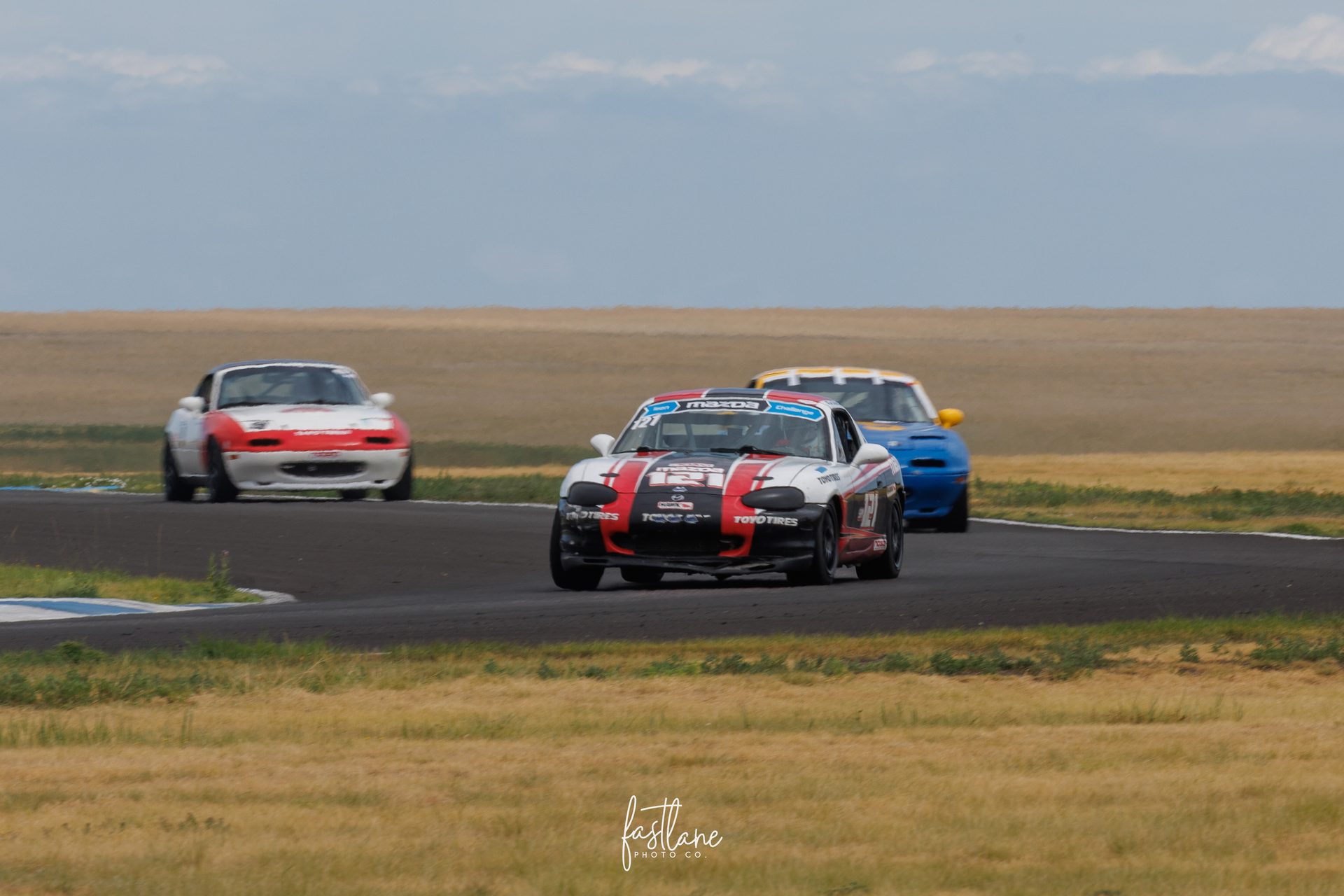 Real cars at real speed. The only way onto this grid is through the club's process.
What an iRacing License Actually Is
Your iRacing license is a skill ranking inside a game. According to iRacing's own getting-started page, you start at Rookie and move up through Class D, C, B, A, and Pro. The class decides which series you're allowed to enter.
Your safety rating starts at 2.5. It goes up with clean laps and drops when you go off track, spin, or hit someone. To leave Rookie, iRacing says you need to finish 2 races or 4 time trials and have a safety rating over 3.0.
There's also iRating, an Elo-style number that sorts you into races against drivers of similar speed. Wikipedia's overview describes both systems, and notes they're tracked separately for each discipline.
Here's the key point. iRacing's system is "no-blame." Contact gives every driver involved the same incident points. It rewards you for staying clean in a world where a crash costs you a few points.
A real license has to answer a different question. Can this person be trusted at speed, next to other people's cars, with real money and real bodies on the line?
What NASA Wants Instead
NASA's competition license isn't earned in a game lobby. It's earned on a track, in front of people who can say no.
The Mazda Motorsports guide to NASA licensing lays out five routes:
- Work through HPDE1 to HPDE4, then apply.
- Race in six TREC endurance events, then apply.
- Send a driving resume if you're an experienced road racer or outdoor karter. The regional director decides what happens next, which may include competition school.
- Request a "checkout ride" in an HPDE session, where officials watch your car control and awareness.
- Graduate from NASA's competition school, or an outside school like Skip Barber, Bondurant, or Bertil Roos, and apply directly.
Whatever route you pick, the same three things apply. You must be a NASA member. You need a physical exam documented on NASA's medical form. And you must pass an open-book written test on the Club Codes and Regulations.
Notice what's missing. No route says "show us your online rating."
Rules and fees vary by region and change over time, and some of the guides out there are years old. Check NASA's current licensing page and your region's rules before you budget. If you want the money side, we broke it down in what a racing license really costs.
Side by Side: Sim Rating vs. Real License
| iRacing license | NASA competition license | |
|---|---|---|
| What it measures | Clean-lap record in a game | Judgment and car control, observed by people |
| How you earn it | Races and time trials online | HPDE ladder, school, checkout ride, or resume review |
| Who decides | An algorithm | Instructors and officials |
| Medical exam | None | Required |
| Written test | None | Open-book test on the club rulebook |
| What a crash costs | Incident points | A real car, and possibly worse |
None of that makes the sim worthless. It makes it a different tool.
Where Sim Time Does Help
Sim racing isn't wasted hours. It's a place to build habits that carry over.
You learn track layouts before you ever see them. You practice racecraft, like how to set up a pass, how to give room, and how to stay calm in traffic. You get thousands of laps of braking-point repetition for the price of electricity.
We went deeper on this in the honest bridge from sim to real racing and in our look at sim tools that actually translate.
But a sim can't give you a few things. It can't tell you what the car feels like when it's about to let go. It can't teach you how a cold tire reacts, or what it's like to be 14 inches from another car with no pause button.
Those lessons come from seat time. That's exactly why the HPDE ladder exists.
What to Do With Your Sim Skills This Month
If you're a sim racer who wants to be on a real grid, here's a plain plan.
- Join NASA and sign up for an HPDE event in your region. Start at the level the club places you.
- Read the rulebook. The written test is open-book, but reading the Club Codes and Regulations early shows you what tech inspectors care about.
- Get your medical sorted before you need it, so paperwork doesn't block you the weekend you're ready.
- Keep a notebook. Track what you learn each session. Our free Race Day Ready Pack has setup and session-tracking sheets built for exactly this.
- Keep simming. Use it to learn the next track before you drive it.
If you want a fast look at how the licensing steps stack up, our walkthrough on getting a racing license with SCCA or NASA covers the process end to end.
Your sim rating doesn't open the door. Your first HPDE weekend does. And you'll probably be a better student on that day than most people, because you already know what a racing line is supposed to look like.
If you're ready to turn sim hours into real seat time, apply to Kart to Car. It's built for exactly this jump.
Sources: iRacing license classes, Wikipedia: iRacing, Mazda Motorsports: Five Ways to Get Your NASA Competition License, NASA Speed News: How to Go Racing in Seven Easy Steps. Checked October 2026; the Mazda and NASA Speed News guides date from 2021 and 2016, so regional NASA requirements and fees vary and change, so confirm with your region before you register. Any claims here are based on these sources plus my own racing experience.
Do you believe?