
Most people asking this question got their answer from somebody who sells fuel.
Here's the version from a team that buys it. For almost everyone reading this, the answer is no. Pump gas is fine. And in a lot of classes, race gas will get you thrown out of the results.
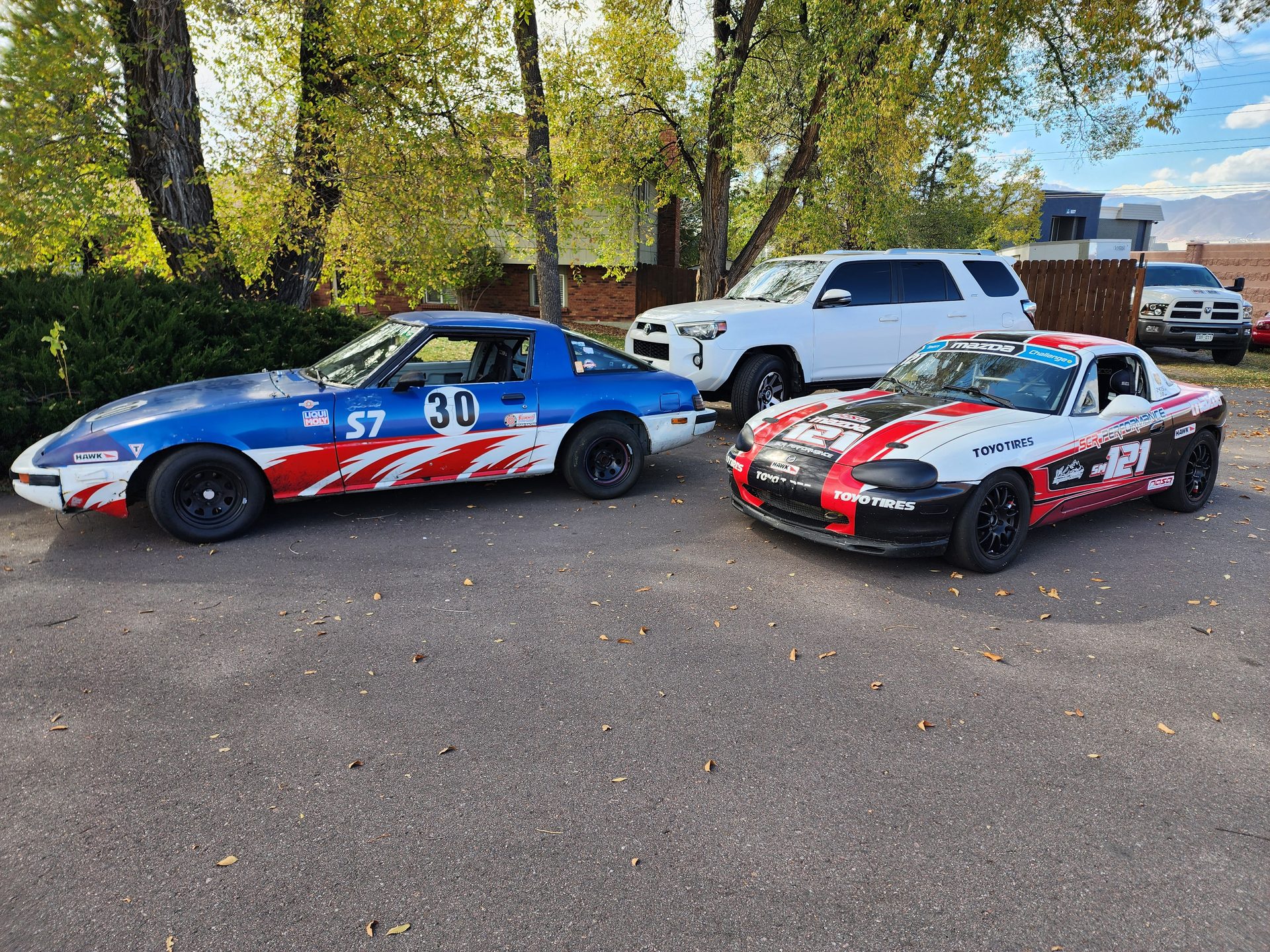 The #121 and a sister car in the paddock. Both run pump gas. The rules say they have to.
The short answer, sorted by what you're doing
| What you're doing | What to run |
|---|---|
| HPDE or track day, stock or lightly modified street car | Whatever octane the owner's manual calls for. Usually premium. |
| Track day, boosted or high-compression build with an aggressive tune | Premium at minimum — or whatever your tuner built the map around |
| Club racing in a spec class (Spec Miata, Spec E30, Spec 3) | Pump gas. The rules require it. |
| An open or unlimited class with a race-fuel tune | Whatever the class rules and your tune allow |
Three out of four of those rows say pump gas. That's not me being cheap. That's the sport.
Octane is not horsepower
This is the part that costs people money.
Octane is a measure of how well fuel resists detonation. Sunoco — a company whose whole business is selling race fuel — puts it plainly in their own tech material: "Octane is simply the measure of detonation resistance." It is not a measure of energy. A gallon of 110 octane does not contain more power than a gallon of 91.
So if your engine never knocks on 91, running 100 buys you nothing. You paid for headroom you aren't using.
Here's where octane genuinely matters on track. A car at sustained load gets hot in a way it never does on the street. Modern engine computers listen for knock, and when they hear it they pull timing — and pull boost, if the car has any. You don't get a warning light. You feel the car go soft in the second half of the session and you blame yourself.
Higher octane on track is insurance against the computer backing you down. It is not a power adder.
What the rulebooks actually say
Start with NASA's Club Codes and Regulations. Section 18.3, Permitted Fuel, reads: "Permitted fuel is any grade of commercially available unmodified gasoline, E85 Ethanol, biodiesel, or diesel." Section 18.3.1 adds that no fuel additives are allowed unless a class specifically permits them.
That sounds wide open. Then the class rules close it.
NASA's 2026 Spec Miata national rules cap octane at 94 (R+M)/2 as labeled on the pump, require unleaded gasoline commonly found at retail pumping stations, and specifically prohibit race fuels. Every fuel additive is illegal.
SCCA's spec-class language works the same way. Fuel has to be federally approved for highway use and sold at filling stations — "commonly called pump fuel" — with a pump-displayed AKI between 87 and 93. There's a hard testing limit above that: a sample that comes back over 95.9 octane is a disqualification with no exceptions.
They do check. SCCA's published fuel testing procedure uses a dielectric constant meter (the G-01, FT-K01, or a Digatron unit) on a sample, and a sealed vial can go to a lab to be tested against GCR 9.3.26.A. Samples get pulled after a protest, a Chief Steward's Action, or a Request for Action — the same post-session world as a tech inspection.
In a spec class, a jug of race gas isn't an advantage. It's a disqualification with your name already on it.
The Colorado wrinkle
Two things trip up people who race out here.
Regular is 85, not 87. Above roughly 3,500 feet, the air is thin enough that less of it packs into the cylinder. Lower effective compression means less knock risk, which is why Colorado, Wyoming, Utah and a few neighbors have sold 85 for decades. It's the same physics that costs you power at altitude in the first place.
Premium is 91, not 93. This one is not an altitude story, even though everybody says it is. A fuels expert interviewed by Denver's FOX31 explained it as a distribution problem: gasoline moves through pipelines, pipelines have limited tankage, and the system can only carry so many grades. The West settled on 91.
What that means practically: SCCA's rule is written around a 93 pump, and 91 is comfortably inside it. The rule is a ceiling, not a floor. You're legal.
But do not put 85 in a track car because it's a few cents cheaper. The altitude math describes a commuter at part throttle, not a car held at wide-open throttle for twenty straight minutes with an oil temp gauge climbing.
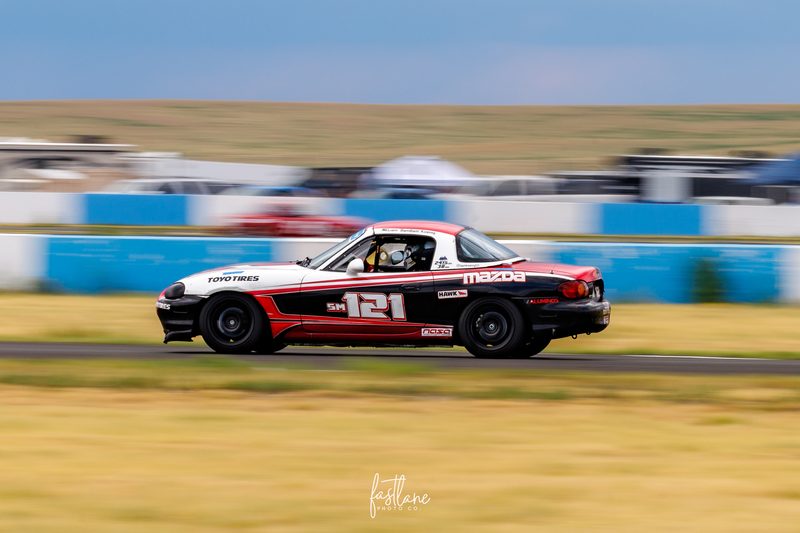 Twenty minutes at High Plains Raceway is a different load case than your commute. Buy fuel accordingly.
What fuel actually costs over a weekend
spec-miata.com's cost breakdown lists roughly $250 for fuel and fluids at a race weekend. That's pump gas, and it lines up with what we spend.
Burn rate is the part beginners underestimate. Spec Miata racers commonly figure about a gallon every six or seven minutes at race pace. A twenty-minute session is three gallons, give or take. Stack up practice, qualifying and two races and you're moving real volume.
Race fuel changes the arithmetic fast. One dealer lists a 54-gallon drum of VP 110 at $695, which works out to roughly $13 a gallon before shipping or hazmat handling. Compare that to whatever your local pump is charging. It's a multiple, not a small premium — and drum pricing and availability swing around, so price it yourself before you plan on it.
Fuel is small next to tires. It's also one of the line items people leave out entirely when they build a budget, right alongside the stuff in what your entry fee actually buys.
The fuel problem that actually bites people
It isn't octane. It's pickup.
Street fuel tanks were never designed for sustained cornering load. Fuel piles up against one wall of the tank, the pump pickup comes uncovered, and the engine stumbles mid-corner. It usually shows up in a long, loaded corner — often a left-hander — and it usually happens to somebody who was trying to squeeze one more session out of a quarter tank.
The standard track-day rule is simple: never start a session below half a tank. Some cars need more than that. Cars on very sticky tires generating real lateral load can starve above half.
Running the tank low is also how fuel pumps die. The fuel is what cools the pump.
One more thing, if you're considering leaded race fuel for a street-registered car: don't. Lead coats oxygen sensors and poisons the catalyst metals in a converter. Sunoco says it in their own literature — leaded fuels should not be used where oxygen sensors or catalytic converters are present. Leaded gasoline also hasn't been legal for on-road use in the United States since 1996. It's a track-only-car product.
So, do you need it?
If you're doing HPDE in a street car, no. Run the grade in your manual, keep the tank above half, and spend the difference on tires or a coaching session. Both find more lap time than fuel ever will.
If you're racing a spec class, no — and actively don't. The rulebook already decided for you.
If you're running a build tuned around race fuel, then yes, and you knew that before you opened this page.
If you'd rather skip the fuel jugs, the drum math, and the tech-shed anxiety entirely, our arrive-and-drive program hands you a car that's already fueled, already legal, and already through tech. You show up and drive it.
Sources: NASA Club Codes and Regulations 2026.3, §18.3 Permitted Fuel, NASA Spec Miata national rules, SCCA Club Spec rules — pump fuel and octane limits, SCCA Fuel Testing Procedures (rev. 2018), spec-miata.com cost breakdown, Sunoco Race Fuels tech corner, FOX31 Denver on Colorado's 85 and 91 octane grades. Rules verified against the current published editions as of September 2026. Race fuel pricing is a single-dealer listing and moves — verify locally before budgeting.
Do you believe?