
It's 6:50 in the morning and your kid has been zipped into their suit since the driveway. The trailer's open, the kart's on the stand, and there are more than four hours before they turn a single competitive lap.
That gap is where most first kart races go sideways. Not on track. In the pit space, with a parent who means well.
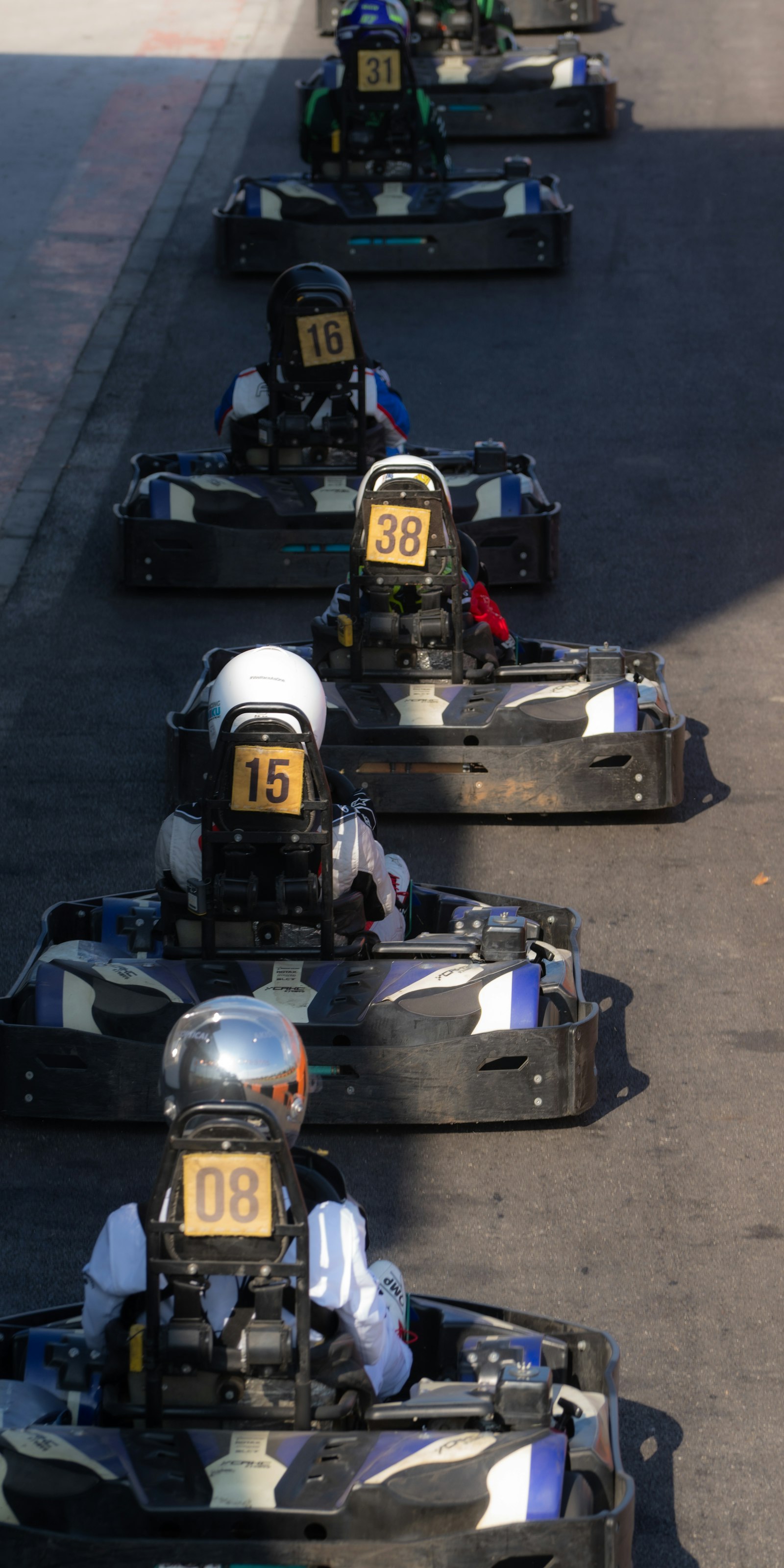 Photo by Felix yu on Unsplash.
The day is mostly waiting
A club race day starts early and finishes late, and almost none of it is driving.
The Ohio Valley Karting Association publishes a schedule that's typical for club karting: gates open at 7:00 a.m., registration and pre-tech at 7:30, two five-minute warm-up sessions at 9:00, a mandatory drivers meeting at 11:00, and racing at 11:30.
Read that again. Four and a half hours from gate open to green flag.
Your kid's total wheel time before the racing starts is about ten minutes, split into two sessions. At North Texas Karters, controlled practice runs a couple of hours before qualifying, and qualifying itself is a five-minute session.
So the shape of the day is long stretches of nothing, punctuated by very short bursts of intensity.
Pack for the nothing. That's the part nobody prepares for.
What has to happen before they turn a lap
There's a sequence, and it's close to identical at every club.
- Register. At the scoring tower or the gatehouse. You'll enter a class, rent a timing transponder if you don't own one, and buy fuel.
- Pit pass and wristband. Often a separate charge from the entry. North Texas Karters lists theirs at $10. Wear it where a volunteer can actually see it.
- Pre-tech. Officials inspect the kart and the safety gear. OVKA hands first-time racers a pre-tech form that has to be completed and signed off by the Tech Director or Race Director. Get in that line early — it's the one that backs up.
- Gear check. A helmet with a current Snell or SFI rating, a race suit or jacket with full-length pants, kart gloves, a neck collar, closed-toe shoes, and an SFI 20.1 chest protector or rib vest for young drivers. Confirm your club's exact list before you buy anything.
- The drivers meeting. Mandatory, and not a formality. What gets said there overrides what you read in the rulebook the night before. Here's why that meeting outranks everything else.
Get all five done before 10 a.m. and the rest of the day is manageable.
How the racing is actually structured
"The race" is usually not one race.
Clubs run a few different formats, and yours will publish which one it uses:
- Heats plus a feature. Two heat races set the grid for a longer final. OVKA's pea-pick format draws the first heat grid at random, then inverts it for the second.
- Qualifying, pre-final, final. A five-minute timed session sets the pre-final grid, and the pre-final sets the final grid.
- Qualifying plus an extended final. No heat races at all.
The races are short. OVKA publishes 8-to-10-lap heats and 10-to-12-lap finals. North Texas Karters runs an 8-lap pre-final and a 16-lap final, with 12 laps for Kid Karts.
Here's the piece that catches new families off guard. After each race, karts go straight to the scale lane to be weighed. Your kid does not drive back to you first. At some events, officials also paint controlled components so they can't be swapped later without the Tech Director's approval.
Every session ends at the scales, not at your pit space.
Tell your kid that the night before. A nine-year-old who expects to find you and instead gets waved into a scale lane by a stranger in a safety vest is going to panic.
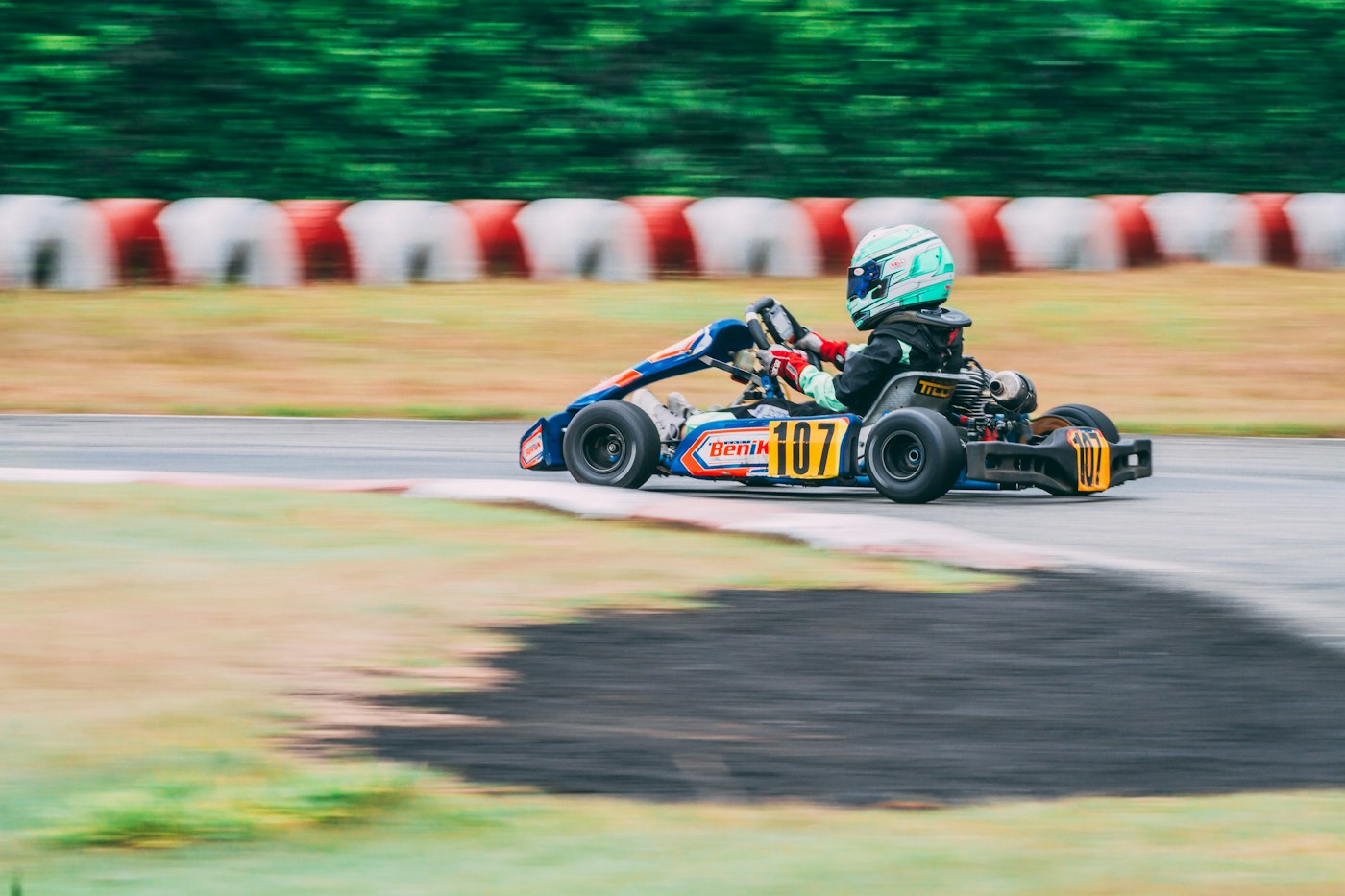 Photo by Diego Gavilanez on Unsplash.
Your kid is starting at the back. That's the rule.
Worth knowing before you get emotionally invested in a result.
Rookies get gridded last on purpose. OVKA requires new karters to start at the rear of the field for their first three race events, and to put an X in tape on the back of the helmet for those three weekends so everyone on track knows who they are. North Texas Karters says it plainly in their procedures: rookie drivers grid behind non-rookies.
That's a good safety rule. It's also a finishing position that was largely decided before your kid ever buckled in.
Which means the result sheet tells you almost nothing about how the day went. And that brings us to the mistake.
The mistake: treating the first race like a performance review
Here's what it looks like in real life.
The kid rolls off the scales after heat one. There are eleven minutes before they need to be back on grid. And the parent starts talking.
Turn three. Your line was wrong. You lifted. You could have had that kid on the last lap.
I understand the instinct completely. You paid for this, you drove three hours, you watched every lap, and you can see exactly what went wrong. But eleven minutes is not a coaching window. It's a recovery window.
Allen Berg, a former Formula 1 driver who now runs a racing school, wrote a dad's guide to karting that names the tell better than I can. When you're talking to your driver at the track and his eyes glaze over, give the coaching a break.
His line about when to walk away from the sport entirely is the one I'd tape to the trailer. If the day comes that your driver is not having fun, that's the day you should stop.
The fix is small and it works.
Ask one question before the session: "What's the one thing you want to try this run?"
Ask one question after: "What did you notice?"
Then be quiet and hand them water. They'll tell you more in that silence than they'd ever answer during a lecture. We dug into this same trap across a whole season in what karting parents wish they'd known in year one.
Your actual job that day
You're the crew chief, not the coach. That job is real and it's more than enough to fill nine hours.
- Fuel, tire pressures, and a quick nut-and-bolt check between sessions
- Food and water on a schedule. Berg's warning is the right one — time slips away and your driver runs out of energy for the last heat of the day
- Watching the clock and getting them to grid early, not on time
- Filming one session from a corner, so they can see a mistake instead of hearing about it from you
- Writing down pressures, gearing, weather, and how the kart felt
That last one is the habit that follows a driver all the way up the ladder. It's the same discipline we run with our car drivers, which is why we packaged our own version of it. The free Race Day Ready Pack has the checklists and the setup log we actually use at the track. We built it for cars, but the routine is identical at a kart club, and first-time parents usually tell us the packing list alone was worth the download.
What a good first race looks like
Not a trophy. Not a pass for position.
A good first race is this: your kid made every call time, the kart finished every session, nobody got hurt, and somewhere on the drive home they asked when the next one is.
That's the whole scorecard for day one. Everything else belongs to year two — and if karting turns out to be the real thing for your family, the Kart to Car pathway is where that road eventually leads.
Somewhere in year two or three, the conversation stops being about tires and starts being about money. Karting gets expensive faster than almost any family expects, and the ones who keep going are usually the ones who learned how to bring money in instead of only sending it out. That's exactly what The First Sponsor System is built for — the real documents we use to fund our own race cars, including a chapter written specifically for karting parents, for $67.
Sources: Ohio Valley Karting Association — Get Started, North Texas Karters — Race Day Procedures, KartClass — What a Race Weekend of Karting Looks Like, Allen Berg Racing Schools — Dad's Guide to Karting. Schedules, lap counts, rookie rules, gear requirements and fees are quoted from those two clubs' own published pages as of September 2026 — formats and fees vary by club, so read your own club's rules and event schedule before you load the trailer.
Do you believe?