
A $2,500 sponsorship ask feels small to a racer. A weekend of entry, tires and fuel can eat that before Sunday lunch.
To a local business owner, it can be a quarter of their whole marketing budget. Here's the math, and what it should change about how you ask.
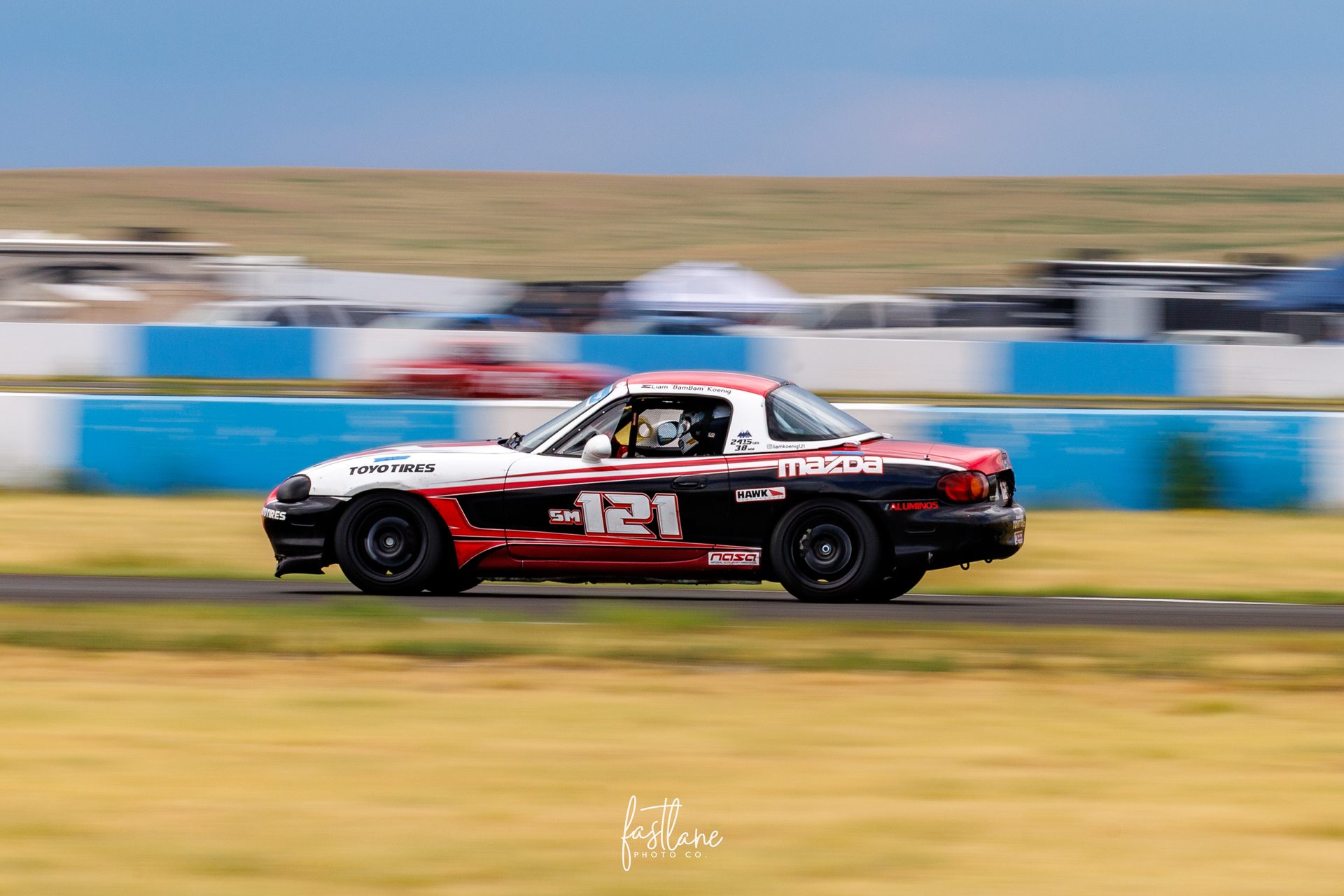 The #121 at the NASA High Plains weekend, August 2026.
The number nobody checks
We tell racers to find local sponsors. I believe that. But almost nobody checks how big a local company's marketing budget really is before they name a price.
Start with a rule of thumb. You'll see it all over the web: the U.S. Small Business Administration "recommends spending 7 to 8 percent of your gross revenue for marketing and advertising." That line comes with conditions: annual sales under $5 million and a net profit margin around 10 to 12 percent, as quoted by GoSmallBiz.
One honest flag. I could not find that figure on SBA.gov itself. Every copy I found is secondhand, and the article that quotes it is from 2019. Treat 7 to 8 percent as a common benchmark, not a law.
Other sources give a wider spread. One 2026 guide puts businesses under $1 million in revenue at 10 to 15 percent, and businesses at $1 million to $5 million at 7 to 10 percent, by its author's own framing. The same GoSmallBiz page also cites "some marketing experts" saying startups often put 2 to 3 percent toward marketing.
For scale, the big-company number: Gartner's 2026 CMO survey found marketing budgets at 7.8% of company revenue. That sample was 401 marketing leaders, mostly at companies over $1 billion. Your local shop is not that company. The percentage just lands in the same neighborhood.
The math, laid out
This table is my arithmetic, not a survey. The revenue figures are made up to show the pattern. Swap in a real business and the shape holds.
| Business revenue | Marketing budget at 7-8% | Your $2,500 ask is... |
|---|---|---|
| $500,000 | $35,000-$40,000 | about 6-7% |
| $1,000,000 | $70,000-$80,000 | about 3% |
| $2,000,000 | $140,000-$160,000 | under 2% |
Now the startup case. A $500,000 business putting 2 to 3 percent into marketing has $10,000 to $15,000 for the whole year. Your ask is about 17 to 25 percent of it.
That is a big bet on one race car.
What this changes about your ask
The takeaway is not "ask for less." It's "know whose budget you're touching."
1. Size the ask to the business. A $2,500 ask to a $2 million company reads as a rounding error. The same ask to a two-person shop reads as a major decision. Look at the shop's size, staff and location before you pick a number.
2. Offer a smaller first yes. A lower first tier, one event or one product, is easier to approve. I wrote about how to price tiers. Build the bottom one for the smallest business on your list.
3. Talk to the person who owns the budget. At a small shop, that is usually the owner. Not a marketing manager, because there isn't one. Our guide to finding local sponsors covers who to approach.
4. Itemize what they get. When your ask is a large share of their budget, they will check what it buys. This is why I put together what $2,500 buys line by line.
5. Fit their calendar. Budgets are set before they're spent. A sponsor's marketing calendar shows where a first-time test usually lives.
Where we stand
I'll be straight. LFR has not run a study of what local businesses spend, and I'm not claiming a result. Several of our current partners support us with product and discounts, such as Engine Ice and OG Racing, not large cash checks. That has kept the asks sized to what each partner can say yes to.
The math above is simple on purpose. Any racer with a calculator can redo it for a real prospect in five minutes.
Get the ask checked before you send it
This is exactly the stage where a second set of eyes pays off. A Sponsorship Proposal Review is $147. You send me your deck, proposal or cold email. I mark it up, check whether the ask fits the business you're sending it to, and rewrite the weakest pages. You get a recorded walkthrough too.
If your first-sponsor plan is still a blank page, The First Sponsor System gives you the templates and the tracker to start with. Then run the finished draft through Proposal Review before it goes out.
A pitch sized to the right budget gets a faster answer, even when the answer is a polite no.
If you're about to send a $2,500 ask to a company you haven't researched, stop. Send me the draft instead. Book a Proposal Review and we'll fit the number to the buyer.
Sources: GoSmallBiz, "Consultant's Corner: How Much Should You Budget for Marketing?", Viewmedia, "How Much Should a Small Business Spend on Marketing?" (Sept. 22, 2026), Gartner 2026 CMO Spend Survey, via SalesTechStar, SBA, Market research and competitive analysis (checked for a marketing percentage; it gives none). Verified as of October 2026. Revenue examples in the table are illustrative, not real businesses. The 7-8% SBA figure is secondhand and unverified at the source. LeadFoot Racing has no customer, sales, or survey data in this post.
Do you believe?