
You know your season by heart. Six weekends, two tracks, dates memorized since December.
The person you're pitching has a calendar too. It has nothing to do with racing, and if your dates don't land somewhere useful on it, you don't get the money. Not because the pitch was bad. Because it didn't fit.
Here's what their year actually looks like from the inside.
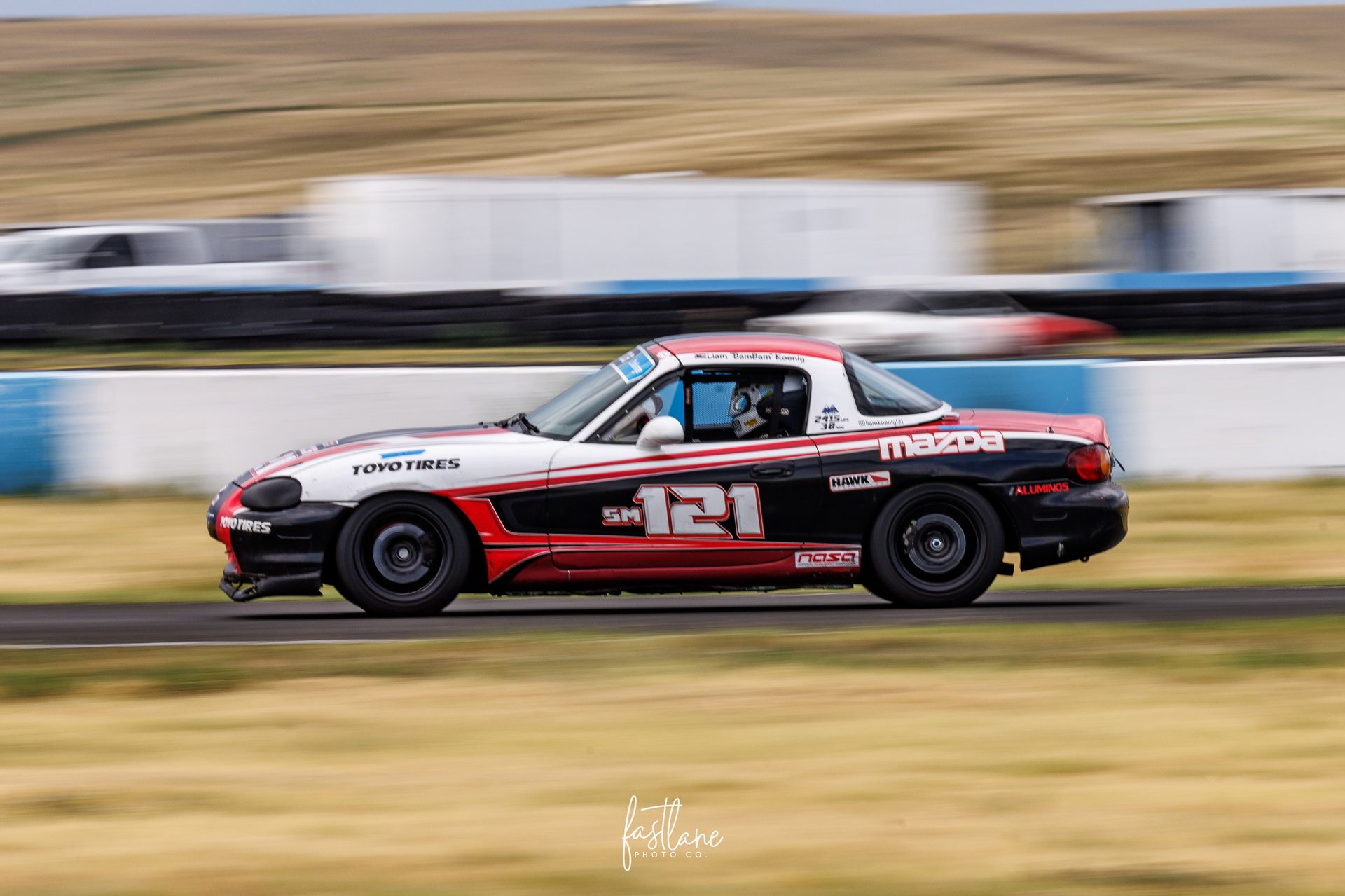 The #121 at speed with the paddock rolling by behind, High Plains Raceway, August 2026.
Their year has four deadlines, not twelve months
Racers think of a sponsor's year as a long open window with a few busy patches. It isn't. It's four blocks, and each one ends with somebody standing in front of leadership defending what they spent.
That's the quarterly business review. Published QBR guidance describes a consistent shape: an executive summary, a scorecard of KPIs against target, a deep dive on anything that missed, risks, and the committed priorities for next quarter.
Read that list again and find where a race car goes. There's no slide called "cool stuff we sponsored." There's a scorecard.
Every dollar your sponsor spends has to survive a meeting you'll never attend.
So the real question isn't "will they like my car." It's "can the person who said yes to me stand up ninety days later and show what it did." If your season gives them nothing to put on that scorecard, you made their job harder, and people don't renew things that make their job harder.
That's the whole reason our proposal templates lead with the reporting schedule instead of the logo placements. Same structure ships inside The Funded Season Kit — because the deliverable a sponsor actually needs is a document they can forward, not a decal.
The money gets committed long before it gets spent
This is the part that costs grassroots racers the most deals, and almost nobody explains it.
There are two different dates on every sponsorship. The date the money gets committed — approved, contracted, assigned a purchase order — and the date the money gets spent. They can be six months apart.
Year-end budget coverage is explicit about this: organizations have to encumber funds before the fiscal year closes or lose them, so purchase orders and contracts get finalized in the last quarter even when delivery happens much later. A deal signed in November can be for a race in June.
Two things follow from that, and they're both actionable.
One. When somebody tells you "we don't have budget for that right now," it often means the current pot is assigned — not that they'll never buy. The correct next move isn't to lower your price. It's to ask when their next planning cycle opens and get on the calendar for it.
Two. Stop pitching for the race that's four weeks away. You're asking for money that's already spoken for. Pitch the season that's a full cycle out, and you're asking for money that doesn't have a home yet.
Worth naming an honest complication: this is shifting. Trade coverage says marketers have moved toward quarter-by-quarter planning and performance measurement, and the old "use it or lose it" year-end scramble is less reliable than it used to be. The mantra now is closer to prove it and improve it. Which is good news for a racer who reports well and bad news for one who just wants a check.
I'm deliberately not re-ranking the months here — best months to pitch racing sponsors already covers the when. This post is about the shape of their year so you know why those months work.
 Close company out of the corner — the #19 at the NASA High Plains weekend, August 2026.
Which pocket your sponsorship actually comes out of
A marketing budget isn't one pile. It's split before you ever email anybody.
Gartner's 2026 CMO Spend Survey — 401 senior marketers, mostly at companies above $1 billion in revenue — puts marketing at 7.8% of company revenue, up a tick from 7.7% the year before. Flat, in other words. Nobody's swimming in new money. Those are big-company numbers, not your local shop's, but the direction is the same everywhere.
Inside that budget, published B2B benchmark templates commonly split roughly 60-70% to demand generation, 20-30% to brand building, and 10-20% to nurture — with a recommendation to hold back 15-20% for testing new channels.
That last slice is where a first-time racing sponsorship usually lives. Not the big demand-gen pot. The experiment pot.
Which tells you exactly how to ask. You're not competing with their paid search budget. You're the thing they try once with a small, defensible number to see if it works. Price it like that, report on it like a test, and you graduate into the real budget line next year.
One more from Gartner: awareness and conversion together account for 62.6% of total media spend. If your proposal can't say which of those two your car delivers, you've handed them a filing problem.
Not everybody's year starts in January
Assuming a calendar year is a rookie error, and it's an easy one to avoid.
Most US retailers run the NRF 4-5-4 calendar, where the fiscal year starts on the Sunday closest to February 1 and every quarter is thirteen weeks of four, five, and four. Their "Q4" is the holiday run, and their new year opens in February.
Plenty of other businesses are offset too. Nonprofits often run July to June. Government-adjacent suppliers follow a federal year ending in September.
So find out. One line in an early email does it: "Quick one — when does your fiscal year start? I want to bring this to you when it's actually useful." That question makes you sound like a vendor who's done this before, which is most of the battle.
Then shift everything. Their planning season is the back half of their year, not yours.
Build the overlay, then send it
Here's the practical work, and you can do it this week.
- Write your race dates in one column — track, date, what happens there.
- Next to it, write their year: fiscal start, four quarter ends, their two or three biggest selling seasons.
- Circle every race that lands inside a season they're already trying to sell into.
- Build the pitch around those races, and offer the rest as the supporting run.
A tire shop's spring is different from a nutrition brand's January. A local restaurant near the track cares about the weekend that fills their dining room. Same car, three different pitches, and the difference is the overlay.
Then commit to reporting inside their cadence, not yours. A recap two days after the race is nice. A quarter-end summary they can paste straight into a QBR deck is a renewal. The between-events version of that is in what to send a sponsor mid-season.
If you'd rather not build all of that from scratch, The Funded Season Kit is the $197 program that walks a full season of partners end to end — the planning overlay, the proposal, the quarter-end reports, the renewal ask. It's the one I'd hand a racer who's done guessing and wants a funded year on paper.
Your season already has a schedule. So does theirs. The racers who get funded are just the ones who bothered to read both.
Not ready for the full program? Start with The First Sponsor System — $67 for the core templates and outreach sequences we use on our own cars. Either way, get your overlay built before the planning season closes on you. The Funded Season Kit exists because most racers pitch a year too late and never find out that's why.
Sources: Gartner 2026 CMO Spend Survey, Gartner — awareness and conversion account for 62.6% of media spend, NRF 4-5-4 Calendar, Data-Mania — B2B Marketing Budget Benchmarks 2026, Digiday — why marketers aren't focused solely on 'use it or lose it' spending in Q4, Gainsight — The Essential Guide to Quarterly Business Reviews. Gartner figures are enterprise-scale and labeled as such. Budget-allocation splits are published B2B benchmark ranges, not a guarantee for any one company. Everything else is our own experience pitching sponsors for our own race cars.
Do you believe?