
The cage cost four thousand dollars. The seat cost nine hundred. The thing that sends you back to the trailer is a thirty-dollar net with the wrong fastener holding it on.
Inspectors almost never fail a first-timer on the big stuff. Big stuff is expensive, so people research it. It's the cheap parts that bounce cars, and it's the same four every time.
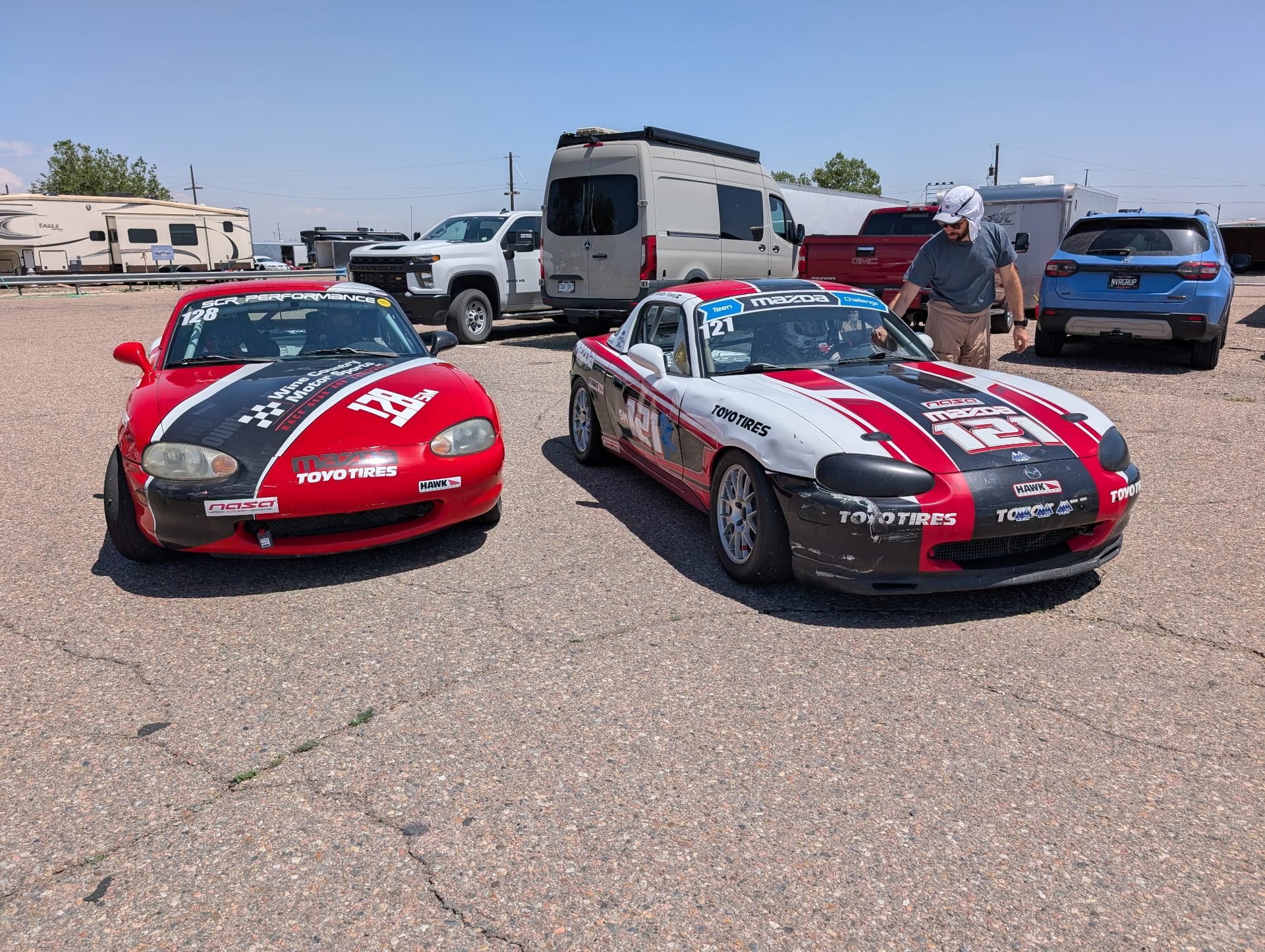 End of a long day. Both of these cars passed tech on Friday because somebody walked them with a form in hand on Tuesday.
First: recommended at a track day, required when you race
This trips people up more than any individual part.
Read NASA's rulebook and the language changes completely between the HPDE chapter and the racing chapter. In HPDE, tow eyes are "strongly recommended." Battery hold-down language uses "should." There's no window net requirement at all for a street car in a novice run group.
Cross into wheel-to-wheel and those same items become hard requirements with specs attached.
Nothing here is optional forever. It's optional right up until the day you decide to race, and then all four show up at once.
The master switch has to work from outside the car
An electrical master switch is required on every NASA race car. The rule is section 15.8, and the part racers miss is the second sentence: it should be mounted so it's easily accessible from the outside of the vehicle.
That's the whole point of it. A corner worker running to your car needs to cut power without reaching across you.
NASA wants the switch to shut off the engine and cut all power except the onboard fire system, radio, and any life support. And the location has to be clearly marked with a cut-off decal.
SCCA is more specific about placement. Their published vehicle requirements recommend the switch in front of the windshield — on the cowl or the top of the fender, close enough to the glass to reach if the car is upside down. The alternative is below the center of the rear window, or on a bracket clamped to the cage. It gets marked with the international symbol: a spark inside a blue triangle, off position clearly indicated.
Common failure: the switch is mounted somewhere fine, and nobody put the decal on. That's a three-dollar sticker standing between you and grid.
The window net: the fastener fails, not the net
A window net is required on the driver's side of every closed race car. It has to carry an SFI 27.1 or FIA label and be in very good condition.
Here's what actually gets people. NASA's rule spells out the mounting in detail:
- Quick release at the top front mount, so the net falls toward the floor when you pop it
- Fasteners must be metal, and must attach to the roll cage — not the door, not the body
- Drilling holes in the cage to mount a net is prohibited unless the holes are properly bushed
- Plastic ties and bungee cords are banned outright
SCCA's requirements read the same way: cage attachment mandatory, quick release that drops the net down instead of flipping it up, no plastic fasteners.
Read that list again and notice how many home installs use a zip tie at one corner "just for now." That's the one the inspector finds.
The date is the other trap. An SFI 27.1 net has to stop a 3-inch ball from passing through the webbing and survive a 175-pound bag dropped from 26.5 inches — and the tag that says so is dated two years out, because UV exposure weakens webbing. NASA's rule is the label plus "very good condition." SCCA's published requirements don't call out a date at all. Clubs read this differently, so ask your region's chief of tech before you assume your four-year-old net is fine.
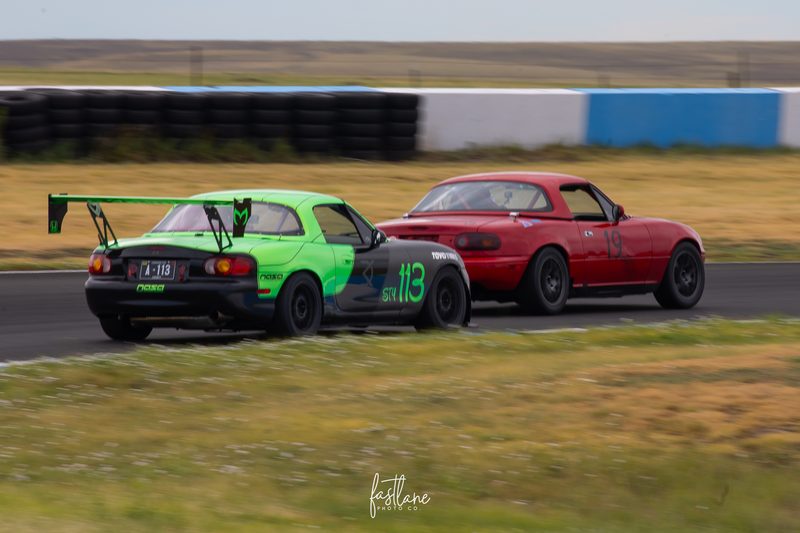 None of this is glamorous. All of it is why the car gets to run.
Tow hooks: front and rear, and bolted to something real
NASA requires at least two easily accessible and usable tow eyes on every race vehicle except formula cars — one front, one rear. They can't protrude dangerously, and they can't require you to remove bodywork to get to them.
SCCA adds a dimension: minimum two-inch inside diameter, accessible without manipulating panels, with the rear hook positioned rearward of the rear axle centerline.
The rulebook is blunt about why. If the tow crew can't find a hook, they hook onto whatever they can reach, and the damage is on you.
There's a second failure that passes tech and fails on track. The threaded eye that screws into your bumper cover is legal-looking and quick, but the sheet metal behind it was designed to pull a car onto a flatbed, not to get dragged half a lap with the driver on the brakes. Racers who've torn one out will tell you to bolt the eye to frame structure instead. At High Plains Raceway, when you're off in the dirt at the far end of the course, that recovery is a long one.
The battery: hold-down first, terminal cover second
Short rule, three ways to fail it.
NASA's racing section says the battery must be securely fastened, and that bungee or rubber cords may not be the sole hold-down. A non-conductive material must cover the positive terminal. Any battery inside the driver's compartment has to be fully covered and secured to the chassis in a marine-type case — though true dry cell and AGM batteries can be mounted without the case. Lithium ion has to live outside the passenger area entirely.
SCCA's version: placement inside the bodywork is unrestricted, a wet cell in the cockpit needs a marine-type container, the battery must be attached to the chassis independent of that container, and the hot terminal must be insulated on all cars.
A missing terminal boot is the cheapest failure in motorsports. It's also one of the most common.
What the whole list costs
Not much, which is the frustrating part.
| Item | Typical price |
|---|---|
| SFI 27.1 window net | around $30 |
| Mounting hardware kit | varies by cage tube size |
| Master disconnect switch | roughly $45 to $87 |
| Master switch decal | under $5 |
| Tow loops or eyes, each | roughly $25 to $50 |
| Tow hook decal | under $5 |
| Hold-down and terminal boot | parts-store cheap |
Call it $150 to $200 to cover all four properly, plus an afternoon. Compare that to losing a Saturday you already paid an entry fee for.
The fix is the same one that works for every item on the full tech inspection checklist: print your club's form, walk the car with it in your hand, and do it the week before — not at 7am on Friday. Same discipline that gets the fire bottle mounted right and the logbook in the truck.
If you'd rather learn the driving part first and skip the build entirely, that's what our arrive-and-drive weekends are for. The net's in, the switch is marked, the hooks are bolted to structure. You bring your gear.
Sources: NASA Club Codes and Regulations, 2026 edition, sections 11.4.9, 11.4.19, 15.8, 15.10, 15.12 and 18.5, SCCA Race Experience vehicle requirements, PRP Seats guide to SFI 27.1 window nets, Pegasus Auto Racing tow hooks and straps, Longacre Racing battery disconnect switches, Discovery Parts window nets. Rules and prices verified against current published editions as of September 2026. Specs vary by club, class and year — your current rulebook and your region's chief of tech are always the authority.
Do you believe?