
Nobody at your first track day is going to make you buy a fire extinguisher. Nobody at your first race is going to let you on track without a fire system.
Those two sentences are most of the answer. The gap between them is about five hundred dollars and a whole lot of confusion, so let's close it properly.
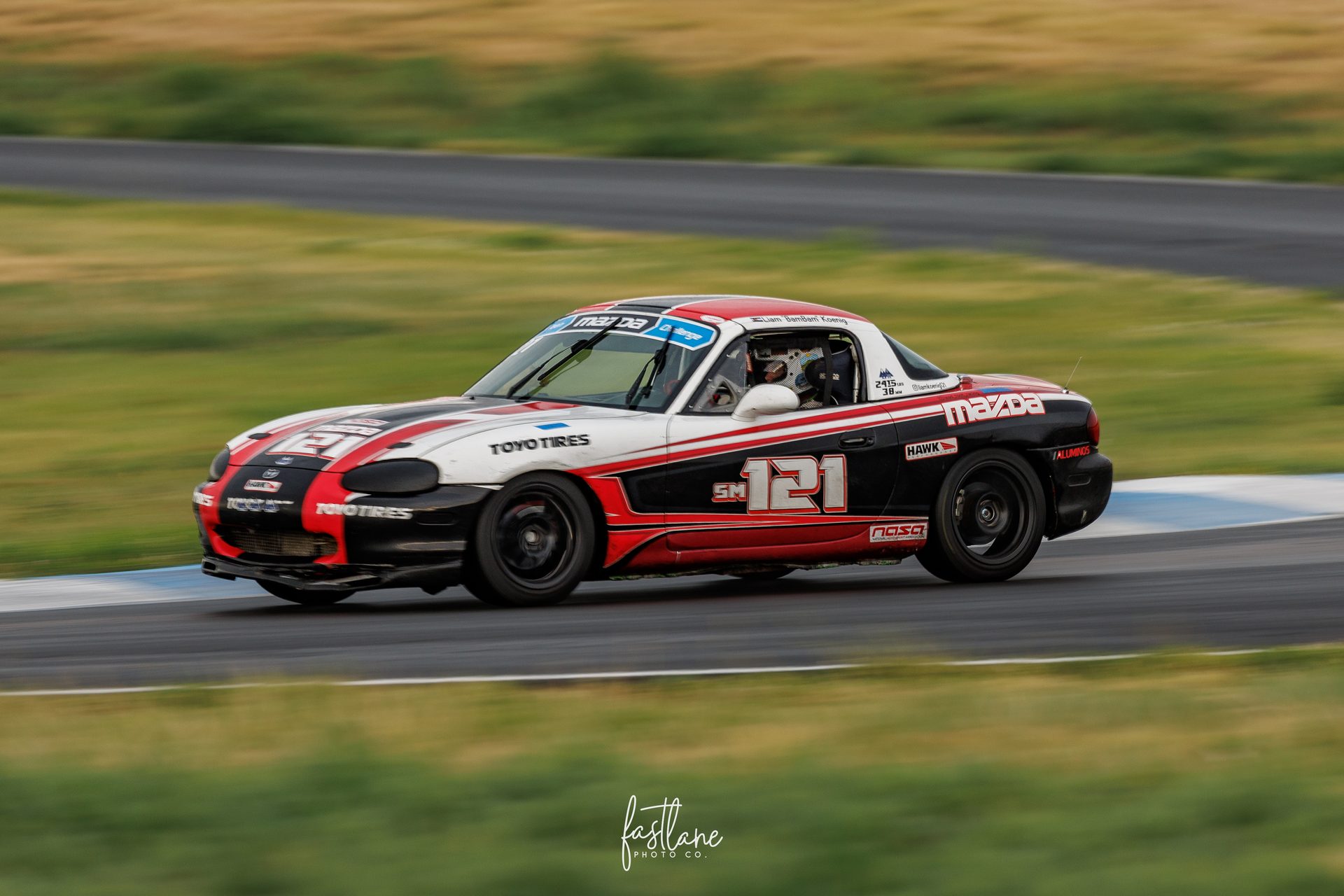 Every car in this run group carries a certified fire system. That wasn't true of any of us at our first HPDE.
The short answer, by event type
The rule changes based on what you signed up for, not what car you're driving.
| What you're doing | What's actually required |
|---|---|
| NASA HPDE or Time Trial | An extinguisher is "highly recommended," not required |
| SCCA Time Trials (Safety Level 2) | Required — a bottle or a system, mounted within reach |
| SCCA Club Racing | On-board system for most classes, hand-held allowed in a short list of classes |
| NASA competition | On-board system required, SFI or FIA certified |
That's the map. Now the details, because the details are where people get turned away at tech.
What NASA's rulebook actually says
NASA splits this cleanly between education and competition.
In the HPDE and Time Trial technical section, the Club Codes and Regulations say it is "highly recommended that a good fire extinguisher be kept in all cars; securely mounted with a metal bracket within easy driver's reach." Then it adds one line that surprises people: A-pillar mounts are prohibited.
So at an HPDE, you can show up with nothing and run. You just shouldn't.
Competition is a different document entirely. NASA's required safety equipment section says a fire system meeting SFI specification 17.1 or 17.2 — or one listed by the FIA on Technical List No. 16 — is required, with a visible certification decal. The system needs at least two nozzles, one in the cockpit and one in the engine bay.
A hand-held bottle is only "recommended in addition to the required fire system." Read that carefully if you're building a car this winter. Under the current NASA regs, the hand-held is the bonus, not the baseline.
You also need two circle "E" decals — one inside at the activation point, one outside near where a corner worker could reach it. That decal isn't decoration. It tells a stranger in a fire suit where to pull while you're still belted in.
What SCCA's rules actually say
SCCA is more forgiving at the entry level and more specific about hardware.
For Time Trials and the Club Racing Experience program, every vehicle needs a device securely mounted with metal quick-release brackets within reach of the driver. The published minimum is one of these:
- Halon 1301, 1211, or DuPont FE-36 — two pounds minimum by weight
- Dry chemical — two pounds minimum with a charge indicator, rated 10BC or 1A10BC
- AFFF or equivalent foam — 2.25 liters minimum by volume
On the club racing side, a 2020 rules memo set the current structure: all cars need an on-board fire system except a named list of classes that includes T3, T4, STL, Spec Miata, B-Spec, and Improved Touring. Those classes may still run a properly mounted hand-held — and a car using a hand-held must not wear the circle "E" decal, because that decal promises something the car doesn't have.
Two pounds is the number that catches people. A 1.0-pound extinguisher off the shelf is legal nowhere, and plenty of racers buy one by accident.
Class lists get amended. Check the current GCR for your class before you spend money, not after.
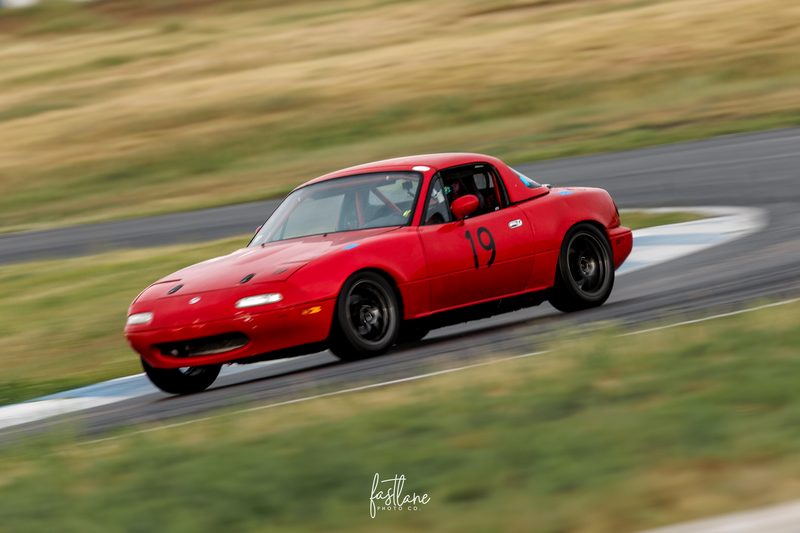 Spec Miata is one of the SCCA classes that still allows a hand-held. NASA competition doesn't.
What it actually costs
Real prices, from the manufacturer and a long-running racing supplier:
| Option | Price | Notes |
|---|---|---|
| Dry chemical hand-held, 2.5 lb | ~$140 | Cheapest legal answer. Makes a mess. |
| Dry chemical hand-held, 5.0 lb | ~$170 | More agent, more weight |
| Halon clean-agent hand-held, 2.5 lb | ~$470 | No residue, roughly triple the price |
| SFI 17.1 on-board system, 5 lb Novec | ~$519–$639 | Pull-cable or auto/manual |
| SFI 17.1 on-board system, 10 lb Novec | ~$779–$899 | Bigger car, bigger bottle |
Budget AFFF foam systems start closer to $400 if you shop used-adjacent, and they're the reason a lot of grassroots cars are legal at all.
The cost people forget is service. SFI and FIA systems both need professional service every two years, typically around $150 plus shipping. SFI bottles have a maximum six-year life. FIA bottles get ten. Nobody tells you that until your inspector flips the bottle over and reads the date — the same way helmets and harnesses expire on you.
So a $520 system is really a $520 system plus about $75 a year. Plan for it.
Mounting is where people actually fail tech
The bottle is the easy part. Every organization cares more about how it's attached.
The rules converge on the same handful of points:
- Metal brackets, quick-release type. Plastic gas-station brackets get rejected on sight.
- Metal bolts, nuts, and washers. NASA specifically prohibits sheet metal screws and rivets. A bottle that tears loose in a wreck becomes a projectile aimed at your helmet.
- Within reach while belted, seated, wheel in place. Not "reachable if you lean." An inspector will ask you to sit down and touch it.
- No A-pillar mounts at NASA events.
- Pull the safety pin before you go on track. An armed system with the pin still in is just expensive ballast. Tag the pin so you remember.
This is the same category of detail that gets cars bounced from tech inspection for a loose tow hook or an expired belt date. None of it is hard. All of it is checkable in your garage on a Tuesday.
What I'd actually do
If you're running HPDE, buy the 2.5-pound dry chemical bottle and mount it correctly. It's $140. You will almost certainly never use it, and the one time you hand it to somebody in the paddock with an oil-fire under a hood, it pays for itself ten times over.
Be honest with yourself about what it does, though. Two pounds of anything is not going to save a fully involved race car. It buys seconds. At a club event in Colorado — out at High Plains in Byers, or down at Pueblo — the first people to reach you are corner workers running with hand bottles, and they're fast. Your bottle is the bridge to them.
If you're building a car for wheel-to-wheel, skip the debate and budget for a certified on-board system now. Not because it's cheaper up front, but because it's the rule almost everywhere you'll eventually want to race, and re-plumbing a car you already finished is miserable. It's the same logic as deciding on a roll cage before you start cutting.
We buy our safety gear through OG Racing, and the single best thing about having a supplier who races is that you can ask "will this pass NASA tech" and get a straight answer instead of a product page.
And if you'd rather not own any of this yet, that's a legitimate answer too. Our arrive-and-drive cars come teched, certified, and serviced — the fire system is our problem, not yours. Show up with a helmet and go drive.
Sources: NASA Club Codes and Regulations, 2026 edition (sections 11.2, 15.1–15.3), SCCA Time Trials Full Safety Rules, SCCA Club Racing Experience vehicle requirements, SCCA Racing Memo RM 20-04, Fire Systems, H3R Performance automotive extinguisher pricing, Pegasus Auto Racing SFI 17.1 systems, No Money Motorsports fire system shopping guide. Prices verified September 2026 and will move. Class exemption lists get amended — always confirm against the current rulebook for your series before you buy.
Do you believe?